

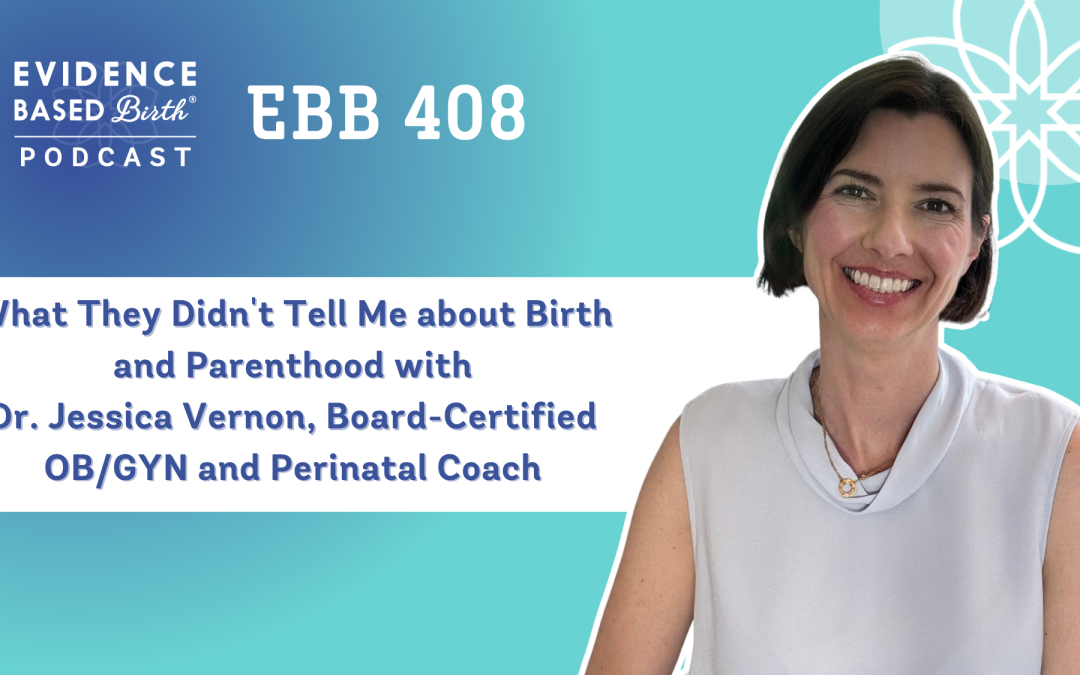
Pregnancy, birth, and postpartum care should support the whole person, physically and mentally. In this episode, Dr. Rebecca Dekker talks with board-certified OB/GYN and perinatal coach Dr. Jessica Vernon about how integrative medicine can create a more holistic and personalized approach to obstetric care.
Dr. Vernon explains how integrative care combines traditional Western medicine with complementary approaches such as therapy, physical therapy, acupuncture, yoga, breathwork, meditation, and nutrition. She also shares how her own experience with postpartum anxiety and depression transformed the way she practices medicine and deepened her understanding of the physical, emotional, and identity-related transitions into parenthood. Plus, get practical guidance for changing providers, asking informed questions after a prior Cesarean, and navigating the overwhelming, and sometimes unreliable, health information found through social media and artificial intelligence.
Resources
Connect with Dr. Vernon and learn more about her 1:1 perinatal coaching: https://www.drjessicavernon.com/
Follow Dr. Vernon on Instagram: https://www.instagram.com/dr.jessicavernon/
Then Comes Baby: An Honest Conversation About Birth, Postpartum, and the Complex Transition to Parenthood by Dr. Jessica Vernon: https://www.bloomsbury.com/us/then-comes-baby-9781538195925/
Matrescence: On Pregnancy, Childbirth, and Motherhood by Lucy Jones: https://www.penguinrandomhouse.com/books/714054/matrescence-by-lucy-jones/
Free Postpartum Support International online support groups: https://postpartum.net/get-help/psi-online-support-meetings/
PSI Perinatal Mental Health Provider Directory: https://postpartum.net/get-help/provider-directory/
For more information about Evidence Based Birth and a crash course on evidence based care, visit www.ebbirth.com. Follow us on Instagram and YouTube! Ready to learn more? Grab an EBB Podcast Listening Guide or read Dr. Dekker’s book, “Babies Are Not Pizzas: They’re Born, Not Delivered!” If you want to get involved at EBB, join our Professional membership (scholarship options available) and get on the wait list for our EBB Instructor program. Find an EBB Instructor here, and click here to learn more about the EBB Childbirth Class.
Chapter Guide
(00:05:47) Understanding matrescence and the transition into parenthood
(00:07:14) What integrative medicine looks like in pregnancy and postpartum care
(00:09:59) Bringing perinatal mental health and integrative medicine into obstetric practice
(00:12:19) Gaps in traditional perinatal care and the need for individualized support
(00:16:59) Supporting parents after infertility, pregnancy loss, birth trauma, or a difficult postpartum experience
(00:21:32) Why it is okay to change providers
(00:24:31) How infertility and pregnancy loss can shape a subsequent pregnancy
(00:27:25) Practicing evidence-based, person-centered care that protects patient autonomy
(00:29:02) Finding trustworthy pregnancy information online
(00:32:27) Balancing medical evidence with personal intuition and individual circumstances
Transcript
Dr. Rebecca Dekker – 00:00:00:
Hi, everyone. On today’s podcast, we’re going to talk with Dr. Jessica Vernon about the integrative medicine approach to obstetrics and one-on-one holistic perinatal coaching. Welcome to the Evidence Based Birth® Podcast. My name is Rebecca Decker, and I’m a nurse with my PhD and the founder of Evidence Based Birth®. Join me each week as we work together to get evidence-based information into the hands of families and professionals around the world. As a reminder, this information is not medical advice. See ebbirth.com/disclaimer for more details. Hi, everyone, and welcome to today’s episode of the Evidence Based Birth® Podcast. Today, I’m so excited to welcome a special guest who’s here to talk with us about a unique approach to obstetrics. Dr. Jessica Vernon is a board-certified OB/GYN and a perinatal coach with expertise in perinatal mental health and women’s integrative medicine. Dr. Vernon is an assistant medical director at Oula. She sees private clients as a perinatal coach and serves on the board of Postpartum Support International. Dr. Vernon brings her lived experience as a mom of two and her deep passion for providing holistic perinatal support to her work. Her first book, Then Comes Baby, an honest conversation about birth, postpartum, and a complex transition to parenthood is available now, and you can connect with Dr. Vernon on Instagram or by email, and we’ll share both of those in the show notes. Jessica, welcome to the Evidence Based Birth® Podcast.
Dr. Jessica Vernon – 00:01:38:
Thank you so much for having me, Rebecca. I’m so excited to be here. I’ve loved your work for a while now.
Dr. Rebecca Dekker – 00:01:43:
Well, it’s awesome. We were super excited to be introduced to you and have this opportunity to chat because we love an OB/GYN ally for evidence-based care. So I was wondering if you could start off by telling us a little bit about what led you to obstetrics and your journey into this field.
Dr. Jessica Vernon – 00:02:03:
Sure. I did not think I would do OB at all. It was kind of not on my radar until I was doing my clerkship rotations. And I was down in South Texas and the midwives ran labor and delivery and the OBs were kind of in the office and would get called in for operative deliveries if needed. However, I was able to work with the midwives really closely and see how they could take someone from feeling like they just couldn’t do it and kind of at this point where they were about to give up and then they would have this birth experience and they would feel so empowered. And it was just really cool to see this transformation and people go through that process and the kind of support you could give someone during that time. And so that’s what led me down the path toward obstetrics.
Dr. Rebecca Dekker – 00:02:48:
So did you then go into residency in obstetrics and what was that like?
Dr. Jessica Vernon – 00:02:52:
Yeah, I went into residency, which was a typical OB/GYN residency and learned all of the basics. I also had midwives where I was doing my training, which was really wonderful. But I didn’t really do the type of practice I do now until I had my own first daughter and that really changed everything about how I practice obstetrics.
Dr. Rebecca Dekker – 00:03:15:
Yeah. So tell us about that experience.
Dr. Jessica Vernon – 00:03:17:
Yeah. So I had her about eight years ago and postpartum, I had really severe anxiety and depression. I think there were lots of parts of the pregnancy and the postpartum experience and the birth itself that I just didn’t know from all of my obstetric training and a lot of things that people don’t really talk about when they’re talking about their birth experiences and their postpartum experiences. And so I just felt very isolated and alone and maybe like I shouldn’t be a parent, that there was something wrong with me. I was struggling so much and it took me a while to get the help that I needed and recover. And then once I did, I really started focusing much more holistically in my patient care and asking people a lot of questions that I didn’t know to ask before and sitting there and holding space for them and helping them get the support and care they needed, both physically, but also mentally and emotionally, giving them a safe space to be and talk about everything that was going on.
Dr. Rebecca Dekker – 00:04:12:
So you mentioned you had already gone through medical school, gone through obstetrics and gynecology residency and been practicing as a physician when you had your baby and you said there were things you didn’t know. Like what were some of those things you didn’t know about birth and parenting?
Dr. Jessica Vernon – 00:04:29:
I think a lot of it is the emotional aspects of it, the matrescence, having these contradictory thoughts in your mind that you’re holding and feeling like I shouldn’t be thinking these things or feeling this way. One of the first times I really felt it was when my daughter was born and I kind of looked at her and felt like there was this person that I was responsible for, but I didn’t feel that consuming love immediately. And it didn’t feel like people said it was supposed to feel. I thought maybe there was something wrong with me and maybe I just wasn’t natural at parenting. And then postpartum, a lot of the parts of the actual physical recovery, there’s just so many things that you go through. And it seems like in society, on social media, you just bounce back and kind of go back to the way you were before, which we know is not true, but no one had really prepared me for that whole actual physical transition. And when I was seeing people as an obstetrician postpartum, we’d see them at one six week visit. And so we were only kind of getting a small glimpse into what they were going through. But a lot of the aspects of matrescence and that whole transformation to becoming a parent were completely blindsiding. I just wasn’t prepared or didn’t know anything about it.
Dr. Rebecca Dekker – 00:05:39:
I don’t know if we’ve talked about matrescence on the podcast. I don’t know if you could like kind of explain a little bit about what that term means.
Dr. Jessica Vernon – 00:05:47:
Yeah, it is kind of like adolescence for becoming a parent or a mother. It is a time of huge changes in your body and your mind. Your brain is actually shifting. Your hormones are changing. You’re creating new pathways in your mind. And it’s the incorporation of this whole new identity as a parent. And we go through it the whole time during pregnancy and birth and postpartum. It is a time that you’re just feeling very vulnerable and there’s so much going on, but we’re not really holding space for people and their experience of matrescence in our society. Like we do know when teenagers are going through it, that they need a little more love and holding and space and care during that time. We’re not really doing that for new parents. There is more being written about it and discussed about it and a lot more research into it these days, which is great. And there’s a really good book by Lucy Jones called Matrescence that was just published a few years ago. And I love that as a resource for people when they want to know more.
Dr. Rebecca Dekker – 00:06:48:
I feel like that book opened a lot of people’s eyes to the concept and it started being talked about more frequently. And as you’re kind of talking about like the emotional, spiritual, and all the physical changes you went through postpartum, like how does that relate to integrative medicine, which I know is one of your passions. And we haven’t really talked about that either. So can you explain what that is?
Dr. Jessica Vernon – 00:07:14:
Yeah, so integrative medicine and a lot of people interchange things like integrative and complementary and alternative and functional medicine. But integrative is really utilizing traditional Western medicine, but also bringing in all of these complementary aspects. And one of them is functional medicine, where we’re looking at kind of the root cause and getting to the why and the how of things that are going on with people in their body. And a lot of that does bring in aspects of that person’s lived experience and not just their medical history, but emotionally things they’ve gone through. And everything from what they were exposed to when they were younger and the environment to their diet is a much more thorough evaluation of someone than rather looking at symptoms and giving a pill. But it also incorporates things like yoga and acupuncture and breath work and meditation and physical therapy and psychotherapy. All of these things that can really help support a person in other ways than just looking objectively at the different stages in pregnancy and prescribing recommendations for screenings and pills when needed for symptoms and that sort of thing.
Dr. Rebecca Dekker – 00:08:24:
Mm-hmm. It reminds me of like how my whole life I had migraines and people would want to prescribe different treatments. Both. You know, medications as well as you know, alternative medical treatments. But nobody ever really asked me, like, when did your headaches start and what happened in your life? When your headache started at the age of six? And, you know, it wasn’t until recently that I kind of put those two pieces together. But that kind of reminds me what you were talking about, like looking at the root of a problem rather than only treating the symptoms.
Dr. Jessica Vernon – 00:09:01:
Yeah. And there’s so much mind-body connection. I think we’re starting to recognize that more in medicine, but I see that. A lot in the work that I do, and especially in obstetrics, because a lot of people are not really embodied a lot of times in their life if they’ve gone through trauma or other things. We kind of live more in our heads than in our body and might be experiencing these symptoms. But pregnancy pulls you back in your body in different ways. And so a lot of people are re-experiencing things that they’ve kind of put aside for a long time. So it’s also a really important time where you’re having to look back at those experiences. And if they’re not healed, and even if they were healed at times, sometimes they’re still triggered during pregnancy and birth.
Dr. Rebecca Dekker – 00:09:40:
And not just related to health, but maybe like how you’ll parent your child and how you’ll bond with your child could be impacted by those things.
Dr. Jessica Vernon – 00:09:47:
Oh, yeah. 100%.Yeah.
Dr. Rebecca Dekker – 00:09:50:
So when did you get interested in integrative medicine and start kind of researching it and incorporating it into your practice?
Dr. Jessica Vernon – 00:09:59:
So the first part of it was looking more holistically at not just treating people physically, but looking at the mental health because that had been such a big part of my journey. And so I really started working with people in perinatal mental health and building collaborative care programs with reproductive psychiatrists and therapists to help people get that support in their obstetric office because so many people were not being treated for their mental health. But even that, we know there’s a lot more than just pills we can use for mental health. And so working with people besides therapy and support groups. Other things they can do, other labs we can be looking at to see if they’re deficient in some things that might be affecting their mental health, especially postpartum when you can have thyroid abnormalities or low iron that we’re not routinely testing for that can really impact that. And then that kind of led me down more looking at more of the root causes of a lot of symptoms and delving into integrative medicine. And then I did an intensive course through Aviva Roomm, which you might know about. She’s a midwife, an herbalist and an MD and is well known for her integrative medicine work. So I did an intensive course in that and have really been incorporating that into my practice more.
Dr. Rebecca Dekker – 00:11:16:
Tell me, have you met other obstetricians who are also interested in this more expansive way of practicing, or are they hard to find?
Dr. Jessica Vernon – 00:11:26:
I think the younger generation is more attuned with the holistic care and the necessity for it. I don’t think there’s a lot of people doing integrative medicine at this point. And really, those visits need a lot more time to get into with people than the traditional OB model allows for. But I think you see a little bit more of it in midwifery practices. And working at OLA, where I am, I do work closely with a lot of midwives. And so they do get more into looking at the lived experience and history and the root causes. And so they’ll bring all of that into the work and their care, especially around pregnancy and birth. It becomes so important.
Dr. Rebecca Dekker – 00:12:08:
What kind of gaps do you see then in traditional perinatal care? Aside from you talked about mental health not being really screened or paid attention to.
Dr. Jessica Vernon – 00:12:19:
Yeah, I think in traditional obstetrics, we’re really taught to look at the objective and the physical. And there’s a routine pathway in certain points which we’re meeting with someone, but we’re really just looking at labs and screenings and ultrasounds when needed. It’s just focused on the prevention and the treatment of complications, really. And then birth is kind of determined based on the patient’s complications, if they have any. And there’s really not a lot of space for anything personalized. Some OBs are talking to people more about how they’re feeling and what’s important to them, their values and goals. But a lot of it is more just routine recommendations, which… I get we don’t have a lot of time in visits and the insurance makes it very hard to, you know, have more than just 10 minutes with each patient. You don’t really see a lot of this kind of additional layers to the support and treating everyone as an individual at
Dr. Rebecca Dekker – 00:13:24:
times. I know because of the gap and the time you’re allowed with patients and kind of perspective and training, one of the things you’ve been incorporating into your care is one-on-one perinatal coaching. Can you talk a little bit about what that looks like in practice?
Dr. Jessica Vernon – 00:13:41:
Yeah, so the coaching is a separate layer than my OB practice. It is done one-on-one with clients. It’s not under my medical license, so I can see people anywhere for the coaching. I really created this out of all of the different work I’ve done for the past 15 years and incorporating all of the parts that I saw were missing. And it’s really another layer of support and information and preparation and empowerment using integrative medicine, looking at mental and physical health, looking at ways to help people regain their agency and feel empowered when they’re talking to their providers, and helping them prepare and optimize for both their desired birth and postpartum experience, but also building that flexibility for when things go off course and how to help them still be able to have a good experience that they come out of. Feeling empowered by even if things don’t go exactly as they wanted.
Dr. Rebecca Dekker – 00:14:39:
So is perinatal coaching something that someone could train in or is it just with life and work experience you build up those skills?
Dr. Jessica Vernon – 00:14:48:
It’s something that I started doing. I know there are other people that are doing different health coaching in different areas, and some people are focusing on preconception or postpartum and pregnancy. The way that I’m doing is how I’ve built up from all of my skills, and it’s really individualized. There’s not like a specific curriculum. It’s more geared towards that person. And a lot of the people that I tend to work with and are attracted to me, and I also saw a lot of them in practice where people who might have a history of reproductive trauma or trauma in other ways are people who are highly anxious, who might also have other layers of support built into their care, like a therapist or a doula. But it kind of like weaves in this other layer for them and gives them a container of a safe space and can really help fill in the gaps for them that they’re not getting from their primary OB care.
Dr. Rebecca Dekker – 00:15:39:
So how do you kind of like separate that then from your OB care? Or is it impossible to really separate the two?
Dr. Jessica Vernon – 00:15:46:
Well, I’m not doing it with my patients that I’m seeing in OB care because it’s a non-medical aspect. So I keep it very separate because it’s outside. It’s more very long visits and seeing people regularly over a longer period of time to really help prepare them for that journey. And I do incorporate some aspects of what I do with my own patients. But even in a midwifery-based practice, I might have 15 minutes with the patient at most as opposed to being able to spend an hour with them.
Dr. Rebecca Dekker – 00:16:17:
Yeah, so it makes sense. So the coaching is where you can spend more time kind of diving deeper into people’s backgrounds and the things that they’re anxious about.
Dr. Jessica Vernon – 00:16:27:
Yeah, and really finding out what’s important for them through this transition and making sure that they’re prepared not just for the physical, but the mental, emotional, the spiritual, and matrescence in general.
Dr. Rebecca Dekker – 00:16:40:
What do you think are the most common… For people who come to you and want this additional education, coaching, integrative medicine, are there some commonalities you see in terms of what people are struggling with these days during pregnancy or birth or postpartum?
Dr. Jessica Vernon – 00:16:59:
Yeah, I think a lot of people that come to me have had an experience before that was not great, whether it’s infertility, pregnancy loss, birth trauma, a really struggled postpartum, and they are pregnant again or trying to get pregnant again, and they really want to set themselves up for a different experience. A lot of times, like for instance, if they had birth trauma, no one’s really even gone through them and kind of looked at what happened last time and helped them really understand all of it from a medical standpoint so that they know when they’re going into their next pregnancy what sort of things to ask from the provider and how to find a provider that will work with them to help them knowing their trauma history. And so I see a lot of people who do kind of want a better experience than what they had in the past, and they’re trying to find ways to help get that experience. I also see a lot of people who just really are so overwhelmed. They don’t know what they don’t know, and so they’re just trying to do the best for themselves and their baby and just want a little guidance and helping them figure out what aspects of this journey they want to focus on.
Dr. Rebecca Dekker – 00:18:13:
So birth trauma is common and then just having uncertainty about all the unknowns and not knowing what you don’t know. For the birth trauma aspect, What have you found most helpful in terms of resources and for those patients?
Dr. Jessica Vernon – 00:18:31:
Yeah. Well, anyone who has trauma that they haven’t worked through, I definitely encourage a perinatal therapist who can do birth trauma work. And it might not be someone who had like a birth experience that could have been from infertility or pregnancy loss and other things as well. But having that layer is so important for them as well, because like we were saying before, things from childhood, things from past trauma, any of it can really be triggered in the subsequent pregnancy and birth. Really working with them to see, you know, if their provider is not holding that space for them in visits to make sure that they do get their questions answered. They know how to feel empowered to get what they need out of the conversations, who they can bring to their visits to help support them in that way. And just make sure that even though it’s important a lot of times for people who have trauma to have a good idea and a plan of like how things are going to still work with them on how things might go differently and making sure they have the tool set for if things do go differently than planned.
Dr. Rebecca Dekker – 00:19:33:
I’m thinking of like if someone had birth trauma, maybe related to a very, very long pushing phase, operative delivery, or a birth that ended in a Cesarean for, you know, baby that they couldn’t push out the first time. I think that’s like a common thing I see. Yeah. How do you walk them through that in terms of how to talk with maybe their new provider to see if that provider would be supportive of a VBAC or if that provider, you know, how they’ll handle if that happens again, that kind of situation.
Dr. Jessica Vernon – 00:20:03:
Yeah, I think it also depends on their personal history because some people had medical complications the last time where they had to be induced and that kind of led to this longer labor and might have ended up in a Cesarean birth. Going through all of their history with them and seeing what things can we do to try to optimize this time to decrease the risks if possible of having those same complications again. And if they are working with a provider, one C, you know, ask the questions like how many Tolacs have they had? How successful are they with their Tolacs? If someone would need to be induced after a prior C-section, do you allow that in your practice? Really getting an idea of if they’re feeling dismissed or they’re feeling like the provider is involved in having the conversation with them. And if they’re not really getting that good feeling from their provider, then letting them know that they can go to another provider and really helping people feel empowered because sometimes people feel scared or they feel like they can’t leave their obstetric provider and change in the middle of their pregnancy. And so helping them be able to make that decision.
Dr. Rebecca Dekker – 00:21:11:
As an OB yourself, what would you tell somebody then who’s afraid of leaving their OB? I don’t know. There’s so many reasons people will tell me. They’ll see that I canceled my appointment. They’ll think badly of me or retaliation or they’ll call my new doctor or I won’t be able to find a new doctor. What are some of the responses you have to those common fears?
Dr. Jessica Vernon – 00:21:32:
I tell them that the most important thing for them in this experience is that they’re with someone that they trust. Understanding that some people don’t really have other options. And then we have to see who we can bring to their visits and who can be with them during the birth to help them have that agency and autonomy throughout their experience. It’s the same as like if you were dating someone, I think is that people feel like they feel bad breaking up with them. But letting them know that ultimately they can’t worry about what that doctor is thinking. Right. I have there might be patients. In my practice that I might not be the best fit for. And that’s okay. Like ultimately they need to do what’s best for them. And so try to get them to focus on themselves and what they need from this very important, vulnerable, pivotal time in their life rather than worrying about what that other provider is thinking.
Dr. Rebecca Dekker – 00:22:17:
That’s really good advice. It can feel like a breakup sometimes.
Dr. Jessica Vernon – 00:22:20:
It can be really hard. And doctors feel like this authority figure as well. And so people feel really bad speaking up against them or saying this isn’t working for me. But you don’t even have to tell them directly. You can just ask the office for your records and move on.
Dr. Rebecca Dekker – 00:22:35:
You’re saying as an OB, it’s okay if you need to break up with your OB.
Dr. Jessica Vernon – 00:22:39:
It is totally okay. And even on labor and delivery, if you’re having an experience during your labor that you just don’t feel comfortable with the provider. In most places, there are other providers around, whether it’s another provider in your practice or in another practice. And people can fire the doctors in labor too or if they’re pushing. I’ve heard patients who did not like how someone was coaching them and pushing. And so they’re like, can you get someone else in here? And they switch during pushing. So it is always okay to ask for your options.
Dr. Rebecca Dekker – 00:23:11:
For parents who are listening who might be more interested in a more holistic pregnancy and postpartum experience, what are some few foundational steps that they could take today?
Dr. Jessica Vernon – 00:23:21:
If they are pregnant, a big part is finding a provider who will listen to you and will work with you if you want to incorporate other modalities into your care. A lot of people are even afraid telling their provider that they’re taking supplements because they don’t want to be looked at differently. But often, if you’re not finding an OB who will work with you on this, then definitely midwives tend to be much more holistic in their care. And so I often encourage people who want to incorporate other elements and who want that extra higher touch of care to work with midwives so they can get that other experience. And there’s a lot of great providers who do all sorts of things from perinatal therapy to physical therapy, acupuncture, yoga, everything that focuses on the pregnant and postpartum population. So depending on where you live, you can usually find some of these alternative providers to help round out your care.
Dr. Rebecca Dekker – 00:24:16:
So finding a provider who’s supportive of more holistic care or finding additional people who can support you. You’ve mentioned infertility and pregnancy loss a few times. Can you talk a little bit about how those might impact someone’s pregnancy, birth, and postpartum journey?
Dr. Jessica Vernon – 00:24:31:
It’s so important because if you start off your journey towards parenthood experiencing troubles conceiving or having pregnancy loss, it really changes your mindset and you lose kind of that story and that dream of what will be. And then you already know that something bad can happen or something hard can happen. So it really can increase the anxiety and the stress during pregnancy, especially in the early part. I always encourage people, one, if they’ve gone through a difficult experience trying to get pregnant or in pregnancy before, make sure you have a good therapist to walk that path with you the next time. And also, again, it’s okay to reach out to your providers and say, you know, I just had a miscarriage or an ectopic pregnancy or I went through a long fertility journey. Can I have an extra visit? Can you show me the baby’s heartbeat on the ultrasound an extra time? Like those things are totally okay. And I will always do that for my patients. And that’s another thing where like find providers who will work with you and give you that extra care and support you need.
Dr. Rebecca Dekker – 00:25:32:
With all of that also comes anxiety, as you’re mentioning, and possibly depression. I was wondering if you could tell us a little bit about your work with Postpartum Support International. And for those who aren’t as familiar with it, like some of the resources that you can access for free there.
Dr. Jessica Vernon – 00:25:50:
Yeah, so Postpartum Support International is the largest organization focused on perinatal mental health. And so a lot more awareness has come around postpartum anxiety and depression now, but you can have anxiety and depression during the whole process from trying to conceive through postpartum. They will have resources for you, free support groups. There’s over 75 different support groups now, which can be really validating to join and talk to other people who are going through or have gone through similar experiences. They also have peer mentors, which will work with you one-on-one to kind of check in with you throughout the pregnancy and postpartum and see how you’re doing. And they also have a lot of great resources. Like if you’re looking for a therapist or a psychiatrist or a psychiatric nurse practitioner, you can go on their database and see who in your state is certified in perinatal mental health so that you can find someone who specializes in this area. Because even if you have a psychiatrist or a therapist going in, often they don’t know the nuances of care during pregnancy and postpartum. And so sometimes it helps to get another consult or have someone else who’s working with you just for this part of your life.
Dr. Rebecca Dekker – 00:26:57:
And you can find those resources at postpartum.net. Yes. With your practice, like you’ve gained so much valuable experience from researching these topics yourself, seeking additional training outside of your OB/GYN training. I was wondering if you could kind of like walk us through what are some ways, you know, as you’re practicing evidence-based practice that really supports agency autonomy, like what are some ways you live that in your obstetric work?
Dr. Jessica Vernon – 00:27:25:
It’s all about having person-centered care. And everything is a conversation. And there is definitely not a one-size-fits-all. I think it’s important to help people guide them towards resources like Evidence Based Birth®, which really give you the good data for things you might be looking at for your pregnancy and postpartum. Helping people understand the data that is out there. A lot of things might not apply specifically to them. It might have been in a different patient population. Or the statistics being reported might not be as significant as they look based on like what something is showing that’s really there to get clicks or that people are writing about. So helping people really interpret the data, but also listening to people’s individual goals, values, intentions throughout this process and helping them make a plan that they feel comfortable with. I’ll always tell people if something is strongly recommended and if so, why? But I also tell people if you decide to go a different route, then we’re still going to care for you and support you or we’re not going to shame you or make you feel bad. Because a lot of people get that experience too. If they go against what a provider is recommending, then they’re not treated well, which is really hard. And like the practice I’m at now is midwifery, but led with OBs collaborating on the higher risk patients. And we do get a lot of transfers later in pregnancy from people who their provider was not being supportive with their decisions.
Dr. Rebecca Dekker – 00:28:48:
Okay, so that’s a good green flag. They’re sharing Evidence Based Birth® resources. Yes. Like really listening to your goals, values, and preferences and supporting you without judgment or without shame or guilt as strategies.
Dr. Jessica Vernon – 00:29:02:
Yeah. And I think it’s so hard today because there’s so much evidence online. And so it’s hard to know where to go for good data, right? So if you just don’t know, go to your provider and talk to them and get the right resources because there are influencers online that might be sharing their experience or their story. And that might not apply to you. Or there might be Reddit threads about something scary that happened to someone and that their history and their experience might not really apply to your situation. And so I really encourage people to like go to Evidence Based Birth® and ask their provider instead of going on AI and down. The rabbit holes on social media.
Dr. Rebecca Dekker – 00:29:39:
I was going to ask you about that. Are you seeing more people come to your appointments with like AI generated info? And what is that like?
Dr. Jessica Vernon – 00:29:46:
We always walk people through things and encourage them to like make sure some people are going down these threads because of anxiety and, you know, seeing how much time are you spending online going through all of this information and getting stuck in these holes. Yeah, exactly. But we’ll always talk them through it and just encourage them if they have questions to always come to us because that’s what we’re here for. We’ve even had people who are in labor who are asking chat GPT if they should go to the hospital yet or not. So AI has been used for a multitude of different things in all areas now. I always encourage people to look for things on their own and if they want a second opinion or need a second opinion, please get a second opinion. But if you found something and it doesn’t align with what your provider is saying, talk to them about it. Have them look at it with you and figure out where things might be not getting relayed correctly in that information or maybe it isn’t. Your provider is not up to date, which happens all the time as well.
Dr. Rebecca Dekker – 00:30:46:
Interesting. Yeah, I think we’ve had the experience at EBB of people sending us, well, can you explain this? And it’s like paragraphs of just AI generated. So you don’t know what in it is hallucination and what in it is good facts because there’s no references. And so we have, you know, that’s kind of where we’re seeing when people come to us with research questions that they asked AI.
Dr. Jessica Vernon – 00:31:08:
Yeah. Yeah, there is an AI open evidence, which I don’t know if you’ve used before, but open evidence really does look at the data and help interpret the data. So I think it’s a little better than using like chat GPT or cloud or something for medical questions. But even then, you do want to go and validate the sources.
Dr. Rebecca Dekker – 00:31:23:
Now, if you Google things, often the top result is a Gemini, which is an AI generated result. We’re talking more about this on the podcast later, but it often shows references to the side of it that are not actually references for what it’s saying in the results. It’s definitely a confusing time and I’m sure it’s an evolving area for physicians and midwives when they’re talking with patients.
Dr. Jessica Vernon – 00:31:44:
But we get it. Like there’s so much out of our control. There’s so many things unknown during pregnancy. And so one way we try to get a feeling of control in some way is to go look at all this information and see what aspects we might be able to change to have a better experience. And so we’re very empathetic to all of that. But I think most providers would like their patients to feel comfortable coming to them and asking the questions and bringing whatever data they have so we can look through it.
Dr. Rebecca Dekker – 00:32:12:
That makes sense. I imagine as like when you’re looking at it from an integrative perspective, it’s not just about information, but also about intuition. Do you ever talk with parents about what their intuition might be in that moment or in that situation?
Dr. Jessica Vernon – 00:32:27:
Yeah, I talk to people all the time about like going inside and seeing how they’re feeling about things. This comes up a lot. Like you mentioned VBACs before. I’ll have people that are really not sure if they want to try for the TOLAC or if they want to have a repeat C-section. And sometimes they’re feeling pressured one way or the other. And so really having them go and like sit with it and see what feels better to them because there’s not one right answer. So you really have to go with your gut and see what feels like the right answer to you. And sometimes there are harder things. Like sometimes there might be a complication like high blood pressure or gestational diabetes where you can feel totally fine still having recommendations for treatment or later in pregnancy, induction of labor. We’re looking at it a little bit different, helping some people understand that even though they feel totally fine, there might be things going on medically where we’d make certain recommendations. When there are decisions to be made and there’s no one right answer, I encourage people to kind of sit quietly with themselves and try to block out all external factors and influences and try to just see what feels best to them.
Dr. Rebecca Dekker – 00:33:37:
That’s really great advice. Jessica, can you tell us a little bit about your book and any other resources you want to share?
Dr. Jessica Vernon – 00:33:42:
Sure. Then Comes Baby was written after my own lived experience. And then the conversations I’ve had with thousands of people since then. And when I’m asking them the questions I didn’t used to ask and finding out the things that they were most blindsided or shocked by or that nobody had prepared them for through birth, postpartum and this matrescence transition through parenthood. And so I compiled all that into the book and it has some personal stories. It also has objective evidence. And really, I try to present things kind of the same way I talk in like a warm conversational, not like a too medicalized in it. I didn’t want other people to feel as like surprised and unprepared and maybe like they were failures because I hear that all the time. People are like, there was something wrong with me. I’m just, it’s not, it didn’t go right. I didn’t do something right. You know, it’s my body’s a failure. So kind of helping people see that a lot of these things are very common. They’re just not always talked about as much and also helping them have some good information and some more clarity for when they’re going into birth and postpartum so they can have better conversations with their providers.
Dr. Rebecca Dekker – 00:34:49:
I know we started this conversation with you kind of sharing your story of being a new mom and feeling like isolated and afraid that you didn’t love your baby because you weren’t having these overwhelming feelings that people told you would have. Like, did that end up, like you did move through that eventually? Did you come out on the other side?
Dr. Jessica Vernon – 00:35:08:
Oh, yeah.
Dr. Rebecca Dekker – 00:35:09:
Yeah.
Dr. Jessica Vernon – 00:35:09:
Yeah, yeah. I think, you know, and I think this happens with a lot of people. It’s like, it’s like we were talking about dating earlier. It’s like you’re getting to know someone new. And for me, that took time and I was really focused on making sure she was safe and healthy early on, but our bond grew over time.
Dr. Rebecca Dekker – 00:35:27:
And instead of instantly.
Dr. Jessica Vernon – 00:35:28:
Yeah, which happens a lot with people. And then with my second one, it was a completely different experience because I had all of the information and I prepared myself differently for all these other aspects of the journey besides just the objective physical measures at the OB visits. It was really night and day. I think all of these things pass over time, but when you’re really in them, it can feel really hard and like you’re never going to get through to the other side, which is why it’s so important to have people who are in your support community who have been there and who can help you see like it will get better.
Dr. Rebecca Dekker – 00:36:03:
This feeling will pass. Yeah. It’s not permanent. So thank you so much, Jessica, for coming on the podcast and sharing your story and these resources and just educating us about integrative care. We really appreciate it.
Dr. Jessica Vernon – 00:36:18:
Thank you.
Dr. Rebecca Dekker – 00:36:19:
Today’s podcast was brought to you by the Evidence Based Birth® Professional Membership. The free articles and podcasts we provide to the public are supported by our professional membership program at Evidence Based Birth®. Our members are professionals in the childbirth field who are committed to being change agents in their community. Professional members at EBB get access to continuing education courses with up to 23 contact hours, live monthly training sessions, an exclusive library of printer-friendly PDFs to share with your clients, and a supportive community for asking questions and sharing challenges, struggles, and success stories. We offer monthly and annual plans, as well as scholarships for students and for people of color. To learn more, visit ebbirth.com/membership.
 Listening to this podcast is an Australian College of Midwives CPD Recognised Activity.

Get Empowered! Learn more…

EBB 283 – How Colonialism, Environmental Instability, & Politics Impact Birth in Puerto Rico with EBB Instructors, Tania Silva Meléndez and Tamara Trinidad González, CPM
Don't miss an episode! Subscribe to our podcast: iTunes | Stitcher | Spotify On today's podcast, I talk with Tania Silva Meléndez and Tamara Trinidad González, birth workers and Evidence Based Birth® instructors about giving birth and midwifery care in Puerto...

EBB 282 – Celebrating “Baby Making for Everybody: A Guide for LGBTQ+ and Solo Parents” with Midwife Authors Marea Goodman & Ray Rachlin
Don't miss an episode! Subscribe to our podcast: iTunes | Stitcher | Spotify On this episode of the Evidence Based Birth® podcast, I talk with Marea Goodman of Restore Midwifery and Ray Rachlin of Refuge Midwifery, all about their work and their new book Baby...

EBB 281 – Mini Q & A on the Evidence on Preterm PROM
Don't miss an episode! Subscribe to our podcast: iTunes | Stitcher | Spotify On this episode of the EBB Podcast, we bring you a mini episode on the research on Preterm Premature Rupture of Membranes. We are excited to share this episode as an extension of the...