

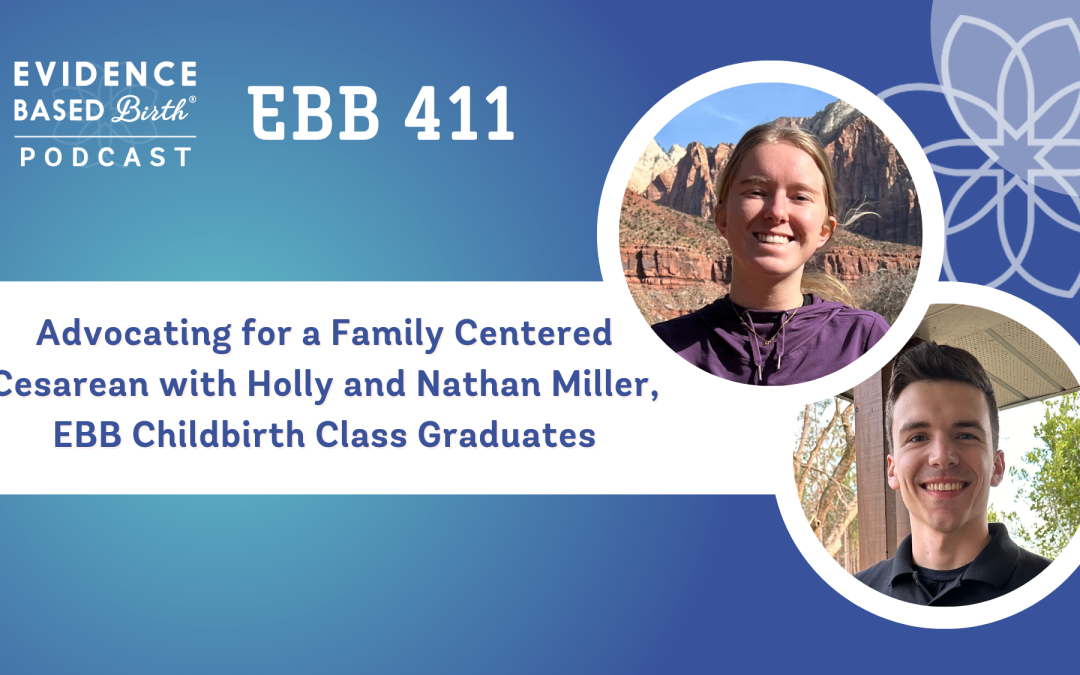
When Holly and Nathan Miller learned their baby was breech late in pregnancy, the unmedicated vaginal birth they had been preparing for suddenly felt out of reach. Living in rural South Georgia, they explored their options, including finding a provider experienced in vaginal breech birth, but ultimately faced limited choices close to home.
In this episode, EBB Childbirth Class graduates Holly and Nathan share how they shifted their focus from the birth they had originally envisioned to creating a family-centered Cesarean experience. They talk about advocating for a clear drape and immediate skin-to-skin, navigating conflicting information from providers, and finding ways to remain active participants in their baby’s birth. They also reflect on Cesarean recovery, the importance of partner support, and what they learned about speaking up for their preferences even when circumstances were outside their control.
Resources
All About Breach
- EBB 299 – A Breech Vaginal Birth Story with EBB Parents Naoma Kleisner, RN, MSN and Mohamed Koraichi
- EBB 298 – Overcoming Barriers to Breech Vaginal Birth with Dr. Emiliano Chavira, OB/GYN and Maternal Fetal Medicine Specialist
- EBB 297 – Frequently Asked Questions about Breech with Dr. Rebecca Dekker and Sara Ailshire, MA
- EBB 296 – Evidence on Breech Birth with Dr. Rebecca Dekker and Sara Ailshire, MA
- EBB 173 – Evidence on External Cephalic Version for Breech Positioned Babies
- EBB 172 – Breech Vaginal Birth with Dr. Rixa Freeze and Dr. David Hayes
- EBB 171 – The Experience of a Unique Vaginal Breech Birth with Janae and Andrew Rick
- EBB 111 – Positioning Breech Babies with Dr. Elliot Berlin
For more information about Evidence Based Birth and a crash course on evidence based care, visit www.ebbirth.com. Follow us on Instagram and YouTube! Ready to learn more? Grab an EBB Podcast Listening Guide or read Dr. Dekker’s book, “Babies Are Not Pizzas: They’re Born, Not Delivered!” If you want to get involved at EBB, join our Professional membership (scholarship options available) and get on the wait list for our EBB Instructor program. Find an EBB Instructor here, and click here to learn more about the EBB Childbirth Class.
Chapter Guide
(01:27) Finding Evidence Based Birth® and Preparing for an Unmedicated Birth
(03:33) When Birth Plans Began to Change
(05:03) Navigating Birth Options in Rural South Georgia
(07:51) Exploring ECV, Vaginal Breech Birth, and Cesarean
(10:24) Shifting Toward a Family-Centered Cesarean
(12:50) Advocating for a Clear Drape and Immediate Skin-to-Skin
(15:10) Holly and Nathan’s Cesarean Birth Story
(17:43) What a Cesarean Felt Like Physically and Emotionally
(22:03) Meeting Eliana and Beginning Skin-to-Skin
(25:31) Breastfeeding and Recovering from a Cesarean
(28:53) Partner Support During Postpartum Recovery
(30:09) Advice for Navigating Breech Birth and Unexpected Changes
(31:53) Looking Ahead to a Future VBAC
Transcript
Dr. Rebecca Dekker – 00:00:00:
Hi, everyone. On today’s podcast, we’re going to talk with EBB Childbirth Class graduates, Holly and Nathan Miller, about the challenges of navigating a breech pregnancy in a rural community and their family-centered Cesarean birth story. Welcome to the Evidence Based Birth® Podcast. My name is Rebecca Decker, and I’m a nurse with my PhD and the founder of Evidence Based Birth®. Join me each week as we work together to get evidence-based information into the hands of families and professionals around the world. As a reminder, this information is not medical advice. See ebbirth.com /disclaimer for more details. Hi, everyone, and welcome to today’s podcast. I am so excited to hear this birth story. Today, we are joined by Holly and Nathan Miller, who live in rural South Georgia with their precious seven-month-old Eliana. Nathan is a flight instructor at a local university, and Holly is a middle school teacher turned stay-at-home mom. Holly and Nathan enjoy all things outdoors and are avid hikers. And today, they are taking time out of their busy schedule to share their birth story with us. Holly and Nathan, welcome to the Evidence Based Birth® Podcast.
Holly Miller – 00:01:17:
Thank you. We’re glad to be here.
Dr. Rebecca Dekker – 00:01:20:
I was wondering if you could just tell us a little bit about kind of how you found Evidence Based Birth® and got involved in the Childbirth Class.
Holly Miller – 00:01:27:
So we originally were planning an unmedicated delivery and I was going back and forth between potentially doing it at home versus in a hospital. And so I was just wanting unbiased information, which I think is really difficult to find. And I had been talking to some friends of mine about it and they recommended EBB. So we found you guys online. I listened to a ton of podcast episodes and it was really helpful signing up for the Childbirth Class whenever we were planning for the unmedicated delivery and then even more helpful whenever we found out she was breached and needed to change course.
Dr. Rebecca Dekker – 00:01:59:
Yeah. I always love it when people come on the podcast and they’re like, I used to listen to the podcast and now I’m here today.
Holly Miller – 00:02:05:
Yeah. Full circle.
Dr. Rebecca Dekker – 00:02:07:
Yeah. Full circle. So can you tell us a little bit about what was your experience like taking the class?
Holly Miller – 00:02:13:
It was great. We had Sandra Crawford as our instructor and we only had, I think one other couple in the class with us. So it was really small and felt very personal. And she did a great job of walking us through the videos. The workbook was really well laid out. We just got a lot of information from it. I loved the handouts. Those were especially helpful. It was definitely a good guide to have as we were planning and navigating everything.
Dr. Rebecca Dekker – 00:02:36:
What about you, Nathan? Was there anything you learned from the class that you didn’t know before?
Nathan Miller – 00:02:40:
A lot of it had to do with advocacy, basically saying like, I know that like the doctors and nurses, they have a certain way that they prefer to do things. But it’s also perfectly fine for us to say, hey, we’re not necessarily comfortable with this. A little foreshadowing, it actually helped us a lot with this one as well. Letting us feel like we still have control over the situation, even though Eliana was breached and that was something that we couldn’t control. So that was something that I personally was able to walk through with Holly. And that was probably the best part about it.
Dr. Rebecca Dekker – 00:03:14:
Is being able to talk about not only the evidence and what you could control and what you couldn’t control, but how to speak up and make your preferences known, even when plans changed. Okay. So Holly, you said you were really interested in an unmedicated birth. So when did you realize that things might go off the rails?
Holly Miller – 00:03:33:
Well, we went at 20 weeks for our ultrasound and she was sitting on my bladders. They told me, and at 20 weeks, I was not worried about her not being head down, but she just never flipped. And so I think around 36 or 37 weeks is whenever they started getting concerned. And whenever I started getting a little bit more concerned. So I think around that time is probably whenever I realized that we were not going to get to have the birth that we wanted, which was hard to deal with. But Sandra was really helpful with walking us through that.
Dr. Rebecca Dekker – 00:04:05:
Yeah. And, you know, tell us a little bit about like the support you were planning. You know, you were planning an unmedicated birth. Were you with an OB or a midwife practice or like what was your support team like?
Holly Miller – 00:04:15:
So we were with a midwife to start with and we had seen her our whole pregnancy. And there were, I think, six midwives of the practice. And so we would shuffle between them, which I thought I was going to love that model and ended up not particularly preferring it. But we would shuffle in between them. And then we got swapped to an OB whenever she had it flipped by 36. And so we got put with one of the OBs that started the practice. He’d been practicing for like 30 years. Very set in his ways. So, yeah. So I guess we had both really like OB and midwife, but we had nurse midwives. So I don’t know if I would consider them the most supportive of just natural unmedicated deliveries.
Dr. Rebecca Dekker – 00:04:55:
Mm. Okay. Is it hard to get an unmedicated birth like where you’re located in South Georgia?
Holly Miller – 00:05:03:
It’s a little bit more difficult. It’s not very common. Home births here are not very common. The closest hospital to us that even sees babies is an hour. So most people, me included, you know, are a little bit too nervous to do it with that big of a distance. But birth is very medicalized in our community. And so that is a little bit hard to try to get over.
Nathan Miller – 00:05:26:
Yeah, I believe people see it as, oh, doing it unmedicated. Are you trying to prove something or are you trying to be a hero?
Holly Miller – 00:05:34:
We got a lot of those comments.
Dr. Rebecca Dekker – 00:05:36:
So Holly, you know, you knew your baby was kind of sitting in that position starting at 20 weeks. Were you kind of monitoring it throughout the rest of pregnancy? Like, were you asking your midwife, like, what position is my baby in? When did you start thinking more about it? And were you doing anything in the meantime?
Holly Miller – 00:05:53:
Like I said, I didn’t really worry about it until she got further along because I know that they could flip. But we started doing spinning babies and I would try to do the belly mapping, which I was not great at. But we did most of the things that I guess were recommended. I went and saw chiropractor to see if that would help. We didn’t end up doing acupuncture, but we had talked about that as well. But my midwives also were not concerned about it until 36 or so weeks. And we actually had one appointment where they told us that she had flipped. And then the next appointment, they confirmed that she had it. So they were back and forth for a while as well.
Nathan Miller – 00:06:27:
Yeah.
Dr. Rebecca Dekker – 00:06:29:
And Nathan, were you starting to get worried at all or did you figure everything would work out?
Nathan Miller – 00:06:33:
Well, I knew that whatever happened was going to be by the Lord’s will. But it was also like if the baby hadn’t flipped, it was pretty much going to be a guaranteed Cesarean if we were going to be with the hospital system. And we weren’t comfortable enough with our first birth to be outside of that environment in case something did go wrong. So we kind of started thinking, oh, this is a real possibility. We’re not going to be able to have the birth that we wanted. And we wanted Holly to be present. So it was a little bit more difficult to be as supportive, like be the support that I wanted to be.
Dr. Rebecca Dekker – 00:07:13:
You felt a little bit like you couldn’t help in this situation or why did you feel like you couldn’t be as supportive?
Nathan Miller – 00:07:19:
The most I could do is talk and encourage. It’s not like I could like coach through a birth like that, you know
Dr. Rebecca Dekker – 00:07:28:
birth.
Nathan Miller – 00:07:29:
Because I was practicing. I was like…
Dr. Rebecca Dekker – 00:07:31:
You’re practicing all the comfort measures.
Nathan Miller – 00:07:32:
Yeah. I was like, close your eyes. Imagine you’re a flower.
Dr. Rebecca Dekker – 00:07:38:
Yeah. I see. So it was for both of you, it was kind of changing, like wrapping your mind around how it would look really different. So Holly, what options were presented to you then when you got to 36, 37 weeks and your daughter was still breech?
Holly Miller – 00:07:51:
So they said that we could try an ECV, but my fluid was really low and she was break breech. And so they did not think that it would be successful. And so they recommended it, but really were not on board with it. So we kind of didn’t have that option, but really the only other option they gave us was just to plan our Cesarean, which I started then really researching if there were any providers that we could find in Georgia that would do breech vaginal deliveries. And the closest one we could find was three and a half hours away and didn’t have great reviews. So it just wasn’t, it didn’t seem on the table for us to have.
Dr. Rebecca Dekker – 00:08:29:
So. Yeah. What did people say when you were starting to ask around, you know, is there any provider that will do this?
Holly Miller – 00:08:36:
A lot of people thought we were crazy because we got told constantly, you know, well, Cesareans aren’t that bad. It’ll be fine. And all the things. So there just wasn’t, I mean, again, like it’s very medicalized here. I think 75% of the women I know have had a C-section with their babies where we are. So it just didn’t seem that big of a deal to a lot of people. Our child birth class instructor, Sandra, she was great at giving us different resources and everything, but she also wasn’t able to come up with a lot of people that were comfortable with breech vaginal deliveries. So, which I knew from the podcast that they’re really not that dangerous. You know, they’re perfectly, it’s just a variation of normal, but it felt dangerous to go in with a provider that wasn’t knowledgeable.
Dr. Rebecca Dekker – 00:09:16:
Right. Because if having someone who doesn’t know what they’re doing at a breech vaginal birth can be risky, it can make the birth less safe. And, you know, we’ve covered this in the podcast before, and I’m sure, did you listen to some of the breech episodes we had? Yeah.
Holly Miller – 00:09:30:
Yeah. Yeah. Yeah.
Dr. Rebecca Dekker – 00:09:32:
So I can just let you know, we’ll share them in the show notes, but we have a discussion about why it’s so hard to find a breech vaginal birth. That’s episode 298 with Dr. Shavira, who’s an OBGYN. And then we went over the evidence on breech birth in episode 296, and we did more frequently asked questions in episode 297. So we have a whole little series. Plus we have other birth stories and other interviews we’ll link to in the show notes, but it’s hard. You can find yourself in a bit of a pickle. Like if you want to explore your options and then you realize there is no support for the other options, which leaves you with only one option, which then doesn’t really feel like an option if you didn’t have other things to choose from.
Holly Miller – 00:10:11:
Yeah, we definitely felt kind of backed into a corner. I think I even looked at neighboring states and couldn’t really find anything. So it just, yeah, we kind of were backed into a corner.
Dr. Rebecca Dekker – 00:10:21:
Yeah. So how did you cope with that?
Holly Miller – 00:10:24:
Not well, if I’m kidding. I’ve heard the quote before, you know, the only thing that matters is a healthy mom and baby. And I don’t agree with that. Like, I do think that there is a lot of weight into how our births go. But I did try to remind myself of that. Like, we can’t find a safe option for breech vaginal delivery. So how can we make a Cesarean as family friendly as possible? And so I think it helped to plan that out and be able to advocate for the way that we wanted it. Because then we didn’t feel so much back into a corner because we were still getting to have the birth that we could find acceptable. And so that was really helpful. And I think there was a whole section in the Childbirth Class about family friendly Cesareans. And so we went through that and we would check everything that we wanted. And then we would go to our appointments and tell them, you know, this is what we want. And this is how we would want it done. And that made us feel much more empowered than just being back into another little corner.
Dr. Rebecca Dekker – 00:11:14:
So what were some of the items from like what you learned that you were interested in having in a Cesarean birth?
Holly Miller – 00:11:20:
So I really wanted a clear drape because since we were wanting to do it unmedicated, my main thing was I wanted to feel like an active participant in this birth, even though it had totally changed. And so I wanted the clear drape. Initially, I kind of wanted them to explain everything, you know, that they were doing, which we didn’t end up asking for that. And I’m kind of glad because I was a little bit out of it mentally anyway. And then we wanted like immediate skin to skin. And so those were our two, my two big ones was I wanted the clear drape and then immediate skin to skin.
Nathan Miller – 00:11:50:
The clear drape as well. And luckily, I was also able to be present during the Cesarean because Holly wasn’t knocked out or anything like that. She was, yeah, she was very like awake. And so whenever they were doing APGAR, I was like, can I peek in and make sure that I just want to have like my eyes on my daughter? And so there was like a little window in the door that I was able to keep an eye on her the entire time, which was incredible. And then immediately whenever we all came back into the room where Holly was, it was like I had the wrapped baby. And I was like. And I was like. Can somebody help me unwrap this baby and get skin to skin on my wife?
Holly Miller – 00:12:35:
We had asked if he could cut the cord because I know that that was another thing mentioned, but they told us no. There were a couple of things I think we asked for.
Dr. Rebecca Dekker – 00:12:43:
That logistically they couldn’t do.
Holly Miller – 00:12:45:
Right. Which they kind of fought us over the clear drape and the skin to skin a little bit. Yeah.
Dr. Rebecca Dekker – 00:12:50:
Tell us about how did that conversation go when you went to the OB and how did you bring up that you had certain wishes and preferences for the Cesarean?
Holly Miller – 00:12:57:
So it was really easy to do with one of our midwives because she had a breech baby that ended up needing a Cesarean. And so she was very open to what we wanted to do, but we kept getting shuffled around. So we would be told different things by different people. So I brought up to one midwife about the clear drape and the skin to skin, and she told us that was perfectly fine and it would be able to happen. Brought it up to another one and she told us that they didn’t have clear drapes and it wasn’t going to be available and they would maybe do skin to skin, but there was like a potential she would have to be separated for 30 or so minutes. And so that got brought up and then we talked to the OB and he said that they didn’t have clear drapes. And so it was just, it ended up being a lot because everybody was telling us different things and nobody was telling us how it was going to go. I think they just assumed we were going to walk into the water
Dr. Rebecca Dekker – 00:13:43:
And follow that standard practice
Holly Miller – 00:13:44:
and just be totally fine with whatever they were doing. So we had to ask the same question several times and make like our wishes known.
Dr. Rebecca Dekker – 00:13:53:
So you can’t just ask one person. You kind of had to repeatedly confirm or ask if this was possible.
Holly Miller – 00:13:59:
Yeah. And we had to do that a lot.
Dr. Rebecca Dekker – 00:14:02:
Yeah. And Nathan, were you in these prenatal visits as well?
Nathan Miller – 00:14:06:
Yeah, I was nearly every single one. There were some times where my work conflicted with it because the appointments were an hour away. But every time I could be there, I was. And so I was having the same conversations. The doctor, he wasn’t even aware of clear drapes. He had never heard of it before. And so this was his first time doing it. And he was like, yeah, I didn’t even know this was a thing.
Dr. Rebecca Dekker – 00:14:28:
Yeah. Wow. So you’re like educating the OB on
Holly Miller – 00:14:31:
Yeah
Dr. Rebecca Dekker – 00:14:32:
ways to have a family-centered Cesarean.
Holly Miller – 00:14:34:
Yeah. Yeah. Right before we started, he was like, I was watching TikTok videos last night about these clear trees. And he’s probably 60 years old.
Dr. Rebecca Dekker – 00:14:45:
Well, I think that’s amazing. You know, you were advocating for yourself, your family, your baby. And yet by doing this in an area where they’ve never done this before, you’ve kind of paved a way, right? For future people, it won’t be so difficult, hopefully, to get some of these practices.
Holly Miller – 00:15:03:
Yeah. I’m hopeful that if another mom comes in and asks for them, they’ll be aware that they are there and that they can do it. It’s an option. These are options.
Dr. Rebecca Dekker – 00:15:10:
Yeah. So share your birth story with us. Like, how did it begin? Did you have a scheduled Cesarean that went as planned or did you go into labor first or what happened?
Holly Miller – 00:15:20:
And so we had a scheduled Cesarean that went as planned. It was Thanksgiving that they wanted to schedule it on, but of course, they’re not going to work on a holiday. So she ended up being scheduled for 39 weeks and four days. So a little bit later, which I was thankful for. I think in hindsight, I don’t know if I would have agreed to that, but in the moment, you know, we did. So she was scheduled for 39 and four. We got to the hospital that morning and the people that were before us were late and didn’t show up. So our time got bumped up, which was nice.
Dr. Rebecca Dekker – 00:15:48:
Oh, so you got to go earlier than you thought? Is that what you’re saying?
Holly Miller – 00:15:51:
Well, we got there on time, but we went to the OR earlier than what we had initially planned for. So all of it went really well. The anesthesiologist was incredible. She was such a blessing. So she turned on music for me that I wanted. And she was like playing with my hair. And she, whenever, of course I got nauseous, you know, at certain parts. And so she was putting like a cold washcloth on my head and everything. She was really a gift. But everything else felt very just by the book. So we were
Nathan Miller – 00:16:18:
separated.
Holly Miller – 00:16:19:
Yeah, we were apart at that point. So he came in actually right around the time that OB was about to start the Cesarean.
Dr. Rebecca Dekker – 00:16:28:
They were not going to prep you without Nathan there.
Holly Miller – 00:16:30:
Right. Yeah. They would let him in for like the prep portion and everything. I let a student.
Dr. Rebecca Dekker – 00:16:35:
How did the epidural go then? I’m assuming that’s what they gave you.
Holly Miller – 00:16:38:
Well, I had a spinal.
Dr. Rebecca Dekker – 00:16:40:
Okay.
Holly Miller – 00:16:40:
Spinal. It was good. I let a student do it. She did a really great job. So that went really well. It’s just an odd feeling to get your spinal and then, you know, be numb everywhere and lay down. So I did kind of panic a little bit. But I felt better once Nathan got in there. But everything went really well. She, I think it maybe took 10 minutes for her to be born. And then we, of course, got to see everything with a clear drape. I think Nate probably got to see more than he wanted to see.
Nathan Miller – 00:17:05:
Yeah. I’ve seen more of Holly than Holly’s seen of her.
Holly Miller – 00:17:07:
Yeah. So that took, you know, just a few minutes. And then they took her away to do her APGAR, which I wasn’t the biggest fan of, but understood. We had asked about that several times and they told us no. And I felt like at that point, we had already asked for a lot of things. So we kind of conceded on that. And they took her for maybe five minutes to do that. And they got to watch everything for that. And then they brought her back out and we did immediate skin to skin. And the only time that her and I were separated was whenever they moved me from the OR bed to the bed to will be into recovery. And other than that, I held her a retired hospital stay, I think. So that was really good. They never fought me on that or anything.
Dr. Rebecca Dekker – 00:17:43:
I have a few questions, Holly, for people who are listening, you know, who are maybe might have a Cesarean in the future or, you know, just are curious, but what sensations did you feel during the surgery? Like, and how are you coping also mentally with it?
Holly Miller – 00:17:58:
So it’s a lot of pushing and pulling, which I didn’t expect. I heard someone say that it feels like your abdomen is a purse and someone’s rummaging around and they’re trying to find their keys. And that’s honestly, that’s how it feels. And so I kind of expected everything to be numb, which was not the case. And I had a lot of nausea, which our anesthesiologist said was from my uterus being taken out and like put back in. So I didn’t expect that either. I got the shakes really bad. So I was nauseous and shaking. I just kept reminding myself that, you know, Nathan was there and it was going to be fine. And as soon as I heard her cry, I felt much better. But the nausea and shaking and everything continued for, I would say, probably like 10 to 15 minutes. So, but he took like some little ply, like the needle nose type of pliers. And he pinched my chest, like up near this area, like my breasts. And then he asked if I felt that. And I said, no. And then he said, okay, we’re going to start. And he just immediately started cutting. So there wasn’t much, you know, lead up or anything. It felt very like fast paced.
Dr. Rebecca Dekker – 00:19:08:
Yeah. And Nathan, how were you feeling? Did you get lightheaded or like, were you feeling pretty good the whole time?
Nathan Miller – 00:19:14:
Usually I don’t take those like pictures. Like Holly used to work at a vet clinic. And so she’s like randomly showing me like some sort of photo of like an operation on a dog or something. I’m like, yeah, I get that.
Dr. Rebecca Dekker – 00:19:26:
I know I have family members who are like that. Oh, don’t show it.
Nathan Miller – 00:19:29:
Yeah. But I guess it was somewhat different because it was Holly and I knew that I had to be there for her. So whenever I was like watching, it actually wasn’t as bad as I thought. Thank the Lord. But more just like hyper focused on Holly and how she was feeling. And I could tell she was starting to get a little nauseous, very nervous. The anesthesiologist, she actually was playing worship music because that was like Holly’s comfort music. And for an environment that seemed like it began so out of control, it felt a lot more. Okay, this is more personalized. You know, we have the music, we have the drape, we have our preferences laid out and I’m here. And so I felt like we could do something about it.
Dr. Rebecca Dekker – 00:20:11:
Were you sitting next to Holly then?
Nathan Miller – 00:20:14:
I was,
Holly Miller – 00:20:15:
yeah.
Dr. Rebecca Dekker – 00:20:15:
And so did you hold hands? Like what comfort did you provide her during the procedure?
Nathan Miller – 00:20:21:
Mainly just talking her through it. Like she had mentioned, she wanted to know exactly what was kind of going on. And so I was saying like, yeah, they’re doing great. There’s no problems. And I think I was also trying to distract her, bringing up other things or cracking jokes and things like that. Cause I know that’s like one way that she can kind of cope with the situation. Distraction.
Dr. Rebecca Dekker – 00:20:42:
Yeah. Holly, was there anything that was particularly helpful for you?
Holly Miller – 00:20:48:
I definitely think the music was helpful and just focusing too on getting to meet Eliana was really helpful. And then like Nate said, we did get to advocate and we got a lot of what we wanted. And so being able to think to myself, like we are still in some way in control of this situation. You know, we have a clear drape and I know I’m going to get to hold her and do skin to skin if she’s healthy was helpful. So I was just keeping my eye on the prize, I think. And thankfully, everything was really fast. So even though it was not very pleasant, I wasn’t in there long, which was really nice.
Dr. Rebecca Dekker – 00:21:21:
That makes sense. Yeah. I like how you said, keep your eye on the prize. That’s just like pushing through a vaginal birth. Like you’re going through something really difficult. And keeping your eye on… What it’ll feel like in the end.
Holly Miller – 00:21:35:
Yeah. Yeah. And the anesthesiologist, she really was, she was incredible. She asked, you know, of course, like about playing with my hair and all the things, but she was just so nice.
Dr. Rebecca Dekker – 00:21:45:
She was, she was like soothing to have around.
Holly Miller – 00:21:48:
She was, it kind of felt like having my mom in there.
Dr. Rebecca Dekker – 00:21:52:
That’s amazing. So I know Nathan, you told us a little bit about Eliana going kind of next door and you were able to watch their window and then they handed her to you, I assume.
Nathan Miller – 00:22:03:
Yes, so they called me in and I like saw how much she weighed and we took a photo of her like in front of the, it was just really like a fun time. But she was still like crying while wrapped up and, you know, understandable. And they took a picture of me holding her and I was like, all right, let’s. All right, we took enough pictures. Let’s go inside. Let’s sleep.
Holly Miller – 00:22:24:
Our anesthesiologist was actually telling them to hurry up because it was taking too long. Yeah. So she was like, you need to hurry up with the baby. But mom wants her.
Nathan Miller – 00:22:34:
So after I was called in, we took a few photos, but then we walked on out. And I was like, all right, I don’t necessarily know how to hold the baby and take off all these blankets. Can somebody help me so we can get this baby on Holly? And then as soon as like just from my experience, as soon as Eliana was put on Holly’s chest, like the baby stopped crying. It was really sweet. It was really sweet.
Dr. Rebecca Dekker – 00:23:01:
Who helped you unwrap her then and put her on Holly’s chest?
Nathan Miller – 00:23:04:
One of the nurses.
Holly Miller – 00:23:05:
I think it was the nurse.
Nathan Miller – 00:23:07:
At the end. Yeah, that would make sense.
Dr. Rebecca Dekker – 00:23:08:
The anesthesiologist helped. Yeah. That’s amazing. And what did that feel like for you, Holly, to have her on your chest?
Holly Miller – 00:23:15:
It was the best. It was definitely the best. She had her little hat on, which we had read in our Childbirth Class that they don’t need the hats, you know, in vaginal deliveries, but if you’re in the cold OR. So I remember thinking about that for some reason. And I was like, the hat is good for her because she might be a little bit cold in the OR. And I don’t know why that stood out so much.
Dr. Rebecca Dekker – 00:23:32:
But her head was right there next to your face.
Holly Miller – 00:23:36:
Yeah. So, but it was just really sweet because she, I mean, just immediately stopped crying. And her eyes were actually opening. And so she was like looking at my face, which was really precious. Yeah. So it was amazing. There’s really nothing like meeting your baby, I think, no matter how many.
Dr. Rebecca Dekker – 00:23:51:
Yeah. And did you notice any reactions from the staff?
Holly Miller – 00:23:55:
Our OB, he was just kind of cracking jokes all the time. And the anesthesiologist was offering to take photos. So she was great. She took, I mean, so many photos and videos for us and everything. But everybody else just seemed very like, they were just focused. I think they were just.
Dr. Rebecca Dekker – 00:24:11:
On the surgery. Yeah. I was just curious, you know, since the clear drape was new to them, was the skin to skin in the OR new to them too? Or had they done that before?
Holly Miller – 00:24:20:
That didn’t seem as new, but yeah. So I’m not sure, but that didn’t seem as new.
Dr. Rebecca Dekker – 00:24:24:
Not sure if it’s, it probably wasn’t routine though.
Holly Miller – 00:24:27:
I doubt it was routine. Yeah. Because we were in the waiting area and they would wheel the moms back in and to recovery, I guess they were all just in one room. And we would see the moms come back in separate from their babies time after time. And they were always separate. So to my knowledge, we were the only people that came back in like with, you know, the baby on me instead of in the bassinet. I definitely don’t think it was routine, but they didn’t seem as surprised by that as a clear drink.
Dr. Rebecca Dekker – 00:24:51:
Okay. So that was something definitely your advocacy paid off.
Holly Miller – 00:24:55:
Oh yeah. For sure.
Nathan Miller – 00:24:57:
We wouldn’t have known to advocate for that kind of stuff to begin with. We kind of like, maybe I was more of the, like whatever hospital says is hospital best. Yeah. So I’m grateful that we knew that we could.
Holly Miller – 00:25:10:
Yeah.
Dr. Rebecca Dekker – 00:25:11:
And seeing the smiles on both your faces when you’re telling the birth story, it was worth it.
Holly Miller – 00:25:17:
Right. It definitely
Dr. Rebecca Dekker – 00:25:18:
added to the experience.
Holly Miller – 00:25:20:
Oh, it definitely did. Breastfeeding was really important to me. And so I knew that we needed to do that. Like that would be most helpful. So I was just thankful that that was able to happen.
Dr. Rebecca Dekker – 00:25:31:
Yeah. How did your breastfeeding and postpartum journey go?
Holly Miller – 00:25:35:
It was good. Cesarean recovery is pretty brutal. So we made it through that. My breastfeeding is going well. I’ve been exclusively nursing on demand for eight-ish months now because she just turned eight months. So that has been a journey. So, but it’s been good. She’s great.
Dr. Rebecca Dekker – 00:25:52:
So she was able to latch right away.
Holly Miller – 00:25:55:
Yeah, she latched about an hour after she was born. My milk came in on day three, which for any mom listening, I hope it’s encouraging because people tell you, you know, that breastfeeding is going to be so much harder by Cesareans or your milk’s going to come in way late. And I know that that can be the case, but it wasn’t for us. And so, but yeah, it was absolutely seamless. We didn’t have any issues.
Dr. Rebecca Dekker – 00:26:15:
Yeah. Well, research does show that that early skin to skin makes a big difference for…
Nathan Miller – 00:26:20:
Oh, yeah.
Dr. Rebecca Dekker – 00:26:21:
Breastfeeding after a Cesarean. Yeah. You mentioned that the recovery was difficult. Can you explain for our listeners like what recovery involved for you?
Holly Miller – 00:26:31:
Yeah. So I never had any surgery or any big thing like that. So I didn’t know what to expect, but I think the thing that is unique about Cesarean recovery is you’re not allowed to slow down. You’re still caring for your baby and you’re still nursing them. You know, if you have chosen that, so that can be hard because you’re just sore everywhere. But it’s difficult to not be able to pick up your own kid or get out of bed whenever you want to get out of bed. And we wanted to do more kind of like safe bed sharing in the beginning, but I couldn’t sleep in certain positions. So we couldn’t do that. So that made sleep overall just a lot more difficult initially. So I think in general, you know, you’re recovering just from a physical surgery, but you’re also recovering from… Just having a baby in general and then taking care of them. So you’re recovering on broken sleep and you’re just mentally trained as well. So I think postpartum is hard regardless, but it seems especially hard recovering from that also.
Dr. Rebecca Dekker – 00:27:27:
You kind of have an additional… Stressor added to the situation. Yeah. Did your incision heal okay? Were you given any instructions on that?
Holly Miller – 00:27:36:
We actually were not given any instructions at all. They just sent us home and we had to Google everything. And they didn’t even, they put glue on the top of it and they didn’t tell us to take the glue off. So I went in for my six week postpartum checkup and they were like, oh, you were supposed to take this off at two weeks. And I’m like, well, no one told us that. So, but everything healed fine, you know, as good as it can. I still have some nerve pain and stuff from it. So I don’t know if that’ll ever go away. And there’s still some numbness, like three inches above it. But other than that, it all healed, I guess is seamless.
Dr. Rebecca Dekker – 00:28:05:
That reminds me, I’ll post in the show notes, a link to, we had up. I believe it was a pelvic floor therapist who talked about post-ceserian recovery and the gentle massage you can do to help break up adhesions and stuff. And we can send that link to you as well.
Holly Miller – 00:28:21:
That’d be great.
Dr. Rebecca Dekker – 00:28:21:
Holly. Yeah.
Holly Miller – 00:28:22:
We listened to that one.
Dr. Rebecca Dekker – 00:28:23:
Yeah. So was it, was that your first checkup then post-surgery was at six weeks?
Holly Miller – 00:28:28:
Yeah. Yeah. Yeah.
Dr. Rebecca Dekker – 00:28:31:
That just astounds me. In some ways that like our healthcare system still does that. Right.
Holly Miller – 00:28:38:
Yeah. Yeah. There weren’t any other checkups. We had to take her to the pediatrician when she was three days old. I mean, you know, they make you fill out the little form. That’s like. How do you feel mentally? But there weren’t any physical checkups for anything. Might have been until six weeks.
Dr. Rebecca Dekker – 00:28:53:
Nathan, how did you see your role as helping her through that kind of immediate postpartum period?
Nathan Miller – 00:28:58:
I was essentially two people when it came to how I was going to be caring. So like if I was thirsty, I would just assume that she’s also thirsty, bring the water to her, anything that she would have to get up for. My goal was to figure out what she needed before she even needed to say it. I was able to take off a decent amount of time from work, which was super nice. We basically just had like the house to ourselves for close to a month. And so… And then getting up in the middle of the night, especially with like figuring out breastfeeding and just getting snacks to her so that she can, you know, never be hungry in the middle of the night. And I kept track with like medications and when Eliana was pooping and all that stuff. So I was like the secretary and nutritionist of the house.
Holly Miller – 00:29:48:
Yeah, he did a great job. He also held her for most of her nights because she just refused to sleep in the bassinet. Yeah. He would just stay up all night holding her and bring her to me when she needed dinner so I could sleep through the night, which was really nice.
Dr. Rebecca Dekker – 00:30:00:
See, both must have been pretty tired. Oh, we
Holly Miller – 00:30:02:
were exhausted. Yeah. But she still does not sleep through the night. So we’re still kind of tired.
Dr. Rebecca Dekker – 00:30:09:
It’s that blur of the first year of parenthood, right? Yeah. Yeah. I was wondering if you have any advice for, you know, listeners who are maybe their baby is breached or maybe they’re realizing they have to have a Cesarean or just advice for parenthood in general. What thoughts do you have?
Holly Miller – 00:30:28:
I would definitely say to not let yourself get back into a corner because even if it feels like you are, you still have options and you can make the experience what you would like for it to be. Mm-hmm. And I know that that can be harder, you know, with emergency situations. But if you have the ability to plan beforehand, make sure you plan and prepare. That would be one of my biggest pieces of advice.
Dr. Rebecca Dekker – 00:30:51:
It reminds me of like feeling backed into a corner and then looking up and seeing like a trap door in the ceiling above you and like finding a third way out
Holly Miller – 00:31:00:
Yeah
Dr. Rebecca Dekker – 00:31:01:
you don’t feel trapped.
Holly Miller – 00:31:03:
Yeah. And I say to do a lot of research, like know who in your area can help you with things. If you have issues, like if you have a certain goal, like breastfeeding is a certain goal. What do you need to accomplish that? And who can help you accomplish it? And what do you do if something comes up that it’s difficult with it? Who can you turn to? That would be one of my biggest pieces.
Dr. Rebecca Dekker – 00:31:21:
It sounds like you also had, you know, your childbirth educator as well to pick her brain and ask questions.
Holly Miller – 00:31:26:
Yeah, she was great. I would definitely recommend taking. You know, the, the EBV class, cause it was totally worth it. So that’s actually,
Dr. Rebecca Dekker – 00:31:33:
and because breech is one of those like big issues that. Kind of comes up and can surprise you at the end of pregnancy, or maybe not surprise you, but you think it’s going to be resolved and it’s not. We did add a special module to the Childbirth Class just with information just about Breechto help people as they’re facing that situation.
Nathan Miller – 00:31:53:
The class was very helpful. I know Holly can definitely explain this a little bit more, but we’re also looking into a VBAC whenever we do decide to have our second child. And so I myself, I’m excited to use some of the stuff that I still remember from the EBB class from all that time ago to hopefully do it with a VBAC for our next kid, but research alongside your spouse as well. I know us guys, it’s not necessarily something that we might not put at the top of the totem pole, but to support your spouse in that is critical because you guys are a family unit. And it lets them know that they’re supported as well, whenever you’re doing this research. And it lets them know like, oh, they like. They care about me and they care about this experience you know it’s not just me taking all the weight and um postpartum as well. Just, uh, Just take the hit and hold the kid for three hours at 2 a.m. Like, it’s not the end of the world, but she’ll get some sleep. So that’s what matters.
Dr. Rebecca Dekker – 00:32:56:
That’s really good advice. And. I think, you know, it’s smart as well to, if you’re planning on having more children after Cesarean to start thinking about your options early so you can explore and not be surprised by any restrictions or difficulties you might, you know, have in finding a VBAC supportive provider, if that’s what you end up wanting. But Holly and Nathan, I think your story is an incredible example. Like you’re paving the way in your community and hopefully in the future, it’ll just be so much easier for people who want a family-centered Cesarean. You know, I think that’s amazing.
Nathan Miller – 00:33:33:
Thank you
Dr. Rebecca Dekker – 00:33:33:
Any other words that you want to share before we go?
Holly Miller – 00:33:36:
We’re definitely very grateful for you guys and the work that you do. I don’t know if we would have had the birth we wanted, which we’re worth class. Very thankful for sure.
Dr. Rebecca Dekker – 00:33:45:
Well, congratulations again. And thank you for sharing your birth story with us. We appreciate it.
Nathan Miller – 00:33:49:
Absolutely.
Dr. Rebecca Dekker – 00:33:51:
This podcast episode was brought to you by the Evidence Based Birth® Childbirth Class. This is Rebecca speaking. When I walked into the hospital to have my first baby, I had no idea what I was getting myself into. Since then, I’ve met countless parents who felt that they too were unprepared for the birth process and navigating the healthcare system. The next time I had a baby, I learned that in order to have the most empowering birth possible, I needed to learn the evidence on childbirth practices. We are now offering the Evidence Based Birth® Childbirth Class totally online. In your class, you will work with an instructor who will skillfully mentor you and your partner in evidence-based care, comfort measures, and advocacy so that you can both embrace your birth and parenting experiences with courage and confidence. Get empowered with an interactive online Childbirth Class you and your partner will love. Visit evidencebasedbirth.com/childbirthclass to find your class now.
 Listening to this podcast is an Australian College of Midwives CPD Recognised Activity.

Get Empowered! Learn more…
EBB 328 – Importance of Bilingual Doula Care with Neysha Reyes Cruz of Olas de Amor
Don't miss an episode! Subscribe to our podcast and leave a review! iTunes | Spotify | Google Neysha Reyes Cruz’s journey to becoming a birth doula was sparked by witnessing the inadequate support and resources during a friend’s hospital birth in Puerto Rico. Her...
EBB 327 – Latina Advocacy and Fighting the Maternal Mortality Epidemic in California with Kimberly Turbin and Michele Monserratt-Ramos of Consumer Watchdog
Don't miss an episode! Subscribe to our podcast and leave a review! iTunes | Spotify | YouTube We are joined by Kimberly Turbin and Michele Monserratt-Ramos, staunch advocates against obstetric violence driven by personal experiences and a commitment to...
EBB 326 – Reducing Toxin Exposure in Pregnancy and Postpartum with Lisa Smith, Dietitian, Holistic Nutritionist, and Gut Health Expert
Don't miss an episode! Subscribe to our podcast and leave a review! iTunes | Spotify | Google Lisa Smith, a registered dietitian and host of the Pretty Well podcast, joins us on the EBB podcast to discuss the crucial topic of reducing toxins in the home during...