

Resources
For more information about Evidence Based Birth® and a crash course on evidence based care, visit www.ebbirth.com. Follow us on Instagram and YouTube! Ready to learn more? Grab an EBB Podcast Listening Guide or read Dr. Dekker’s book, “Babies Are Not Pizzas: They’re Born, Not Delivered!” If you want to get involved at EBB, join our Professional membership (scholarship options available) and get on the wait list for our EBB Instructor program. Find an EBB Instructor here, and click here to learn more about the EBB Childbirth Class.
Chapter Guide
Transcript
Shafia Monroe – 00:00:00:
Motherhood is a cherished gift. You deserve to be honored, protected, cared for, consoled, and uplifted by society.
Dr. Rebecca Dekker – 00:00:09:
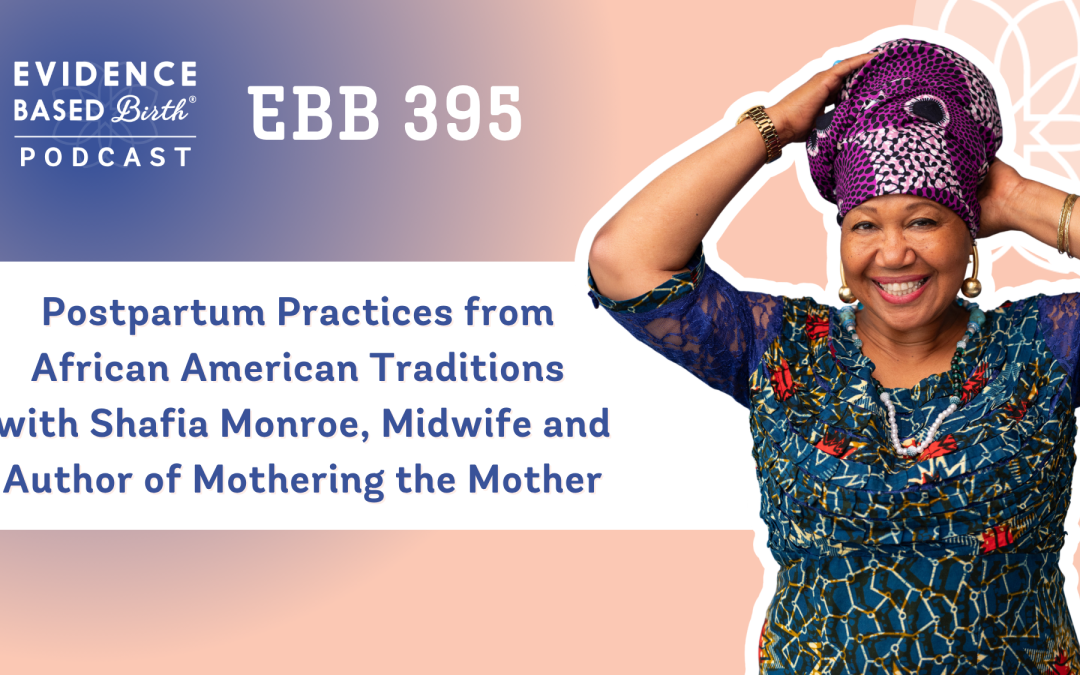
Hi, everyone. On today’s podcast, we’re going to talk with Shafia Monroe about culturally rooted African-American postpartum practices. Welcome to the Evidence Based Birth® Podcast. My name is Rebecca Dekker, and I’m a nurse with my PhD and the founder of Evidence Based Birth®. Join me each week as we work together to get evidence-based information into the hands of families and professionals around the world. As a reminder, this information is not medical advice. See ebbirth.com/disclaimer for more details. Hi, everyone, and welcome to today’s episode. Today, I am so excited and honored to introduce our special guest, Shafia Monroe. Shafia Monroe has her Master’s of Public Health and is a veteran midwife, cultural historian, and author of Mothering the Mother, African-American Postpartum Traditions, Recipes, and Healing. Mama Shafia is the founder of the International Center for Traditional Childbearing and CEO of SMC Full Circle Doula Birth Companion Training, the first Black-led doula training program in the United States, which has trained more than 5,000 doulas nationwide. Through Shafia Monroe Consulting and Birthing Change, she works with healthcare professionals and organizations to improve cultural competency, diversify the workforce, and advance equitable birth outcomes. A leading voice on African-American birth traditions and maternal health, Shafia’s work has earned numerous awards, and in 2022, she was recognized by Scientific American as one of the people helping us make healthcare more fair. Mama Shafia, welcome to the Evidence Based Birth® Podcast.
Shafia Monroe – 00:01:54:
Thank you, Rebecca. So nice to be here again. Of course, I follow your amazing work. So thank you for what you do.
Dr. Rebecca Dekker – 00:02:01:
Yeah, and we last had you on Evidence Based Birth® Podcast, episode 152. So you were a special repeat guest. We don’t have many people who come back a second time.
Shafia Monroe – 00:02:12:
I’m on it.
Dr. Rebecca Dekker – 00:02:13:
And it’s one of my absolute favorite episodes. So if any of our listeners haven’t heard it yet, it’s episode 152, all about traditional Black midwifery and the role of spirituality in midwifery. And then you also joined us last year in our EBB conference, where you educated us about preventing infant mortality, which I know is another one of your areas of interest. Tell us what you’ve been up to recently, in particular, your latest big project.
Shafia Monroe – 00:02:43:
So exciting. I’ve been up to so much, but the most, I think, pressing, most exciting things actually, I have become an author, an official author. So, you know, I’ve been teaching, as you know, doulas for 23 years, and I have great PowerPoints, and I talk all about the history of African-American healing, which leads into African-American postpartum care. And folks are like, okay, well, you know, how do I find this? And it’s like, I’m thinking, you know, if you don’t take the program, you can’t find it. And a PowerPoint really does not do justice. Of course, if I teach in person, it does justice, but I’m not always able to be everywhere. So as it says in my book, my mother always told us, if there’s something important you want people to know, you need to write it down. So about five years ago, I decided I was going to write a book on African-American postpartum traditions, recipes, and healing, because you can’t find it anywhere. And the work and the way that our culture did things was very healing for new mothers.
Dr. Rebecca Dekker – 00:03:42:
Your book is called Mothering the Mother, and it’s one of the most beautiful books I’ve ever read, both inside as well as the cover.
Shafia Monroe – 00:03:50:
Thank you.
Dr. Rebecca Dekker – 00:03:52:
Take us back to like, you know, you said you wanted to write it down, but was there anything in particular that inspired you to focus your first book on postpartum, on mothering the mother?
Shafia Monroe – 00:04:04:
Well, you know, as a traditional midwife. And being a full circle doula birth companion training, they go together. It was never just birth or postpartum. But since people seem to know so much about birth and not a lot about the postpartum aspect, I wanted to cover that. But also just because of the… The attention to the lack of postpartum education for all races, but then particularly for Black women having more… Unfortunate outcomes in their postpartum experience, whether just not being heard, you know, coming out more sick, more near misses. Our family’s really not, you know, what is our cause? Like, what do we do? And of course, the maternal mortality. So that really, I had already had this idea, like I said, five years ago, I was going to do it anyways, but when I realized things were moving along, that I need to move along and pick up the pace. So I just, you know, threw myself into it, but it was the fact that there’s nothing. And, you know, when you write a book and you’re published, they want you to look at all the things out there. And I did a lot of research. I could not find one book that really focused on African-American postpartum traditions. And so that got me even more excited as being a cultural student, like, oh my God, here’s my chance, you know, to write the history, to do all this great research and to give something to African-American people that is particularly can be traced to Africa, you know, our origins and how we got through enslavement and how we got to Jim Crow and where we are today and why we’re here today, but more so what we can do to fix it. It is definitely a solution book. And that was important. That’s something that we could not just hear about. Oh yeah. Okay. Yes. This is what’s happened. But I’m always about, well, what can we do to fix it? So we can learn to rest. We can have certain kinds of foods. It’s written for parents. It’s written for the mother, you know, for her loved ones. It’s written for grandmas and granddads and sorority groups and best friends. Your friend comes over and it’s like, you know, Hey, here’s a diaper bag. I don’t know what to do for you. How about rub her back? How about massage her feet? How about change your sheets? How about say she looks beautiful? How about just sit with her and drink tea for a couple of minutes? So just things that people like, I want to help, but I really don’t know what to do. And so here’s a step to read and take any part, 13 chapters, take anything out of those chapters. And if you just do one thing, you’re going to help a new mother get through. I mean, new moms. I mean, I’m a mother, I have seven children. I have daughters. I’m a grandma. I’m a friend. I am an active midwife. Mother due any day right now, doula trainer. And also on social media. And the things I hear what mothers are saying today, it’s heartbreaking. You know, it’s so difficult for them. They just don’t know what to do. They’re not seeing the joy. And because if you have not had a good postpartum recuperation, it’s hard to see the joy. The book talks about this postpartum time. It’s not a time to heal. It’s really a time to get to know your baby and smell your baby and kiss your baby and enjoy your baby. And your baby to get to know and enjoy you. Yes, the healing part comes along, but we’re seeing it so medical. You know, just no company. You know, just some type of no guests. And it’s like, this is a social time. And so many mothers say, I feel so alone because no one comes by because I can’t have company. It’s just me and the baby. It’s like, I’m just going crazy as opposed to, yeah, people can come by. And now there’s a book that says, come by. And you know, you don’t come by and say, hey, could you go get me a cup of tea? You come like, hey, don’t get up. I’m going to get that for you. Or let me put something up. Let me elevate your feet. I see your cup is empty. You know, let me give you some water. And by the way, once again, you look amazing. Your baby’s so cute. And here’s 50 bucks. And I’ll see you in a couple of days. And off you go. And I was like, oh, all that oxytocin. You know, you’re just contracting. She’s happy. Milk squirting and baby glowing. And so, yeah, I’m just so happy to write the book.
Dr. Rebecca Dekker – 00:07:47:
I really feel like you infuse a sense of love throughout the whole book.
Shafia Monroe – 00:07:51:
Oh, yes, yes, yes.
Dr. Rebecca Dekker – 00:07:52:
You know, and you start by offering a love letter to Black mothers. Can you talk a little bit about some of those words of encouragement that you would give to someone if you came to see them? You kind of gave some examples of some actions you could do and that you tell them they’re beautiful. But what are some other, like, words you would say? Because I know you talk about how in the book how some people don’t even say congratulations to someone when they have a baby.
Shafia Monroe – 00:08:19:
Right.
Dr. Rebecca Dekker – 00:08:19:
Can you start off by sharing some of those words of affirmation?
Shafia Monroe – 00:08:22:
Yes. And the reason why it’s called Mothering the Mother, because if you have daughters or even sons who have children. Normally, it’s a night for us to want to mother our daughter. Again, having a daughter, everything that I put in the book are things that I would and did do for her. So some of the things in the book is even saying things like, just first of all, I look for the page. Oh, dear mother. Let me be the first to tell you that you are beautiful, blessed in love. Motherhood is a cherished gift. You deserve to be honored, protected, cared for, consoled, and uplifted by society. I want to help you rejoice in motherhood, heal after childbirth, and bond with your new baby. In African culture, motherhood is the epitome of sacredness and power. Therefore, you are sacred. You are powerful. I see you and I’m familiar with your journey of motherhood that you will travel for the rest of your life. You made a sacrifice to bring your baby into the world as a gift. You deserve all the love and support that comes being a mother. You deserve to receive the help you need to raise your baby and regain your strength after childbirth. I know and believe the African proverb, it takes a village to raise a child. I know all too well, having seven children, that motherhood is a village effort. This support held me up when I least expected it, but needed most. So please accept the help from your village for you and your baby’s sake. If you were my daughter, I would be there to help you and the father of your child during your birth. I would be so excited and proud of you. I remind you of our rich tradition of birthing without fear, believing in your body to do everything perfectly. I would say the prayer of Thanksgiving to bless you while you held and nourished your baby for the first time. While in bed, I would hand feed you my special postpartum coconut curry chicken soup that I made to warm your insides. Give you energy, and begin your postpartum recovery to wellness. I would practice African-American postpartum care to keep you happy, prevent postpartum depression, and help you produce abundant breast milk. I would apply the African-American belly wrap to hold your uterus in place while it shrinks to pre-pregnancy size and back down into your pelvis. I would wait on you hand and foot because I love you so much. I would care for you so you could love, smell, kiss, nurse, and marvel at your new baby. I’d be there to answer any baby care questions, let you rest while I bathe and change your baby, and I would teach you how to safely co-sleep like I did with you and your siblings for infant health, easy nursing, and optimal rest. After you complete the 42 day lining period, we would honor you with a milestone with a beautiful naming ceremony. I’ll stop.
Dr. Rebecca Dekker – 00:11:21:
Thank you so much for reading that. And so beautiful. And. As you say in the book, so many people don’t receive that kind of love in the postpartum period. And, instead, we kind of… have to deal with this Western model that you describe in the book. So you just showed us what postpartum care can look like. And then you go into depth in the book. What does it too often look like and what’s missing right now from postpartum care?
Shafia Monroe – 00:11:56:
Well, you know, what’s missing from postpartum care is the family knowing what to do. Because the medical team, that’s clinical. You know, when we have a mom, you know, we’re happy that insurance has increased the postpartum visit. At the same time, it’s a challenge because we’re saying optimal rest for the first 42 days. We know postpartumly that, you know, at birth, there’s issues for mothers. And then from zero to seven, there’s issues. And from seven to 42 days, which is why my book says 42 days specifically. And so what’s missing is that we’re having mothers leave the house too soon for the baby checks. You know, so within three weeks, they’ve made four visits. You know, check the weight, jaundice, is going back to lactation consultant. So when I see them, their vaginal tear is very sore. They’re up, not resting it. They’re feeling tired. They’re more depressed. And they’re just tired. They’re not happy because they have to get up, dress their baby, get them in the car seat, and often drive themselves. Then wait for the visit. You know, the physician provider tells them everything’s fine or not fine. And back home they go. They get back out the car. So it’s a lot of work. It’s the opposite of African-American postpartum care where… If she has to go, definitely someone should be with her. Definitely somebody should not even bring the car seat. We really want moms to get into carrying their babies in their arms, get out of these applications where they are actually holding their baby more to keep their oxytocin going up. One part of the book talks about our tradition that the co-sleeping is a form of medicine because the closer the baby is to you, the more oxytocin and the more we’re going to have good contractions to shrink the uterus, which prevents uterus hemorrhaging, by having the baby close as opposed to the baby in another room or the baby in a little bouncy away from the mom. If the mom is rested, she can hold her baby, but she’s tired. She doesn’t want to hold her baby. She’s going to keep putting in things because she’s up trying to do things. The other thing about the book I think is important is the kind of walking into someone’s home with intentions of praying for health and protection in their home. You know, walk in with, I’m coming here. For us, to serve is worship, to serve as a form of praise and the creator for this mom. So we want to help her. And back in the day, people, we’re talking about 1940, 1950, people will come to your house. They wanted to help you. It wasn’t a job. You didn’t have to hire someone for three hours. And even still… The doula is not enough. When I mother the mother, I move in with my daughter or my daughter comes to my home. So therefore, I am there 24 hours a day to help her because after the doula leaves, then what happens? She still needs help. So I mentioned Michael Tootie in my book, who I really admire. His book is called The Cooking Gene. He says that in the South, a recent book, I think he wrote a 2000 book. But he said that in his research, he researches life on the plantation, that people would go, Black folks would walk by the street and pick up fresh watercress to bring to somebody ill. Then they would sit and they would take shifts. So that person was never left. There was always somebody with them. Well, the same for postpartum care. Even though it’s not a sickness, it is a physiological. High point of a person’s life that they need to have someone sitting next to them or in the home 24 hours a day. And I know so many mothers say, even if I’m just in the front room drinking, I’ve already helped her out. So now she’s resting. I’m in the front room, just drinking tea or scrolling my phone, to be honest, or looking at a book. She’ll say, lady, just the fact that you was in my house, I slept better. I felt safer. They don’t want to be all by themselves. So this thing of the Western concept that independence, self-soothe yourself, self-soothe your baby, is not normal. Mothers need to be mothered so they can mother their baby. They are vulnerable. They need to know that they’re okay. Even with your seventh child, I still wanted people around me telling that everything was okay because that’s a different baby. I had a different kind of pregnancy. I had a different kind of labor. I’m a different kind of postpartum experience. And those after pains are number seven, eight, no joke. Gosh, if you know about Afterpains, from five up. They don’t get any better. So this book really talks about, you know, hands-on approach. Like, you know, we’re in a society where everything’s considered inappropriate. It’s the opposite. If I come in just, oh, how are you doing? You’re looking wonderful. Or, oh my goodness, you know, just let me hold your hand. Or at the end of the book, we’re touching your foot. Or just listen, it’s time for that postpartum massage. The grand midwives, aka granny midwives, they greased them mothers up every time they saw them. That was the culture to use. It wasn’t Shea Butter back then or Olive Oil, but they had lard grease. And grease from the grease, which we know now too, by the way, the fats in food are so important for a new mom. So just massaging with these fat oils going through her pores is just helping her overall heart. Just really quick, I just think another part important to remember that when a woman gets pregnant, when a female gets pregnant, her brain structure changes near the end of her pregnancy so she can focus more on the baby. So it’s not the brain fog. She’s designed to protect it. We are mammals, and every mammal except for the human heavily protects their child and stays close to their child. So we support that. You know, stay with your baby. Stay close. You know, family members, yes, let me hold the baby to get some rest. But validating the fact that she doesn’t want to leave her baby because we’re talking like, you know, what do you mean? Why are you being so attached? You know, yes, you’re supposed to feel that way. So validating her normal mammalian cultural beliefs that your baby should stay next to you. And that’s a good thing. I’m going to help the baby stay next to you by doing the cooking and changing the sheets. So you don’t have to do that. So now you can stay close and bond with your baby. And when you’re tired, as a grandma, because I am a grandma, I’m going to swoop that baby up and say, okay, you know, you’re looking tired, you’re leaning over, baby sleep, I’ll shake the baby or whatever you want me to do. So you can take a couple of hours and I’ll be sure to wake you up when the baby wants you. So you can, that’s okay. Because, you know, moms, they run vigilance. I think another part important too for Black women, we live in a state of high cortisol. We are in a state of flight, fight or freeze because our children are always being impacted. It’s not in a school with someone cutting our kids’ hair because they’ve got beads or, you know, some teachers not being nice. So the police force, targeting our kids, these are well-documented. Lifetime issues. And so we talk about epigenetics. We’re just so worried and we don’t even know why. So by the time we have our baby, we’re just so uptight. And I think reading this book helps us to tell the mom that it’s safe now. You can relax now. You’re home. We’re here with you. I’m just letting her get that cortisol out and get that prolactin, that oxytocin up. I wonder if Black women have such a hard time with their postpartum experience because we’re not aware of the fight, flight, or fear. We don’t talk about that. And I think we need to talk about so we can say, this is why you’re feeling this way. So let’s meditate. Let’s do some music. Let me hold your hand. Let me pray with you. Let me massage all things that we know that bring about our relaxation and brings the body back to a balance under these conditions.
Dr. Rebecca Dekker – 00:19:06:
Yeah, you talk in your book about bringing the body back into equilibrium from the hyper-vigilance, especially. Being Black and pregnant in the United States. And you talk a lot about the wisdom of the granny midwives or the grand midwives and that… You know, could you share with us by the number one advice? That a granny midwife might say to someone who is hyper-vigilant, who is doing too much? What would they tell that person who’s postpartum?
Shafia Monroe – 00:19:36:
Definitely get off that cold floor. You know, the heat was a big thing. So we talk about mother roasting. Black midwives are definitely keeping you hot, maybe too hot sometimes. So you’re in your room. You know, back then they’re burning wood to keep the room warm. Of course, people had shacks, so definitely there was more cold air coming out. But even the summer, they kept the rooms very warm for moms. They just, they believed in sweating, giving a lot of sassafras tea, giving castor oil so that you wasn’t constipated. So, you know, we give other kinds of options. Everybody got a tablespoon on the third day. Another thing I found very interesting, they felt that the baby’s eyes were not developed right away. And they wanted to keep the house dark. And I go to people’s house all the time. They’ll say, my baby never wakes up. And I’ll say, the baby is awake. It’s too bright. And we pull the shades down. And sure enough, what the baby do, as you know, they open their eyes. So the granny midwives knew to give them, they don’t need all that bright light. They did believe in keeping dim lights, resting, staying off your feet. I read that they did a lot of massaging of the feet, a lot of massaging of the shoulders. So I think the most that I would say was to rest. And I think coming from a society where women were enslaved and these grand midwives coming after enslavement, but still having to deal with the Jim Crow, which basically was sharecropping, was another form of enslavement. They just knew that we already were working so hard. You need to rest. I think they saw women bleeding and hemorrhaging who did not have a chance to rest. I think they knew from there ancestors telling them straight from Africa that, you know, women take time off, women are honored. And so I think that’s why the rest is such a very… It’s across the board of all my research. Everyone was like bed, rest, rest. You know, rest, not necessarily sleep, but I did write the difference between resting and sleeping.
Dr. Rebecca Dekker – 00:21:26:
And you talk about the lying in period, which I know a lot of cultures have something similar. So how long would that be in the African-American tradition?
Shafia Monroe – 00:21:34:
It is 42 days. So people say 40 days. And I added the two more days in the book because when I did the math, six weeks actually is 42 days. And so I made it, you know, we had the 40 days. So it is 42 days. And it’s not necessarily, you know, in the beginning they do, they did stay almost, they almost in bed all the time. And then you could get up like on the third week and you could walk on the house. You could go into your front yard. People had front yards there, but you couldn’t leave the gate. And still, people didn’t come. It’s strangers. Family could come see you, your sisters, brothers, cousins, but not people from the church who were not biologically related to you. And so it was the whole 42 days. And after 42 days, they would take the mother out the bed, some bother. They would smoke her clothes, by the way. They would take her dress, and they would wet it and put it somewhere near the fireplace. And they would throw a bunch of corn shucks in there and even pine needles. And the dress would have a very smoky smell to it. And that was kind of like the sterilizer dress in their belief. But also, when I did research of other cultures in Africa, they actually have a much nicer smell. And when the woman walks out the door, it’s so strong that people know that she’s coming out. And only the new mom has that particular smell. So they know that a new mother is now, first of all, she survived. That’s the question. You know, she actually lived to come out. Because as we know from our research, that from 7 to 42 days, it’s a very high rate of material mortality and material morbidity. So can that mother even get to walk out? So this is really about the midwives knowing that life, well, birth is a life and death situation. And we want the mom to live. And so we’re going to keep her resting and do all the things for us. So on the 42nd day, she can walk around the house. So that’s a lying in. She would lie in. Then they would pick, they would take her out the bed. They would come and say, okay, you’ve made it. You know, hallelujah, praise the Lord. Help her stand up. You know, put on her little slippers and put this dress under that smelled like pine and corn. They would give her a small, back there was a thimble of water. And she walked three times around the house and prayed clockwise. Rotation of the universe, rotation of the sun. Going to the right, some other type of cosmology energy. And on the third time, she would drink the water. And now she’s officially out of the red zone. She could now receive people. And she’d go back to church and have her baby baptized and, you know, whatever the celebration might be.
Dr. Rebecca Dekker – 00:24:01:
I love hearing the descriptions of different ways that… African-American culture honored the mother and the sacred transition. In your book, I’m going to read a paragraph about like kind of the current postpartum model of care. You write, the Western postpartum model of care emphasizes physical and mental risks. It prescribes antidepressants for postpartum depression and strongly recommends birth control. It confirms that you can expect to feel exhausted and overwhelmed and suffer from a variety of maladies such as painful sex, incontinence, body aches, and a colicky baby. At her postpartum clinic visits, rarely does a mother get a congratulations. She is not reassured that everything is going to be fine and that with each week she will begin to feel stronger and more confident in her mothering and decision-making. Mamas are not told you can have a full life as a mother. It is not one or the other. On top of this, Black women also get this subtle and overt message that they don’t deserve to be a mother. And you go on to talk about the emphasis on birth control. With the opposite model that you’re talking about, where… People are treated as if this is a sacred time and that the whole community is kind of rallying around them. You have a lot of… Examples of other traditions that… Promote physical recovery. And one of the big ones you talk about in this book is postpartum food traditions. So you’ve mentioned a few herbs. And warming foods. Can you give us a few more examples of like your favorite food traditions or… Recipes that can nourish new parents.
Shafia Monroe – 00:25:45:
Well, one, I just want to go back to what you’ve read, and thanks for reading that. And that’s important because psychologically, if a mother doesn’t hear that this is normal, that she’ll get through it, and that it’s not going to last long, it’s just, it’s like stress. So we hear that, you know, when we read postpartum, it’s always what I just said, as opposed to granny midwife.
Dr. Rebecca Dekker – 00:26:06:
I was going to say, it’s always bad news.
Shafia Monroe – 00:26:07:
Right. But everything that’s in that book is going to reduce that. So if you are having a sore vagina afterward, which we say is normal, by her giving that sitz bath, putting those warm compresses, putting that healing salve there, and I’ve done it. So I know, like, within minutes, it’s better. No one’s burning when they urinate with me. That does not happen because we have that warm tea of the coffee being poured the exact time. Soon as the placenta is out, there’s a warm compress immediately on there. We don’t use ice. We’re using heat, which we know brings circulation. To the area and not using the ice pops. So it’s a complete opposite. For a colicky baby, we’re giving them catnip tea, and we’re giving them a bath up to the shoulders in the dark room, almost like the Le Boye method, which calms babies down. And so these things that they talk as the norm are not the norm, just that they don’t know what to do to give mothers relief. And so the Black midwife did. So for the foods, the big thing was soups. So soups is a very common tradition out of Africa. I have a little piece how… We had the one-pot meal. And the other thing I’m excited about is that the recipes all have majority foods from Africa. So okra, black-eyed peas. Collard greens come from Europe, by the way, that we eat them. But the reason why black people eat them so much is because we used to eat banana leaves and other kind of leaves in Africa that we couldn’t get in the United States. We recognize the big leaves and we use those. And again, as Michael Tweedy says in my book, Black folks just knew that greens make them healthy. So having greens is a big part of it. Having wet foods, you know, it says that moms are crying, urinating, leaking milk, you know, defecating, bleeding, sweating. So it’s easy to get dehydrated. And so by offering soups for the 42 days, that’s going to keep her healthy. And we know that when you have the liquids, we call the pot liquor, all the vitamins is in that pot. And so we give that. So my favorite is the peanut soup. And peanuts come from Africa. They’re called goobas. They would smash the peanuts real small, almost like a paste, and cook it down with, you know, green peppers and garlic. The other thing, too, we give spicy foods to our moms. We believe that spice keeps the heat up. So the little red cayenne peppers go in there. Of course, the water, the salt, a little vinegar, and usually we would make rice. Rice also comes from Africa, so they make the soup, and then the rice would be on the side. And moms would just eat that! And be happy and glowy and pretty.
Dr. Rebecca Dekker – 00:28:41:
I remember in one part of the book, you mentioned like, what if you don’t have anybody? Take care for you right now. And you gave an example of a really simple soup, that a chicken soup that a new parent could make if nobody is there to help with them. I’m sure you know it by heart, and I recognized it growing up in the South, so I loved reading that part. Could you tell us about that easy chicken soup?
Shafia Monroe – 00:29:07:
Well, one thing I suggest that every new mother/parent get a crock pot, because they don’t catch on fire. If you fall asleep, you should be okay. So that’s the thing. Who wants to try to cook and stay with the new baby in the pot side, and you’re afraid it’s going to cook out? So get the crock pot, a little bit of peanut oil in it, chop some onions and garlic and some celery and some carrots. Put a chicken in there and put a bunch of water over it and a bay leaf and hop in that bed and go to sleep. Salt and pepper. And once you get up, you can make it the way you want. If you want more pepper, more salt, you can season it, but at least you can go to sleep and wake up and that chicken soup is ready for you. And that will last you, if it’s just you, for a few days. But even if you have other children, they can also eat it. And that’s why we make the rice. The rice will make it heavier if you want to have rice with it. And we do recommend the rice because mothers do need carbohydrates. So we do say, you know, it’s soup, but we still, and there are starchy vegetables in it, like the celery or the sweet potato or, you know, maybe beets or definitely the turnips. Those are starchy vegetables, but we are rice people. So most likely we used to be. Now people are getting spaghetti and a lot of casseroles, but we are reverting with this book to go back to our original African diet that really is much more rehabilitative for a new mom, get things moving through her body because she’s having this great soup as opposed to heavy, mainly starches and meat, but getting those vegetables in there. That’s kind of it, Rebecca, from I can remember.
Dr. Rebecca Dekker – 00:30:42:
Yeah, that sounds like mine. I think you added in the book, you mentioned cayenne pepper, which was the only thing that my family didn’t do. But yeah, I can see that making it, adding the heat to it as well. Yeah, and then your whole house, your whole home smells amazing to you, right?
Shafia Monroe – 00:30:58:
It does. It does smell amazing. You know, warm soup, you know, we give people after the birth, you know, we give them, I see people eating cold sushi on these. You know, what do you call it? Just social media. You know, big, huge thing of that’s a new thing. Give them a whole thing of sushi after the baby’s born or, you know, they’re getting that big casserole. And I know people have very good intentions. There’s nothing wrong with that if you want to do that. But again, this book is African-American postpartum traditions, recipes, and healing. And we don’t believe that those are healing foods. So the soup, as I mentioned, the hydration is a big deal. So many people become dehydrated when they’re pregnant. They forget to drink, but they get in those three bowls of soup or three or four cups of soup plus their herbal tea on the side. They should be okay. And that’s something that, as you mentioned, because everybody doesn’t have a family and they will be by themselves. Even if they’re alone. Getting a friend, if you have a friend, you can pop your phone up and do a Zoom while you eat with them if that’s possible. If you don’t have somebody, you have no friends, believe it or not. Then maybe it’s watching a comedy while you eat. Not watching, but anything to keep your oxytocin at a high level. And I remember when George Floyd was murdered on TV and I saw it by accident. I did not want to see that. And I turned the TV on. I’ll never forget it. It’s something you don’t want to see. And I remember putting out a quick alert on social media. If you’re breastfeeding or if you’re pregnant, do not watch the news because you shouldn’t watch the news. That’s one thing about the Black midwife. You were not allowed to go to funerals if you’re pregnant or a new mom or allowed to see or hear about bad things. Like, oh, get out that room with her. You know she just had that baby. She don’t need to be hearing that. So people know you didn’t bring bad news around the new mom. We’re not trying to get her cortisol up. We’re trying to keep her in a relaxed state with her oxytocin going and her to be in a good state. So I think we need to think about that, too, because now there’s so much information on my children, my child, everything should turn on social media. You don’t even ask for it. This stuff just pops up. You have to be really careful, you know, and protect yourself as a new mother. Or family members protect her and make sure she watches things that make her happy. You know, nice magazine talk about putting plants in her room for fresh oxygen, you know, changing the flower water, opening the windows for her, sweeping her floor, airing her home out, you know, burning frankincense and myrrh for a minute to keep a good smell going. You know, using organic cleaners if you can when you clean a house so she and the baby aren’t, you know, being fumigated. All those things count on someone’s feeling cared about and then benefiting from your intention that you’re trying to help, but also using quality practice than not having to open the window and can’t breathe. So just to be aware, that’s also included. I love taking care of a new mom. That’s like my favorite. I mean, I love this
Dr. Rebecca Dekker – 00:33:50:
This whole book is such a gift to everyone. No matter your ethnicity or your background, because these traditions are really, really special and important. And they cross a lot of… lines in terms, I don’t know if that’s the right way to say it, but it just feels like when you, when you protect and love and care for black women and black birthing people, like everyone benefits. All of society does. It’s universal.
Shafia Monroe – 00:34:19:
That’s right.
Dr. Rebecca Dekker – 00:34:19:
For sure.
Shafia Monroe – 00:34:20:
We all just love this.
Dr. Rebecca Dekker – 00:34:22:
And so, you know, I want to personally say thank you for compiling all of these pages and pages of wonderful soups and stew recipes that you, I’m sure, have made many times. You even have a warm Mama Shafia’s warm salad recipe for if you’re not supposed to be eating cold things.
Shafia Monroe – 00:34:39:
Right, right.
Dr. Rebecca Dekker – 00:34:39:
And then you have a lot of recuperation drinks or teas. And you’ve mentioned tea a few times. You know, what is… One of your favorite cups of tea to share with a new mother.
Shafia Monroe – 00:34:52:
I like the raspberry ginger nettle mint tea. I don’t know if it’s in there, but I know I mentioned ginger a lot. Ginger is nice and spicy. That’s a root good for circulation and strength of news.
Dr. Rebecca Dekker – 00:35:04:
Did you grate the root? So how do you make this tea then?
Shafia Monroe – 00:35:08:
So, you know, we say that it’s one teaspoon per cup of water. So if I’m going to use three of these, I try to make enough, so I’m not keep making it. So I’ll probably make about… Gallon to be honest so i’m just going to fill up a big eight quart pot and get uh a cup of ginger ginger root grated and then let it boil because ginger is a root so i’m going to boil that for 15 minutes and after 15 minutes boiling i smell like the spice in the air i’m going to shut it off and add a half a cup of uh raspberry leaf and a half a cup of uh mint and then cover it and just let it steep for about you know 30 to 40 minutes and i’m going to strain it put some honey in it and that can be her drink either warmed up or room temperature and that way the person coming or the mother or the grandma who does have to keep making a cup of tea every second
Dr. Rebecca Dekker – 00:35:58:
So you make like a whole pitcher and then just reheat it.
Shafia Monroe – 00:36:01:
Yeah. Definitely mint, ginger, raspberry, you know, nettle, things that, you know, I put about iron is a big issue. So I do try to give iron fortified foods. You know, most women in this country are anemic, particularly African-American women, because unfortunately suffer from fibroids more often. So there’s more bleeding during the menstrual period because of food deserts. Folks did not know how to eat. So all their life they were having their period without food to be billed. So when we get them as a midwife, they’re already anemic. And in the hospital, they don’t always check for anemia unless you hemorrhage. So the book is written that we assume that you are. So chicken livers, I have a whole list of high iron foods based on the level. And so I know that in the South, and you might know too, Rebecca, chicken livers were very common. So, you know, chicken liver, gravy over rice. Even then, you can know it was the wet food. It was always a gravy. No one ate dry food. It was always some kind of gravy, black-eyed pea gravy. The okra gravy is always a wet food in our culture. So I remember my mother, you know, making this nice brown gravy that was floating, and she would stir fry the chicken liver, a little bit of onion, and on top of rice, she would have this, you know, this delicious meal with the okra on the side or the beets on the side. So… spearmint is actually very high in iron, I found out as well. That’s in the book. Or clams. If you’re from the shores, Black folks ate a lot of seafood. If they were inward, then they ate a lot of liver. And beef, and of course they ate pork. I did not put pork in the book, but all the other ones, if somebody wants to eat pork liver, however, pork liver is very low in iron, by the way. The highest is actually chicken, and I believe the next one was goat. So, yeah. The teas are good.
Dr. Rebecca Dekker – 00:37:45:
Lots of examples in the book of teas and stews and broths. And one more thing, kind of going back towards more the spiritual… Side of postpartum, you talk about mother wit and how midwives… You know, developed and honed their mother wit, but also any parent can also. Develop that. Can you talk about what is mother wit and how it’s important in the postpartum period?
Shafia Monroe – 00:38:17:
Yes, mother wit is something that we’re all born with. We even say dad wit. But mother way is that the mother knows. What her baby, if something’s wrong with the baby, if something’s wrong with her. And I bring that in because we hear so many stories of Black moms going back to the hospital saying, I don’t feel right, and them sending them home. And unfortunately, often many of them dying because they knew something was wrong, and the medical team just did not research it or just overrided it. So I want Black moms to use their mother wit. If you know something’s wrong, to be persistent in them doing, the medical team doing, the work they need to do to find out what that problem is. I get the example of my daughter was five months old, my third child in the book, and she wasn’t acting right. I could tell something was wrong. She just didn’t seem right. And I brought her in. They said she was fine. I went back three times. I kept going back. And finally, on the third time, she had pneumonia. And so I picked up the pneumonia as a mother before the lab could see the germs. I felt it intuitively as a mother. My mother was like, my baby’s not okay. There’s something wrong. So I picked it up before they even could pick it up. But I kept going back. If I didn’t go back, she probably wouldn’t be here today. She might have died, walking pneumonia for an infant. So if you know that your baby’s not doing well and your internal compass your mother wit, you’re the mom that’s like, I can’t put my finger on it. You don’t have to name it. That’s why we’re spirits. The spiritual has the unseen. I don’t have to say what it is, but I know something’s wrong. And that is enough for you to go back and say, I don’t know what it is, but I know there’s something wrong. I need you to help me find out what it is. And be persistent. Same with you. When you go back as a new mom to the hospital and they’re saying that, you know, there’s nothing wrong, but you don’t feel right. Just because your high blood pressure hasn’t spiked yet, you know that you’re not feeling yourself. So insist on the care. I think for Black women, a lot of us just go back, you know, they said, I’m okay, they’re not finding anything, and we doubt ourselves, and we need to not do that. We have that gift to know our own bodies, all humans. We have that gift to know when our children aren’t doing okay. I want us to own that in the book. It’s a lifesaver.
Dr. Rebecca Dekker – 00:40:29:
It is. I remember reading that story that you told about your child, and my mom has a similar story of my older sister who had some kind of bug, you know, infection, and… My mom just knew something was wrong, though, because she was so sleepy. She was three years old and just wasn’t waking up. And she took her to the doctor. And the doctor was like, we need to get a taxi because this is before ambulances. Take you right now to the hospital because she had meningitis.
Shafia Monroe – 00:40:59:
Oh, wow.
Dr. Rebecca Dekker – 00:40:59:
And my mom always thinks, what if I hadn’t listened to my intuition? And then at the same time, we can have intuition, and you talk about this in the book, that tells us everything is right. When, especially I can imagine Black women are constantly being kind of told, you’re at high risk for this, you’re at high risk for that. But what if you know all is well?
Shafia Monroe – 00:41:25:
Yes. And that’s important too, because we look at the high level of the fear tactics for all women. But again, we look at statistics that more Black women are offered Cesarean section. By the way, we know now that were not needed, and more Black women are being induced because of whatever reason, you have to know that my baby’s not late. You know? My baby’s okay in here, and I don’t think I’m going to die, and I don’t think my baby’s going to die. So therefore, I’m going to deny that Cesarean section. I think that’s so important because a lot of these maternal mortality deaths are coming from Cesarean section births that often were not needed. But if you walk in afraid, and you don’t know your body, and you don’t trust your body, and you don’t have faith in your body, as I said in the book. With the Black Mother’s Letter that, you know, in our tradition, we don’t fear birth. And we know that our bodies are designed perfectly, as opposed to I’m coming in broken because I’m over, you know, 38 years old or because I’m Black. And Black alone, being a Black woman is considered high risk. It was in the book. They might have taken it out. But definitely among the conversation in the room, oh, she’s Black. Well, you know, she’s going to need a Cesarean section. She’s probably going to get hypertension. This kind of things. Even a Caucasian nurse told me, she said, well, Shafia, we don’t really promote breastfeeding on the floor because we’re told that Black women don’t want to breastfeed. We don’t want to bother them. So these little, you know. Cultural inaccuracies are going around. And so you have to know as a Black woman, you have to know what your status is. You have to tell them what’s going to work for you and not allow them. You have to believe that the creator made you perfect and that your body is perfect and that you’re designed as a baby and you’re going to be okay. And I think the book talks about why we offer and promote midwifery in the book, because midwives are taught that birth is normal. You know, and for, I talked to someone the other day in one of my trainings and I asked them how many knew that nurse midwives work in hospitals out of the nine, only two did. And so still there’s lack of information that midwives are available in hospitals where most Black women give birth. Hospital birth still is the norm. And so we want Black women to know that there are midwives in there, regardless of race, get a midwife first. That’s your first, you know, line of defense. But yeah, but know your body.
Dr. Rebecca Dekker – 00:43:45:
Yes. Thank you for that reminder. And before we go, I was wondering if… You know, what else would you like to say? What is your mother wit calling you to tell our listeners today that maybe they need to hear about? Taking away this information, integrating traditional wisdom into their postpartum care.
Shafia Monroe – 00:44:08:
You know, I wish in society that we could help people more publicly. You know, I love when I go someplace and I’m able to hold the door for a new mother. And they’re always so surprised. Like, let me hold that for you. You know, I remember once I grabbed a bag from a lady, she had a baby and a toddler. She just looked at some crazy midwife. I just love helping people. She just smiled and I would help to get to her car. I know that’s not always safe, but we used to do things like that. Now the mother’s struggling with the baby, the car, and her bags. And we’ve been so desensitized not to help. And new mothers need help. You know, they need help. And so even though they’re out of the house at 42 days or three months, as I said in the book, it’s a lifeline, a lifetime of being a parent. So I wish that we could at least say congratulations. I love to walk down. Everything I talk about, I do. I’ll walk down the street. I don’t care the race. Like, congratulations. And they look up, oh, thank you. They’re so happy. They’re like, oh, so unnoticed. I mean, you’re proud of a baby. You want someone to congratulate you all day long. You know, he just did this. You know, you’re showing your baby off. So do congratulations, you all. Offer to help. Sometimes just help. Don’t even ask. Sometimes people, we’re prone, book says for Black women and women in general, we’re prone to say, no, we’re taught to be independent. We don’t need help. We do need help. So just say, hey, let me grab that for you. They say, don’t, that’s one thing, but just, let me just put this, let me just help you and just grab this right here for you. And they can tell that you’re alone. We can look at people’s face like, okay, this is a safe person. They know. They have their mother wit. We can tell this person’s okay. So don’t be afraid to offer. Don’t be afraid. They say, no, it’s okay. You offer it. You get the blessings for trying to help. This is a form of worship. When we help the human species, we are worshiping the creator. We’re being grateful. Our goal on earth is to help each other and to make a better world. And this book is about making a better world. If the mother’s happy with their baby, that’s two more people that are okay to go back in society to bring back the love that they’ve gotten from us. So that is my message to end with.
Dr. Rebecca Dekker – 00:46:04:
Thank you for sharing your message with us, Mama Shafia. And for our listeners, I highly recommend getting this book, Mothering the Mother, African-American Postpartum Traditions, Recipes, and Healing. You can find it on many different places. You can also order it in bulk from the Shafia. It’s called shafiamonroe.com has a link to order in bulk if you want to gift copies to your clients or to other doulas. It’s an amazing gift. Thank you so much.
Shafia Monroe – 00:46:30:
Thank you, Rebecca. And that was so good to see you and all the good work you do. And I’ll keep following along with your evidence-based information.
Dr. Rebecca Dekker – 00:46:38:
Thank you.
Shafia Monroe – 00:46:39:
Thank you.
Dr. Rebecca Dekker – 00:46:40:
Today’s podcast episode was brought to you by the online workshops for birth professionals taught by Evidence Based Birth® instructors. We have an amazing group of EBB instructors from around the world who can provide you with live, interactive, continuing education workshops that are fully online. We designed Savvy Birth Pro workshops to help birth professionals who are feeling stressed by the limitations of the healthcare system. Our instructors also teach the popular Comfort Measures for Birth Professionals and Labor and Delivery Nurses workshop. If you are a nurse or birth professional who wants instruction in massage, upright birthing positions, acupressure for pain relief, and more, you will love the Comfort Measures Workshop. Visit ebbirth.com/events to find a list of upcoming online workshops.
 Listening to this podcast is an Australian College of Midwives CPD Recognised Activity.

Get Empowered! Learn more…
EBB 413 – Evidence on Migraines and Pregnancy: Frequency, Prevention, and Comfort Measures
Don't miss an episode! Subscribe to our podcast and leave a review! iTunes | Spotify | YouTube Migraines during pregnancy can be debilitating, and figuring out how to prevent or manage them can be especially challenging. In this episode, Dr. Rebecca Dekker...
EBB 412 – Induction Tips for Families with High-Risk Doula Jennifer Anderson, RN
Don't miss an episode! Subscribe to our podcast and leave a review! iTunes | Spotify | YouTube An induction may change your birth plan, but it doesn’t mean giving up your preferences or your role in the decision-making process. In this episode, EBB's Director of...

EBB 411 – Advocating for a Family Centered Cesarean with Holly and Nathan Miller, EBB Childbirth Class Graduates
Don't miss an episode! Subscribe to our podcast and leave a review! iTunes | Spotify | YouTube When Holly and Nathan Miller learned their baby was breech late in pregnancy, the unmedicated vaginal birth they had been preparing for suddenly felt out of reach....