

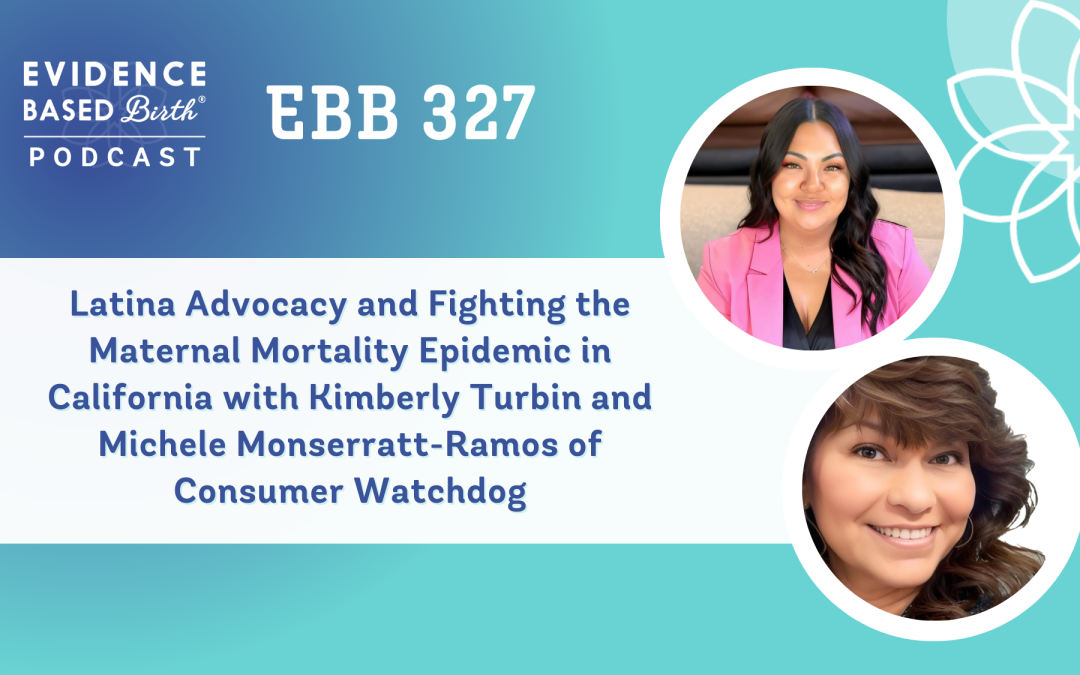
We are joined by Kimberly Turbin and Michele Monserratt-Ramos, staunch advocates against obstetric violence driven by personal experiences and a commitment to marginalized communities. Kimberly’s advocacy began after a traumatic birth experience in 2013, which she courageously shared publicly to ignite awareness and debate on obstetric mistreatment. Michele, with her extensive background in public interest and healthcare safety, collaborates with Kimberly to address maternal health issues, particularly affecting Latina women in California. Their joint efforts focus on systemic change, emphasizing the need for resources, education and support to ensure informed healthcare decisions and improved maternal health outcomes.
Content Warning: This episode contains discussion of obstetric violence. Listener discretion is advised.
Resources
- Learn about Consumer Watchdog here.
- Watch Kimberly Turbin’s birth video here.
- Follow Kimberly Turbin on Instagram.
Transcript (English)
Dr. Rebecca Dekker – 00:00:00:
Hi everyone. On today’s podcast, we’re going to talk with Kimberly Turbin and Michele Monserratt-Ramos about their advocacy efforts to combat obstetric violence and the maternal mortality crisis for Latina women. Welcome to the Evidence Based Birth® podcast. My name is Rebecca Dekker, and I’m a nurse with my PhD and the founder of Evidence Based Birth®. Join me each week as we work together to get evidence-based information into the hands of families and professionals around the world. As a reminder, this information is not medical advice. See ebbirth.com/disclaimer for more details.
Hi everyone, and welcome to today’s episode of the EBB podcast. We have a very important episode for you today with some special guests. I do want to let you know before we get started that this episode will contain discussion of obstetric violence and maternal mortality and listener discretion is advised. Also, if you’d like to read a complete transcript of this conversation in English or español, it is available at evidencebasedbirth.com/327.
Now, I’d like to introduce our two honored guests. We are so fortunate to have both Kimberly Turbin and Michele Monserratt-Ramos here today. Kimberly’s advocacy journey began after the birth of her son in 2013. After experiencing mistreatment and assault during her delivery, she took the bold step of videotaping the birth and sharing it on YouTube, igniting the public debate on these issues. Kimberly’s experience served as a catalyst for her to become actively involved in advocating for the rights of mothers and babies in healthcare settings and to seek meaningful involvement in organizations such as Birth Monopoly and The Birth Nurse.
Michele Monserratt-Ramos is the Kathy Olsen Patient Safety Advocate for Consumer Watchdog, where they focus on healthcare safety, patient safety, maternal health, legislation, and regulatory board matters in the state of California. Michele has 20 years’ experience working for the public interest. She is a statewide and national patient advocate and brings that experience to Consumer Watchdog, an organization we’re going to learn more about today. Who was leading the effort to organize advocates to work on medical board public policy, medical board sunset review, maternal health and maternal mortality issues, legislation, and public participation in legislative hearings.
Kimberly and Michele, thank you so much for being here today and welcome to the Evidence Based Birth® podcast.
Michele Monserratt-Ramos – 00:02:26:
Thank you, Rebecca, for having us.
Kimberly Turbin – 00:02:28:
Thanks, Rebecca.
Dr. Rebecca Dekker – 00:02:29:
So Kimberly, I was wondering if you could start off by sharing with us your advocacy journey and what inspired you to become actively involved in advocating for the rights of mothers and babies and in maternity care.
Kimberly Turbin – 00:02:44:
Yeah, well, I had a baby in 2013, and it was my first baby, my first pregnancy. And I was just curious on researching. I think it was like the beginning, I guess, for me, where you could go online, Google, look up documentaries. I remember growing up watching The Business of Being Born. So I was just curious. So I watched that movie and I was like, oh, you can ask questions or you can be curious about your birth. And one thing it pointed out was the Pitocin. And that’s another thing that always crossed my mind. So when I gave birth, I really went in super happy. I was in perfect shape. I had a perfect pregnancy for me. I didn’t have any complications. Nothing was wrong with me, really. I didn’t even have nausea. And I went in. And I checked myself in because my water had broken. And after that, I caught it on video. With that being said, I had a pretty scary, horrific, traumatizing birth. And I questioned what happened to me. And even if I fought it the whole time, I still questioned that. Was I crazy or was I not crazy? And so what I did advocate for myself after was put it on YouTube. I said, either people are going to tell me that, you know, I blew it out of proportion. I’ll let it go. Or people are going to tell me that something went wrong. And so that’s kind of where I began my journey of advocating. And then I was seeing how women were being treated. And mothers were being treated at the clinic where I was seeking care. It was like long wait lines and it was just awful. That’s kind of where I began.
Dr. Rebecca Dekker – 00:04:27:
So, Kimberly, I want to hear more about how you put the YouTube video up and what the response was. But in the meantime, Michele, since you’re here, can you tell us a little bit about what Consumer Watchdog does and how your organization is involved in maternity care?
Michele Monserratt-Ramos – 00:04:44:
Absolutely. Consumer Watchdogs works with the public to gain accountability on issues such as: healthcare, energy, insurance, privacy, and other issues. As you mentioned, I’m the Kathy Olsen Patient Safety Advocate at Consumer Watchdogs, and my focus is on health care. And we became involved in maternity care and the maternal mortality issue during our campaign to update the medical negligence caps in California, which we successfully did a couple of years ago. And during that campaign, I worked with families across the state, and I found a mother who had lost her daughter in the Central Valley. So, I reached out to her, and she needed some assistance, and I was able to get her some media coverage. And once those media stories hit, Rebecca, my phone started ringing off the hook. And another mother called, whose 23-year-old daughter had died and a grandmother called who her 23-year-old granddaughter died. A father whose son had only lived for 18 hours, and there was just a domino effect from that particular part of the state. And like I mentioned, I worked with families across the state from Chula Vista, from the border, all the way through deep into Northern California. But there was nowhere else like the Central Valley where there was the crisis in maternal mortality and maternal care as in that part of the state. So that’s how we became involved. And I work directly with the families to try to help them. You know, through the process to try to gain accountability for their families. Part of that process is also helping them deal with grief. Because their losses were new. And their grief was complicated. And I understood that because I had lost my husband due to medical negligence. So, every step that they had had to take throughout the process. I myself had taken those steps and I myself had faced those obstacles and hit those walls, et cetera. So, what was interesting about that part of the state is that there were so many mothers that had lost their lives only by maybe three physicians that were involved, in deaths that reached double digits.
Dr. Rebecca Dekker – 00:07:18:
So, you’re saying there were three physicians who had double digits of maternal death?
Michele Monserratt-Ramos – 00:07:22:
Yes, of young mothers and babies.
Dr. Rebecca Dekker – 00:07:26:
Okay.
Michele Monserratt-Ramos – 00:07:27:
That had died, lost their lives. You know, due to negligent maternal prenatal care and maternal care. Some that had survived but had lifelong harm. But as I found, as I spoke to all these families and worked with them, there were maybe three physicians involved. Where, I had a family who… the mother had had her first child. And her first child was harmed during the delivery with one particular OB, so she changed. She changed OBs and she had another baby later and ended up dying before her baby was born. And another family, her daughters were seeing an OB-GYN for gynecology. And they had learned through a media report that that OB had been accused and had received discipline by his regulatory board because of sexual assault allegations and negligence, etc. So, of course they were concerned and they changed physicians. And the 23-year-old daughter later changed OBs. And she became pregnant and she ended up passing away. And her baby only lived for 18 hours. So, it was such a crisis situation because you had families that were interlinked between three physicians. So, I decided. When one particular family, one of the physicians had been accused of being linked to mothers’ and babies’ deaths for 25 years. And he was still practicing. And so, one family that had reached out to me. They had been promised that this time that the physician involved would go all the way to administrative law judge hearing. For possible revocation. But just before that occurred, the regulatory board settled with the physician. And he received probation again. And he’d already received probation before, for the deaths of two babies, and license suspension for the deaths of two mothers. And with this 23-year-old mother, again, he received probation. So, I had other families that also had lost their daughters and children. And the care was linked to the same physician. So, I decided. We couldn’t keep doing the same thing and expect a different outcome. So, I actually organized a campaign in the Central Valley, called Bakersfield Families Call to Action. I organized a campaign. There’s an educational outreach campaign about maternal health, maternal negligence, and how to advocate for yourself. And through that campaign, a lot of other families reached out that had also been harmed. And there were a lot of mothers that reached out that were currently pregnant, and they were experiencing pregnancy complications. And nobody would listen to them. And they didn’t know what to do. So, through that effort, there’s a lot of one-on-one advocacy with the moms that needed help. And more families came forward. You know, with their tragic stories of what happened to other young mothers and babies.
Dr. Rebecca Dekker – 00:11:03:
So, your story is just, I’m trying to think back to how it started with your own experience, but then with getting media attention on one case of obstetric violence slash maternal mortality, and then the floodgates kind of opened and all the reports started coming in. And you mentioned negligence. So, for our listeners who aren’t familiar with that term, because it tends to be used in like a legal context, can you describe what that means?
Michele Monserratt-Ramos – 00:11:31:
Negligence can occur in your health care, whether it’s maternal care or any other type of health care. Where something goes wrong in terms of the delivery of your care, whether it’s during labor and delivery. Or whether it’s during pregnancy. And you have you know, all the symptoms of preeclampsia, but concerns are ignored and you’re left undiagnosed. It happens so very often now. And, you know, unfortunately, when something goes wrong, and maybe a life is lost… a lot of times, the family isn’t told. Exactly what happened. You know, they just know that, you know, they went to the hospital for the happiest moment of a young mother’s life, and they left that hospital without their daughter. Without a mother for the baby.
Dr. Rebecca Dekker – 00:12:31:
Kimberly, you were also an example of someone who had a lot of media attention, you know, which I think took a concerted effort, because your YouTube video got a lot of attention. But then with the help of others advocating with you, you got more national media attention around your story. What was the reaction to your story? Because I know you were saying when you were talking—when you were in the middle of experiencing obstetric violence. You thought, “Am I crazy?” Like, you know, it was a very like gaslighting experience where you weren’t sure what was happening to you. What was the response and how did that make you feel?
Kimberly Turbin – 00:13:09:
Yeah, the response online was a lot of mothers on different stages of life. Were responding with saying, “That happened to me.” And, “I was told the same thing. I was told 20 years ago that I was crazy or that I was exaggerating.” And I even learned about really mean terms like the “husband stitch.” Well, we could just sew you back up and things like that. So, I think with my video, it just kind of proved to a lot of women that this is a real thing. And this really did happen. And I was harmed and that they were harmed, too. A lot of these stories and a lot of things, even if you go back and read the comments 10 years back. It’s validating that their feelings, that what they felt at that time, it really did happen. And it’s something that just doesn’t go away. So, I saw those stories and those were some of the comments that I remember back then. And then I think some people also saw that I had a baby and that my baby came out okay. So why am I complaining? And that I’m fine. But the reality is that I wasn’t fine. Because we fast forward to around like 2020. And then in the media, I started, I thought this was just an obstetric violence problem among people giving birth. I didn’t realize when I started reading stories that mothers were actually dying, is when I took it a step further with advocating. And that’s when I met Michele. And, you know, I cried to her on the phone. I said, I cannot believe like these mothers are dying. I was reading news left and right about mothers dying. And it just bothered me. So, I joined this advocacy group called Consumer Watchdog that she’s a part of. And I haven’t left since.
Dr. Rebecca Dekker – 00:14:55:
You mentioned it seems there’s this link between obstetric violence and maternal mortality. And Michele, with your experience in patient advocacy, can you talk a little bit about how this is impacting Latina women, particularly in California?
Michele Monserratt-Ramos – 00:15:13:
It’s definitely impacting Latina women and Latina mothers, especially in the area that I spoke of. In the area that, because we found so many families that come forward, we decided to focus on that part of the state. Part of the problem is that the state is focusing on 5% of mothers. And, you know, the state has done a really good job of providing resources and funding where there’s committees in every county of the state. And there’s some programming in every county of the state. But we’ve continued to see the maternal mortality crises. The numbers are increasing. They’re not decreasing. And one of the reasons why we feel that’s the case is because 50% of the birthing population in California are being ignored. They’re not included in those resources, in those committees. We feel that the only way that we can begin to address this issue is by including a larger percentage of the birthing population. One of the problems that Latinas face in California is that many of moms have Medi-Cal. They don’t have private insurance. And many times, they don’t have private insurance because their employers don’t offer private insurance. And Latinas… You know, have the lowest paid range of the majority of all men, and the majority of women of different ethnicities as well. And every family that I’ve worked with, has been a Medi-Cal family. And with Medi-Cal, a lot of the moms are going to clinics. And what I’ve seen is that a lot of the moms are not regularly seeing their OB. They’re being seen by nurse practitioners and other healthcare professionals. And part of the problem with that is that the moms are not able to form a relationship with their OB. By the time they’re ready to deliver the baby. You know, some moms have seen their OB maybe twice during their prenatal care. And that’s a problem. You need to develop a relationship. We know what your OB means. So that when that time comes to deliver your baby, you’re familiar with them. They’re familiar with you. You know, they know your past history and whether it’s been complications with prior pregnancies or what have you. And the moms are not in such a vulnerable position. You know, and I think that kind of leads back to Kim’s story as well. You know, because with Kim, she’d only met her OB one time before she delivered.
Kimberly Turbin – 00:18:17:
The day before.
Michele Monserratt-Ramos – 00:18:18:
And that potentially led to some of the issues that Kim ended up having. And so… you know, with Latinas predominantly having MediCal- that’s an issue. Latinas more than other moms tend to receive less prenatal care than other moms. And so, I think there is a lot of issues there that lead to some of the complications that all moms are experiencing. But in regards to your question, Latina moms are experiencing. That’s why. You know, we’re transitioning to advocacy. You know, we want to develop advocacy training, starting in the Central Valley. But extending statewide. Because I truly believe, you know, it was safer for our mothers and our grandmothers to have a baby than it is for moms today. And so, we truly believe that a pregnant mom needs an advocate with the office visits and also at the time of delivery. Someone that could help them coordinate their care, someone that could, you know, build that team environment for them, someone that could ask the questions, you know, and ask for certain things when they see things going wrong because the mom is in such a vulnerable position. You know, at that point. And I think that is… one piece that’s missing. And I think that it would really make a difference.
Dr. Rebecca Dekker – 00:19:52:
Michele, I think I want to take what you said and ask Kimberly if you have any more thoughts, because while Michele was talking about advocacy, it’s not just enough to self-advocate, because as we saw in your video, Kimberly, you said “no,” you spoke up for yourself. You talked back. You didn’t, you know, just let things happen to you, but nobody else in the room advocated for you. So, we had a situation where not only was there a bad actor, a doctor who had never been held accountable for abuse, but also nobody else helped protect you. Can you talk a little bit about the importance of having advocates in the room?
Kimberly Turbin – 00:20:30:
Yeah, I think it’s really important because what happened to me looks really bad on camera. But what’s worse is that it’s happening all the time, and nobody has it on video. Right? And I look back and I, you know, I get asked a lot, like, what could you have done different or what would you want them to have done? And that question has always been really hard for me to answer because I think everybody like allowed this doctor to practice that way. Nobody ever stood up to him, and he was just allowed to do it. And a lot of the nurses, they were my age or even younger that I remember. And I think they just like genuinely feared him. So having like an outside advocate who’s not with the hospital, I think it would have helped me. It would have helped me a lot to someone to intervene and actually like do something about it.
Dr. Rebecca Dekker – 00:21:24:
But then that person actually having the power and the skills to be able to speak up and have people listen to them, too, because you could be, for example, like a newer doula and just feel like deer in the headlights. I don’t know what to do as well.
Kimberly Turbin – 00:21:37:
Yeah, it’s a complicated situation. I think everybody needs to be kind of like retrained on like what not to do. I think my video should be used as training purposes for like a what not to do video. And it should be one of those videos that they show at conferences and at like convention centers. You know, it should even be given with a little piece of paper saying, like, if you were in the room, what would you have done? Or what do you think is wrong with this situation? I think it would be just like a teaching moment. We did. There’s this woman named Michele McCartney. She’s my friend in Chicago. She’s an artist. And she sent the transcripts of my birth video to about 80 OBs in the Chicagoland area. Nobody responded back, but we did send it to 80 different OB offices so they could read it. But we never got a response from it.
Dr. Rebecca Dekker – 00:22:31:
Michele, you know, I think one of the things that Consumer Watchdog is working on with advocacy, it seems like is accountability. And we’ve had Cristen Pascucci on the podcast before talking about the lack of accountability. Like if you complain to a hospital, nothing necessarily has to change. You can complain to a medical board, and they can just ignore if they feel like it. What are some of the solutions that you see for creating more accountability so that there’s actual like rules that you can’t do this. And then if you do it, you get punished.
Michele Monserratt-Ramos – 00:23:06:
Well. There’s many ways to approach that. What I do with individual families, as I work with them directly. And I’ve known… You know, like I mentioned before, previously, some of the families that I’ve worked with, they have been dealing with repeat offender physicians. And it was a matter of really organizing in the community and organizing to elevate their complaint to a high-level complaint. But besides the work we do with families, we also work on policy change. And legislation, you know, with the medical board. So, you know, I have a team of advocates that attend medical board meetings, osteopathic medical board meetings, and medical boards of California meetings with us. And we present as a team. And we come up with our own legislative priorities. And we’ve been able to work with the medical board, so they support our legislative priorities and take those legislative priorities. Some of the most recent changes that we’ve been able to make, that has given complainants or family members more of a voice in the process is a recorded interview. Before a complaint is closed by the medical board, and also a patient impact statement, similar to the victim impact statement that families are able to give in a courtroom. And I had actually asked for three priorities, and we got two out of the three. The third that we were pushing was for contact with the family after the physician interview. Because what we learned through the process is that the process is very one-sided. You know, a family member can file a complaint and typically they do that alone. You know, with some of our families, I do that with. But when the physician’s notified, he comes in with his lawyer and he comes in with his lawyer. He is able to bring his own medical expert. Even though the medical board has medical experts. And he’s able to bring additional medical records that the family may not know. So, I really thought that was a key point, of trying to get some family contact or response. And then, of course, the physician gets to be interviewed with his lawyer. But throughout the process, most families are doing this alone. You know, they submit their complaint. And they believe or hope that it’s a fair process because the mission is that the board’s responsible for consumer protection. But throughout this process, we discovered, as I said before, it was very one-sided. So those are some of the things that we do legislatively, and it’s kind of a step by step.
Dr. Rebecca Dekker – 00:26:09:
And state by state, right? Because each state has their own laws that govern medical practice, essentially.
Michele Monserratt-Ramos – 00:26:16:
Yes.
Dr. Rebecca Dekker – 00:26:18:
Okay. And were you saying that anybody can attend a medical board meeting, or do you have to be invited?
Michele Monserratt-Ramos – 00:26:26:
No, there are four quarterly board meetings a year. They’re open to the public. Anyone can attend. And now with the Medical Board of California, they also webcast the meetings. And they offer meetings by teleconference or by WebEx. So, you don’t actually have to travel to the meeting location. You can still participate online. And that’s something that really changed during COVID, but the actual webcasting and the actual teleconferencing was something I moved the board to do years ago. To increase engagement with the board, because California is a big state.
Dr. Rebecca Dekker – 00:27:09:
Yeah, it would take a long time to drive there.
Michele Monserratt-Ramos – 00:27:12:
Yes.
Dr. Rebecca Dekker – 00:27:13:
Yeah.
Michele Monserratt-Ramos – 00:27:13:
You know, so it may require jumping on a plane. And a lot of families can’t do that.
Dr. Rebecca Dekker – 00:27:18:
Right.
Michele Monserratt-Ramos – 00:27:19:
So, it took a while, but the board eventually agreed. And they initiated teleconferencing. Because when I first started to participate in medical board meetings, you physically have to be there. There was maybe one camera person in the room. You could request a video, but you never did receive it. And if you were advocating on an issue like I was many years ago. And there was a meeting in San Francisco, and this is actually what caused me to do this. There was a very important vote in San Francisco. And I was caregiving for my father. And he was really ill, and I couldn’t leave him on that particular day. So, I contacted the medical board. “Can I submit my testimony by email?” I was told no. You know, “Can I call in?” I was told no. Every way that I tried to participate in that vote, I was told no. So, I knew at that point that, I filed it away. And at a later date, I would have to approach that issue. And like I mentioned, it took a while, but we did get teleconferencing out of it. So, the outcome is any Californian can participate in any public board meeting by Webex or by teleconference, their webcast and all the meetings. If you’re not able to participate on that day, you can go on YouTube and you can look at past medical board meetings.
Dr. Rebecca Dekker – 00:28:47:
That’s really good to know. It’s also encouraging to hear that groups like the Consumer Watchdog are out there attending those meetings, trying to like literally do what your name says. That’s super encouraging. Kimberly, we didn’t really talk a lot about accountability for the obstetric violence you experienced. Did you feel like you got some measure of accountability, either from the state or from the legal system? And if so, how did you do that?
Kimberly Turbin – 00:29:12:
That’s a hard question. So, just talking a little bit about my process with the Medical Board of California, I did submit a complaint. What they did was they called me, and they just said, wow, like, you know, that’s really messed up. It was two gentlemen. And they told me a little bit about how their wife’s births happened and how mine was really bad because I was able to submit a CD and show them what actually happened to me. What they did with mine was they allowed the doctor to surrender his license. They gave him a choice. And he did that. He surrendered his license to the medical board. And at the time, I thought like. I didn’t give that part much thought, but I said, okay, at least I got the doctor not practicing anymore. You know, I did that. I had a team of advocates with me at the time too, but you know, I still submitted my complaint and everything. And I was just glad because at the time I had met Dr. Abbassi, just the day before at a clinic. And like Michele mentioned, I only saw nurse practitioners the whole time. So, you know, I was able to get him off, you know, from practicing. And then later I did find out that he was fired from the clinic and then he was suspended at the hospital that I met him at, too. They said that they couldn’t tell me why, though. I still don’t know why to this day.
Dr. Rebecca Dekker – 00:30:27:
There was no transparency with what happened for you.
Kimberly Turbin – 00:30:30:
No. And when I did meet with the hospital, too, and I submitted my complaint to them, they said, “Honestly, just sue him.” I said, “I don’t want to sue him. I just want you guys to not let him do this to anybody else.” You know, this wasn’t about a lawsuit at the time. And that was a part of my comments too. Like, oh, you just want to sue somebody. It was 80 lawyers told me no, because the baby was fine. So that was a hard process too. So, with accountability, the only thing I was able to do was get him to stop practicing. And I did sue him for assault and battery. I chose to do that because that’s what it was. And I really wanted to stick to what it was, which it was an assault. So, I didn’t want to pursue it as like negligence or like, you know, I just wanted to really set that precedence. And I think I did that.
Dr. Rebecca Dekker – 00:31:19:
Yeah, you definitely did. Kimberly, when you talk with other new mothers, particularly Latina mothers who might be concerned about experiencing mistreatment, obstetric violence, or even, you know, mortality facing that in birth, what advice do you give them or what words of wisdom?
Kimberly Turbin – 00:31:39:
New mothers – it’s really hard. It’s 50-50 for me. I want to let them know. What I do is I ask them, like, how are they doing? Or how do they feel? Do they have any questions about birth? And then I kind of go in with, did you know that you can change doctors? Do you know that if you don’t like your doctor, you could change them? Did you know, like, that you can ask more questions or that you could tell people no? And a lot of times they think that you can’t. That’s my experience. But, when I think of a new mom, it’s I guess because we work in this type of stuff. The last thing I want a new mom to see is my video because it’s so… it’s so like horrible. But it really depends on how I met that mom and that one’s hard. That one. That’s a hard question.
Dr. Rebecca Dekker – 00:32:29:
It’s like you’re trying to protect them from, you know, building more fear. But you also don’t want them to go into it with. You know, not knowing what they could be up against.
Kimberly Turbin – 00:32:44:
The advice I do give, though, is — get to know your doctor. Go with somebody that I want to say like a recommendation, right? Like if someone had this doctor and they recommended and they had them before and they really liked the way they were treated. Pursue somebody like that versus somebody that you absolutely don’t know. And so that’s some advice that I could give. But-
Dr. Rebecca Dekker – 00:33:07:
Yeah.
Kimberly Turbin – 00:33:07:
It’s just it really depends. A lot of this people that I meet is after something has happened, sadly, but it’s 50-50. It just changes. I do work, when I did work, a lot of expecting mothers at my jobs, they would ask me questions. I was like the go to person. So that was kind of cool, so.
Dr. Rebecca Dekker – 00:33:25:
Yeah, knowing and trusting who your provider is, is important. And Michele, it was really eye opening when you were talking about how many moms on Medi-Cal, which you said it’s like more than 50%. They’re just seeing a random provider every time and they don’t even have a chance to meet who might be at the birth. And Michele, something you said earlier stuck out at me about the repeat offenders. And like Kimberly, you know, you had a video of what Dr. Abbassi did to you and how he assaulted you. But it’s possible, I would say likely that maybe he was doing obstetric violence, you know, plenty of other times it was never caught on video. Nobody reported it. But if it was reported, Michele, is there a way to look up your doctor or, you know, nurse midwife or whoever your provider is to see if they have any prior offenses or are those things not on their record? How does it work?
Michele Monserratt-Ramos – 00:34:22:
In California, the first place, and this is what I usually advise families when I meet them, the first place is to go to your regulatory board.
Dr. Rebecca Dekker – 00:34:31:
The regulatory board for your state?
Michele Monserratt-Ramos – 00:34:35:
The Medical Board of California, the Osteopathic Board of California, Board of Registering Nursing. And look up your provider. Look up your provider and see what the information the medical board provides. Unfortunately, because of legislation and medical associations’ influence on legislation, not everything is available. For instance, judgments, past judgments. In California, if you go onto your medical board website and you see one judgment that a physician has received, that actually means that there’s three other judgments out there. So that’s actually the fourth judgment, not the first.
What I also advise families to do is to go to their superior court website and do a civil index search. And a criminal index search on their physician’s name to see how many other families tried to file a lawsuit in civil index, and if there are any issues criminally with the provider. And that gives you a little more information, in order for you to make the best decision possible. I also encourage families… when a lot of times you don’t have the choice in terms of the hospital that you’re going to deliver, it’s based on, you know, your provider, where they have privileges. But I also recommend for families to go to the Department of Public Health website and look up the hospital where they plan on delivering and seeing how many complaints have been filed. And what type of deficiencies that Department of Public Health has found, you know, against the hospital. That’s information that’s public, that you can find. And it’s really important. It’s really important to go into this process as prepared as you can be. We do that with everything else we do. If we purchase electronic equipment, we do our research. You know, what’s the best product to purchase? So why wouldn’t we do that? With our healthcare, with our maternal healthcare.
Dr. Rebecca Dekker – 00:36:45:
It’s almost like you have to do your own background check on the providers at your clinic.
Michele Monserratt-Ramos – 00:36:50:
Yes. And the hospitals.
Dr. Rebecca Dekker – 00:36:53:
That’s true. Yeah. So I know we’ve been talking about obstetric violence, the maternal mortality crisis. And one thing I was wondering if you could shed some light on either one of you is, you know, is there a maternal mortality crisis for Latina women? Because sometimes when you see the numbers, it shows it’s not as bad as other groups per se, but I’m wondering from your perspectives, like how big of a problem is this? Obviously, any death is unacceptable, but what’s going on? What are you seeing on the ground?
Michele Monserratt-Ramos – 00:37:26:
Well. There is definitely a problem. And I think one of the problems that we’re having is a lack of data. Because when research is done and data is collected, it’s collected based on race. Not based on ethnicity. So, when you look at different research, you’ll see Latinas grouped together with Caucasian women. And that’s a problem. And I believe that if more entities did research based on ethnicity, the numbers would change. Just in terms of the data we get from the Department of Public Health, you know, it shows that the maternal mortality crisis is greatest in the Central Valley. Initially, when we first started working on this issue, it was South Central Valley. It’s moving further into the north Central Valley now. But that’s agricultural community. You know, there is a large percentage of Latinas that live in those communities. Another issue that we’re dealing with legislatively is the maternity care deserts in California. Where a lot of hospitals are closing their labor and delivery units. And all they have to do is just put a notice up on the website, that their labor and delivery units are closed. And some may make suggestions as to where a pregnant mom may find other resources. There is one particular hospital that they just closed their labor and delivery unit in March. And when I went to the website, their referrals were 86 and 113 miles away from the hospital. And when I read, there’s legislation that we’re supporting that’s starting to look into, that’s requiring community impact assessments. And it’s requiring public notification. It’s requiring the hospital to actually hold a community meeting to alert families that their labor and delivery unit is closing. And where their closest resources are. But, you know, it’s not just a matter of traveling 86 miles or 113 miles to deliver your baby. There are no longer OBs at that hospital. Yes, you can go to the emergency room, but if you’re experiencing complications, it’s not going to be an OB there. So, you’re going to have to travel that far. And in the analysis, the bill analysis literally states that where these hospitals are closing their labor and delivery units is primarily in rural areas in California and in underrepresented areas in California, and greatly impacts Latinas more than anyone else in the state. There has been 46 labor and delivery units closed in California.
Dr. Rebecca Dekker – 00:40:35:
Wow.
Michele Monserratt-Ramos – 00:40:36:
That there has been you know, multiple units since then that are currently closing. Right now. There was a labor and delivery unit in Chula Vista that was closed last month in May. Yes, in May. And there was actually a protest. And… There were pregnant moms and families, but there were also OBs and labor and delivery nurses protesting the closure as well.
Dr. Rebecca Dekker – 00:41:07:
It was not their choice to close down.
Michele Monserratt-Ramos – 00:41:10:
Right. And they would have to find somewhere else to practice as well. And they called on, this is before the legislation was introduced. They called on the Department of Public Health to conduct a community impact assessment in order to determine the closest maternity care resources for that community. And the Department of Public Health declined. And so that’s kind of where the legislation, you know, came from. But it got to a point where providers were protesting alongside pregnant mothers, in San Diego, because in that situation, those mothers are going to have to travel very far, as well, to receive maternity care. But like I mentioned in the bill analysis, it specifically states that of all communities mostly impacted by these maternity care deserts, it’s Latinas.
Dr. Rebecca Dekker – 00:42:11:
Kimberly, any words you want to share?
Kimberly Turbin – 00:42:15:
Yeah, I just want to add that we make up such a large population here in the state of California, and it would just be impossible to act like it’s not happening to us. It’s just there’s no way. I think the data has to be redone. I’ve been in rooms where I even mention it slightly, and they jump up and show me some data chart that’s completely outdated. And they say, no, no, no, no, you’re included right here, you see? And it’s one thing out of a bunch of other charts and a bunch of other datas that they have so many of those. But they save one and say that, no, no, no, you’re in here. It needs to be redone. I think it’s just impossible to act like we’re not here.
Dr. Rebecca Dekker – 00:43:04:
But yeah, they’re treating you as if you are invisible and these things aren’t happening.
Kimberly Turbin – 00:43:09:
It feels really invisible. And when obstetric violence happened to me, At the time, my initial reaction was, oh, my God, this is happening to all the mothers here that don’t speak English. They’re not from this country, that I met at this clinic. And the reason that I’m here and still talking about this, because I felt like I had to do a service for my people because I was lucky enough to be born in this country and do something about it and not be silenced, that I had to pursue a career in advocacy. It’s just no way that I could turn my back on my people because I know that there was something wrong, that we were completely invisible in this argument, in this fight. So that’s why I’m still here today. And I think I did not meet Michele by accident.
Michele Monserratt-Ramos – 00:43:57:
You know, we don’t want to take resources from any other mothers. From any other community. We spent the past five years working on this issue, working on these crises. Seeing the numbers increase instead of decrease. We just want to make sure that more mothers are receiving these resources. You know, receiving these educational opportunities. And even the Nurse-Family Partnership and other opportunities that are available out there. So, and we feel that if more mothers are included in the narrative, in the process, that we’ll start to see a change in the numbers. And that’s really what we want.
Dr. Rebecca Dekker – 00:44:44:
Yeah, I’m so grateful you two have joined forces and that you’re working together. And I want to encourage our listeners to go to consumerwatchdog.org and click on the healthcare tab and you can see a lot more detailed information about everything you were both talking about today. Are there any other resources or anything else you want to share with our listeners?
Kimberly Turbin – 00:45:05:
I’ve made myself available to anybody who needs me online. I’m very close to any family I’ve ever helped. To me, when I help a family in need with advocacy, you’re not just a headline on a story that I repost on Instagram or Facebook. I genuinely talk to you forever and I’m there for you. That’s what I offer. That’s what I was taught and that’s what I learned.
Dr. Rebecca Dekker – 00:45:29:
And how can people find you, Kimberly?
Kimberly Turbin – 00:45:32:
Yes, you can find me on Instagram. My name is lolita_rios_kimberlyturbin.
Dr. Rebecca Dekker – 00:45:40:
We’ll make sure to share that in the show notes. So, Michele, any, anything else you want to share?
Michele Monserratt-Ramos – 00:45:44:
Gosh. We could talk about this issue forever. We just have more resources that we’re going to be producing in the future. But like Kim said, you know, we have a growing team. And, you know, we’re here for anyone that, as I always tell people, it’s so much harder to fight this alone than it is, you know, it’s so much easier to do this in a team effort. And, you know, we found that. You know, working as a team, it’s been successful for us here in California. So, anyone that needs help and whether you’re currently in a crisis. Because we do that too. Or you’ve already lost your family member. Feel free to reach out to Kim or to me, it’s at Consumer Watchdog.
Dr. Rebecca Dekker – 00:46:37:
Yeah. Thank you for making yourselves available like that. And also, I think just educating us all about the work that you’re doing and about Consumer Watchdog and that a stat that always strikes me is I think it’s like one out of every nine births in the United States happens in California. So, this is like, you know, it’s a huge issue. It’s a lot of families and we really appreciate all the advocacy you’re both doing. Thank you so much.
Kimberly Turbin – 00:47:04:
Thanks, Rebecca.
Michele Monserratt-Ramos – 00:47:04:
Thank you.
Dr. Rebecca Dekker –
Thank you everyone for listening to this important conversation with Kimberly and Michele. I know we did not go into depth about Kimberly’s experience and video, we talked about it at a higher level, but if you want to learn more about what happened to her in detail, we will link to the YouTube video in the comments. I want to give you a head’s up that there is a strong trigger warning with that video, as it has direct views of a very violent episiotomy. However, as Kimberly said, she hopes it will be used for educational purposes, particularly with medical students. Also, I encourage everyone to follow the work that Consumer Watchdog is doing. Next week, we will be back with another important guest who is coming on to help us celebrate National Hispanic Heritage Month, and we’ll be talking about the importance of bilingual doulas and how having doula care in your native language can make a huge impact. So please join us then, and I look forward to seeing you next week! Bye!
Dr. Rebecca Dekker –
Today’s podcast episode was brought to you by the online workshops for birth professionals taught by evidence-based birth instructors. We have an amazing group of EBB instructors from around the world who can provide you with live, interactive, continuing education workshops that are fully online. We designed The Savvy Birth Pro Workshop to help birth professionals who are feeling stressed by the limitations of the healthcare system. Our instructors also teach the popular Comfort Measures for Birth Professionals and Labor and Delivery Nurses workshop. If you are a nurse or birth professional who wants instruction in massage, upright birthing positions, acupressure for pain relief, and more, you will love the Comfort Measures Workshop. Visit ebbirth.com/events to find a list of upcoming online workshops.
Transcript (Español)
Dra. Rebecca Dekker – 00:00:00:
Hola a todos. En el podcast de hoy, vamos a hablar con Kimberly Turbin y Michele Monserratt -Ramos sobre sus esfuerzos de defensa para combatir la violencia obstétrica y la crisis de mortalidad materna entre las mujeres latinas. Bienvenidos al podcast Evidence Based Birth®. Mi nombre es Rebecca Dekker, enfermera con doctorado y fundadora de Evidence Based Birth®. Únase a mí cada semana para trabajar juntas para poner información basada en evidencia en manos de familias y profesionales de todo el mundo. Como recordatorio, Esta información no constituye asesoramiento médico. Para obtener más detalles, consulte ebbirth.com/disclaimer.
Hola a todos y bienvenidos al episodio de hoy del podcast EBB. Tenemos un episodio muy importante para ustedes hoy con algunos invitados muy especiales. Quiero informarles antes de comenzar que este episodio contendrá una discusión sobre la violencia obstétrica y la mortalidad materna y se recomienda discreción a los oyentes. Además, si desean leer una transcripción completa de esta conversación en inglés o español , está disponible en evidencebasedbirth.com/327.
Ahora, me gustaría presentar a nuestras dos invitadas de honor. Somos muy afortunados de tener aquí hoy a Kimberly Turbin y a Michele Monserratt -Ramos. El camino de defensa de los derechos de Kimberly comenzó después del nacimiento de su hijo en 2013. Después de sufrir malos tratos y agresiones durante el parto, tomó la valiente decisión de grabar el nacimiento en vídeo y compartirlo en YouTube, lo que encendió el debate público sobre estos temas. La experiencia de Kimberly sirvió como catalizador para que se involucrara activamente en la defensa de los derechos de las madres y los bebés en los entornos sanitarios y buscara una participación significativa en organizaciones como Birth Monopoly y The Birth Nurse.
Michele Monserratt -Ramos es la Defensora de la Seguridad del Paciente Kathy Olsen de Consumer Watchdog, donde se centran en la seguridad de la atención médica, la seguridad del paciente, la salud materna, la legislación y los asuntos de las juntas reguladoras en el estado de California. Michele tiene 20 años de experiencia trabajando por el interés público. Es una defensora de los pacientes a nivel estatal y nacional y aporta esa experiencia a Consumer Watchdog, una organización sobre la que vamos a aprender más hoy. Ella estaba liderando el esfuerzo para organizar a los defensores para trabajar en la política pública de la junta médica, la revisión de la caducidad de la junta médica, la salud materna y la mortalidad materna, la legislación y la participación pública en las audiencias legislativas.
Kimberly y Michele, muchas gracias por estar aquí hoy y bienvenidas al podcast Evidence Based Birth®.
Michele Monserratt -Ramos – 00:02:26:
Gracias, Rebecca, por invitarnos.
Kimberly Turbin – 00:02:28:
Gracias, Rebecca.
Dra. Rebecca Dekker – 00:02:29:
Kimberly, me preguntaba si podrías comenzar compartiendo con nosotros tu trayectoria de defensa de los derechos y qué te inspiró a involucrarte activamente en la defensa de los derechos de las madres y los bebés y en la atención materna .
Kimberly Turbin – 00:02:44:
Sí, bueno, tuve un bebé en 2013, y fue mi primer bebé, mi primer embarazo. Y tenía curiosidad por investigar. Creo que fue como el comienzo, supongo, para mí, donde podías buscar documentales en Internet, en Google. Recuerdo que crecí viendo El negocio de nacer. Así que tenía curiosidad. Vi esa película y pensé: oh, puedes hacer preguntas o puedes sentir curiosidad sobre tu parto. Y una cosa que destacó fue la oxitocina. Y esa es otra cosa que siempre me pasó por la cabeza. Entonces, cuando di a luz, entré súper feliz. Estaba en perfecta forma. Tuve un embarazo perfecto para mí. No tuve ninguna complicación. No me pasaba nada, en realidad. Ni siquiera tenía náuseas. Y entré. Y me registré porque se me había roto la bolsa. Y después de eso, lo grabé en video. Dicho esto, tuve un parto bastante aterrador, horrible y traumático. Y me pregunté qué me había pasado. Y aunque luché contra ello todo el tiempo, todavía me lo cuestionaba. ¿Estaba loca o no? Y lo que sí defendí después fue publicarlo en YouTube. Me dije que o la gente me iba a decir que lo había exagerado y que lo dejaría pasar o que algo había ido mal. Y así fue como empecé mi camino como defensora de derechos. Y luego vi cómo trataban a las mujeres y cómo trataban a las madres en la clínica donde yo buscaba atención. Había largas colas de espera y era horrible. Así fue como empecé.
Dra. Rebecca Dekker – 00:04:27:
Kimberly, me gustaría saber más sobre cómo subiste el video a YouTube y cuál fue la respuesta. Mientras tanto, Michele, ya que estás aquí, ¿puedes contarnos un poco sobre lo que hace Consumer Watchdog y cómo? ¿Su organización está involucrada en la atención de maternidad?
Michele Monserratt -Ramos – 00:04:44:
Por supuesto. Consumer Watchdogs trabaja con el público para lograr la rendición de cuentas en cuestiones como la atención sanitaria, la energía, los seguros, la privacidad y otras cuestiones. Como usted ha mencionado, soy la defensora de la seguridad del paciente Kathy Olsen en Consumer Watchdogs y mi enfoque está en la atención sanitaria. Y nos involucramos en la atención de maternidad y el problema de la mortalidad materna durante nuestra campaña para actualizar los límites de negligencia médica en California, lo que hicimos con éxito hace un par de años. Y durante esa campaña, trabajé con familias de todo el estado y encontré a una madre que había perdido a su hija en el Valle Central. Así que me puse en contacto con ella, ya que necesitaba ayuda, y pude conseguirle algo de cobertura mediática. Y una vez que esas historias mediáticas aparecieron, Rebecca, mi teléfono empezó a sonar sin parar. Y llamó otra madre, su hija de 23 años había muerto y llamó una abuela que había muerto su nieta de 23 años. Un padre cuyo hijo había vivido sólo 18 horas, y se produjo un efecto dominó en esa parte concreta del estado. Y como mencioné, trabajé con familias en todo el estado, desde Chula Vista, desde la frontera, hasta el norte de California. Pero no había ningún otro lugar como el Valle Central donde hubiera una crisis de mortalidad materna y atención materna en esa parte del estado. Así es como nos involucramos. Y trabajo directamente con las familias para tratar de ayudarlas. Ya sabes, a través del proceso para tratar de ganar responsabilidad por sus familias. Parte de ese proceso también es ayudarlos a lidiar con el duelo. Porque sus pérdidas eran nuevas y su duelo era complicado. Y lo entendí porque había perdido a mi esposo debido a una negligencia médica. Así que, cada paso que tuvieron que dar a lo largo del proceso, yo misma había dado esos pasos y me había enfrentado a esos obstáculos y los había golpeado, etcétera. Entonces, lo interesante de esa parte del estado es que había tantas madres que habían perdido la vida solo por tal vez tres médicos que estuvieron involucrados, en muertes que alcanzaron los dos dígitos.
Dra. Rebecca Dekker – 00:07:18:
Entonces, ¿estás diciendo que hubo tres médicos que tuvieron cifras de dos dígitos de muerte materna?
Michele Monserratt -Ramos – 00:07:22:
Sí, de madres jóvenes y de bebés.
Dra. Rebecca Dekker – 00:07:26:
Bueno.
Michele Monserratt -Ramos – 00:07:27:
Habían muerto, habían perdido la vida. Ya sabe, debido a la negligencia en la atención prenatal y materna. Algunas sobrevivieron, pero sufrieron daños de por vida. Pero descubrí, cuando hablé con todas estas familias y trabajé con ellas, que había tal vez tres médicos involucrados. Tenía una familia que… La madre había tenido su primer hijo. Y su primer hijo sufrió daños durante el parto con un obstetra en particular, así que cambió. Cambió de obstetra y tuvo otro bebé más tarde y terminó muriendo antes de que su bebé naciera. Y otra familia, sus hijas estaban viendo a un obstetra-ginecólogo para ginecología. Y se enteraron a través de un informe de los medios de comunicación que ese obstetra había sido acusado y había recibido sanciones por parte de su junta reguladora debido a acusaciones de agresión sexual y negligencia, etc. Entonces, por supuesto, estaban preocupados y cambiaron de médico. Y la hija de 23 años luego cambió de obstetra. Y quedó embarazada y terminó falleciendo. Y su bebé solo vivió 18 horas. Entonces, fue una situación de crisis porque había familias que estaban interconectadas entre tres médicos. Entonces, decidí. Cuando una familia en particular, uno de los médicos había sido acusado de estar vinculado a las muertes de madres y bebés durante 25 años. Y todavía estaba ejerciendo. Entonces, una familia se puso en contacto conmigo. Les habían prometido que esta vez el médico involucrado iría hasta la audiencia del juez de derecho administrativo. Para una posible revocación. Pero justo antes de que eso ocurriera, la junta reguladora llegó a un acuerdo con el médico. Y recibió libertad condicional nuevamente. Y ya había recibido libertad condicional antes, por la muerte de dos bebés, y suspensión de licencia por la muerte de dos madres. Y con esta madre de 23 años, nuevamente recibió libertad condicional. Entonces, tenía otras familias que también habían perdido a sus hijas y niños. Y la atención estaba vinculada al mismo médico. Entonces, decidí. No podíamos seguir haciendo lo mismo y esperar un resultado diferente. Entonces, de hecho, organicé una campaña en el Valle Central, llamada Las familias de Bakersfield llaman a la acción. Organicé una campaña. Hay una campaña de divulgación educativa sobre la salud materna, la negligencia materna y cómo defenderse. Y a través de esa campaña, muchas otras familias que también habían sido perjudicadas se acercaron. Y hubo muchas madres que se acercaron porque estaban embarazadas y estaban experimentando complicaciones durante el embarazo. Y nadie las escuchaba. Y no sabían qué hacer. Entonces, a través de ese esfuerzo, hay mucha defensa individual con las madres que necesitaban ayuda. Y más familias se acercaron, con sus trágicas historias de lo que les sucedió a otras madres jóvenes y bebés.
Dra. Rebecca Dekker – 00:11:03:
Entonces, tu historia es simplemente… Estoy tratando de recordar cómo empezó con tu propia experiencia, pero luego con conseguir la atención de los medios sobre un caso de violencia obstétrica y mortalidad materna, y luego las compuertas se abrieron y aparecieron todos los informes… Empezaron a llegar casos y usted mencionó la negligencia. Para nuestros oyentes que no están familiarizados con ese término, porque suele usarse en un contexto legal, ¿puede describir qué significa?
Michele Monserratt -Ramos – 00:11:31:
La negligencia puede ocurrir en la atención médica, ya sea en la atención materna o en cualquier otro tipo de atención médica. Cuando algo sale mal en términos de la prestación de su atención, ya sea durante el parto o el nacimiento, o durante el embarazo. Y usted tiene, ya sabe, todos los síntomas de la preeclampsia, pero se ignoran las preocupaciones y no se realiza un diagnóstico. Esto sucede muy a menudo ahora. Y, ya sabe, por desgracia, cuando algo sale mal, y tal vez se pierda una vida… muchas veces, no se le dice a la familia. Exactamente lo que me pasó a mí. Ya sabe, simplemente sabe que, ya sabe, fue al hospital para el momento más feliz de la vida de una madre joven, y salió de ese hospital sin su hija. Sin una madre para el bebé.
Dra. Rebecca Dekker – 00:12:31:
Kimberly, tú también fuiste un ejemplo de alguien que tuvo mucha atención de los medios, ya sabes, lo que creo que requirió un esfuerzo concertado, porque tu video de YouTube recibió mucha atención. Pero luego, con la ayuda de otras personas que abogaron por ti, obtuviste más atención de los medios nacionales en torno a tu historia. ¿Cuál fue la reacción a tu historia? Porque sé que cuando estabas hablando, cuando estabas en medio de una experiencia de violencia obstétrica, pensabas: “¿Estoy loca?”. Fue como una experiencia de manipulación psicológica en la que no estabas segura de lo que te estaba pasando. ¿Cuál fue la respuesta y cómo te hizo sentir eso?
Kimberly Turbin – 00:13:09:
Sí, la respuesta en línea fue que muchas madres en diferentes etapas de la vida respondieron diciendo:
” Eso me pasó a mí”. Y, “Me dijeron lo mismo. Hace 20 años me dijeron que estaba loca o que exageraba”. E incluso aprendí sobre términos realmente crueles como “punto de marido”. Bueno, podríamos volver a coserte y cosas así. Entonces, creo que con mi video, simplemente le demostré a muchas mujeres que esto es algo real. Y esto realmente sucedió. Y me hicieron daño y ellas también. Muchas de estas historias y muchas cosas, incluso si vuelves y lees los comentarios hace 10 años. Es validar que sus sentimientos, que lo que sintieron en ese momento, realmente sucedió. Y es algo que simplemente no desaparece. Entonces, vi esas historias y esos fueron algunos de los comentarios que recuerdo en ese momento. Y luego creo que algunas personas también vieron que tuve un bebé y que mi bebé nació bien. Entonces, ¿por qué me quejo? Y que estoy bien. Pero la realidad es que no estaba bien. Porque avanzamos rápidamente hasta alrededor de 2020. Y luego, en los medios, comencé a pensar que esto era solo un problema de violencia obstétrica entre las personas que dan a luz. No me di cuenta cuando comencé a leer historias de que las madres realmente estaban muriendo, fue cuando di un paso más y empecé a abogar por ellas. Y fue entonces cuando conocí a Michele. Y, ya sabes, lloré con ella por teléfono. Le dije: “No puedo creer que estas madres estén muriendo”. Estaba leyendo noticias por todas partes sobre madres que morían. Y simplemente me molestó. Entonces, me uní a este grupo de defensa llamado Consumer Watchdog del que ella forma parte. Y no me he ido desde entonces.
Dra. Rebecca Dekker – 00:14:55:
Mencionaste que parece que existe un vínculo entre la violencia obstétrica y la mortalidad materna. Michele, con tu experiencia en la defensa de pacientes, ¿puedes hablarnos un poco sobre cómo esto está afectando a las mujeres latinas, particularmente en California?
Michele Monserratt -Ramos – 00:15:13:
Definitivamente está afectando a las mujeres latinas y a las madres latinas, especialmente en la zona de la que hablé. En la zona en la que, como encontramos tantas familias que se presentan, decidimos centrarnos en esa parte del estado. Parte del problema es que el estado se está centrando en el 5% de las madres. Y, ya sabes, el estado ha hecho un muy buen trabajo proporcionando recursos y financiación. Hay comités en cada condado del estado. Y hay algún programa en cada condado del estado. Pero hemos seguido viendo la crisis de mortalidad materna. Las cifras están aumentando. No están disminuyendo. Y una de las razones por las que creemos que es así es porque el 50% de la población de California que da a luz está siendo ignorada. No se las incluye en esos recursos, en esos comités. Creemos que la única forma de empezar a abordar este problema es incluyendo un porcentaje mayor de la población que da a luz. Uno de los problemas que enfrentan las latinas en California es que muchas de las madres tienen Medi-Cal. No tienen seguro privado. Y muchas veces, no tienen seguro privado porque sus empleadores no ofrecen seguro privado. Y las latinas… Ya sabes, tienen el salario más bajo de la mayoría de los hombres, y también de la mayoría de las mujeres de diferentes etnias. Y todas las familias con las que he trabajado han sido familias con Medi-Cal. Y con Medi-Cal, muchas de las mamás van a clínicas. Y lo que he visto es que muchas de las mamás no ven regularmente a su obstetra. Las ven enfermeras y otros profesionales de la salud. Y parte del problema con eso es que las mamás no pueden formar una relación con su obstetra. Para cuando están listas para dar a luz al bebé. Ya sabes, algunas mamás han visto a su obstetra tal vez dos veces durante su atención prenatal. Y eso es un problema. Necesitas desarrollar una relación. Sabemos lo que significa tu obstetra. Ya sabes, para que cuando llegue el momento de dar a luz a tu bebé, estés familiarizada con él. Él está familiarizado contigo. Saben tu historia pasada y si tuviste complicaciones con embarazos anteriores o algo así. Y las mamás no están en una posición tan vulnerable. Y creo que eso también nos lleva de nuevo a la historia de Kim. Porque Kim solo había visto a su obstetra una vez antes de dar a luz.
Kimberly Turbin – 00:18:17:
El día anterior.
Michele Monserratt -Ramos – 00:18:18:
Y eso potencialmente llevó a algunos de los problemas que Kim terminó teniendo. Y entonces… Ya sabes, con las latinas predominantemente teniendo MediCal , eso es un problema. Las latinas más que otras mamás tienden a recibir menos atención prenatal que otras mamás. Y entonces, creo que hay muchos problemas allí que llevan a algunas de las complicaciones que todas las mamás están experimentando. Pero con respecto a tu pregunta, las mamás latinas están experimentando. Es por eso. Ya sabes, estamos haciendo la transición a la defensa. Ya sabes, queremos desarrollar capacitación en defensa, comenzando en el Valle Central. Pero extendiéndonos a todo el estado. Porque realmente creo, ya sabes, que era más seguro para nuestras madres y nuestras abuelas tener un bebé de lo que es a partir de hoy. Y entonces, realmente creemos que una mamá embarazada necesita un defensor en las visitas al consultorio y también en el momento del parto. Alguien que pueda ayudarlas a coordinar su atención, alguien que pueda, ya sabes, crear ese entorno de equipo para ellas, alguien que pueda hacer las preguntas, ya sabes, y pedir ciertas cosas cuando vea que las cosas van mal porque la mamá está en una posición tan vulnerable. Ya sabes, en ese momento… Y creo que es una pieza que falta y que realmente marcaría la diferencia.
Dra. Rebecca Dekker – 00:19:52:
Michele, creo que quiero tomar lo que dijiste y preguntarle a Kimberly si tienes más ideas, porque si bien Michele estaba hablando sobre la defensa, no es suficiente solo defenderse a sí mismo, porque como vimos en tu video, Kimberly, dijiste “No”, hablaste por ti mismo. Respondiste. No dejaste que te pasaran cosas, pero nadie más en la sala abogó por ti. Entonces, tuvimos una situación en la que no solo había Un mal actor, un médico que nunca había sido responsabilizado por el abuso, pero nadie más ayudó a protegerlo. ¿Puede hablarnos un poco sobre la importancia de tener defensores en la sala?
Kimberly Turbin – 00:20:30:
Sí, creo que es muy importante porque lo que me pasó se ve muy mal en cámara. Pero lo peor es que está pasando todo el tiempo y nadie lo graba en video. ¿Verdad? Y miro hacia atrás y me preguntan mucho qué podría haber hecho de manera diferente o qué le hubiera gustado que hubieran hecho. Esa pregunta siempre me ha resultado muy difícil de responder porque creo que todos permitieron que este médico practicara de esa manera. Nadie se le enfrentó y simplemente se le permitió hacerlo. Y recuerdo que muchas de las enfermeras eran de mi edad o incluso más jóvenes. Y creo que realmente le tenían miedo. Entonces, tener un defensor externo que no esté en el hospital creo que me habría ayudado. Me habría ayudado mucho que alguien interviniera y realmente hiciera algo al respecto.
Dra. Rebecca Dekker – 00:21:24:
Pero entonces, esa persona tiene el poder y las habilidades para poder hablar y hacer que la gente también la escuche, porque podrías ser, por ejemplo, una doula nueva y sentirte como un ciervo deslumbrado por los faros de un coche. No sé qué hacer.
Kimberly Turbin – 00:21:37:
Sí, es una situación complicada. Creo que todo el mundo necesita una especie de reentrenamiento sobre lo que no se debe hacer. Creo que mi video debería usarse como un video de capacitación sobre lo que no se debe hacer. Y debería ser uno de esos videos que se muestran en conferencias y centros de convenciones. Debería incluso entregarse con un pequeño papel que diga, por ejemplo, si estuvieras en la sala, ¿qué habrías hecho? ¿O qué crees que está mal en esta situación? Creo que sería como un momento de enseñanza. Lo hicimos. Hay una mujer llamada Michele McCartney. Es mi amiga en Chicago. Es artista. Y envió las transcripciones del video de mi parto a unos 80 obstetras en el área de Chicago. Nadie respondió, pero lo enviamos a 80 consultorios de obstetricia diferentes para que lo leyeran. Pero nunca obtuvimos una respuesta.
Dra. Rebecca Dekker – 00:22:31:
Michele, creo que una de las cosas en las que Consumer Watchdog está trabajando con la defensa de los derechos es la rendición de cuentas. Y ya hemos tenido a Cristen Pascucci en el podcast hablando de la falta de rendición de cuentas. Por ejemplo, si te quejas ante un hospital, no tiene por qué cambiar nada necesariamente. Puedes quejarte ante una junta médica y ellos pueden ignorarte si les parece bien. ¿Cuáles son algunas de las soluciones que ves para crear más rendición de cuentas, de modo que haya reglas reales que digan que no puedes hacer esto y que, si lo haces, te sancionen?
Michele Monserratt -Ramos – 00:23:06:
Bueno, hay muchas maneras de abordar lo que hago. Con familias individuales, ya que trabajo con ellas directamente. Y he sabido… Ya sabes, como mencioné antes, anteriormente, algunas de las familias con las que he trabajado, han estado lidiando con médicos reincidentes. Y era una cuestión de organizar realmente a la comunidad y organizarse para elevar su queja a una queja de alto nivel. Pero además del trabajo que hacemos con las familias, también trabajamos en el cambio de políticas. Y la legislación, ya sabes, con la junta médica. Así que, ya sabes, tengo un equipo de defensores que asisten a las reuniones de la junta médica, las reuniones de la junta médica osteopática y las reuniones de las juntas médicas de California con nosotros. Y nos presentamos como un equipo. Y se nos ocurren nuestras propias prioridades legislativas. Y hemos podido trabajar con la junta médica , por lo que apoyan nuestras prioridades legislativas y toman esas prioridades legislativas. Algunos de los cambios más recientes que hemos podido hacer, que han dado a los denunciantes o a los miembros de la familia más voz en el proceso es una entrevista grabada. Antes de que la junta médica cierre una queja, tienen una declaración de impacto en el paciente, similar a la declaración de impacto en la víctima que las familias pueden presentar en un tribunal. Y de hecho, había pedido tres prioridades, y obtuvimos dos de las tres. La tercera que estábamos impulsando era el contacto con la familia después de la entrevista con el médico. Porque lo que aprendimos a través del proceso es que el proceso es muy unilateral. Ya sabes, un familiar puede presentar una queja y, por lo general, lo hace solo. Ya sabes, con algunas de nuestras familias, yo hago eso. Pero cuando se notifica al médico, viene con su abogado y puede traer a su propio experto médico, aunque la junta médica tiene expertos médicos. Y puede traer registros médicos adicionales que la familia necesita. Entonces, realmente pensé que ese era un punto clave, tratar de obtener algún contacto o respuesta de la familia. Y luego, por supuesto, el médico puede ser entrevistado con su abogado. Pero a lo largo del proceso, la mayoría de las familias lo hacen solas. Ya sabes, presentan su queja. Y creen o esperan que sea un proceso justo porque la misión de la junta es la de proteger al consumidor. Pero a lo largo de este proceso, descubrimos, como dije antes, que era muy unilateral. Así que esas son algunas de las cosas que hacemos legislativamente, y es como un proceso paso a paso.
Dra. Rebecca Dekker – 00:26:09:
Y cada estado tiene sus propias leyes que rigen la práctica médica, en esencia.
Michele Monserratt -Ramos – 00:26:16:
Sí.
Dra. Rebecca Dekker – 00:26:18:
Está bien. ¿Y estabas diciendo que cualquiera puede asistir a una reunión de la junta médica o es necesario que te inviten?
Michele Monserratt -Ramos – 00:26:26:
No, hay cuatro reuniones trimestrales de la junta al año. Están abiertas al público. Cualquiera puede asistir. Y ahora, con la Junta Médica de California, también transmiten por Internet las reuniones. Y ofrecen reuniones por teleconferencia o por WebEx . Por lo tanto, no es necesario viajar al lugar de la reunión. Todavía se puede participar en línea. Y eso es algo que realmente cambió durante la COVID, pero la transmisión por Internet y la teleconferencia en sí fueron algo que trasladé a la junta para aumentar la participación con la junta, porque California es un estado grande.
Dra. Rebecca Dekker – 00:27:09:
Sí, tomaría mucho tiempo llegar hasta allí en coche.
Michele Monserratt -Ramos – 00:27:12:
Sí.
Dra. Rebecca Dekker – 00:27:13:
Sí.
Michele Monserratt -Ramos – 00:27:13:
Ya sabes, puede que sea necesario subirse a un avión, y muchas familias no pueden hacerlo.
Dra. Rebecca Dekker – 00:27:18:
Bien.
Michele Monserratt -Ramos – 00:27:19:
Entonces, tomó un tiempo, pero la junta finalmente estuvo de acuerdo. Y comenzaron a hacer teleconferencias. Porque cuando comencé a participar en las reuniones de la junta médica, tenías que estar físicamente allí. Tal vez había una persona con cámara en la sala. Podías solicitar un video, pero nunca lo recibías. Y si estabas abogando por un tema como lo hice yo hace muchos años. Y hubo una reunión en San Francisco, y esto es lo que realmente me llevó a hacer esto. Hubo una votación muy importante en San Francisco. Y estaba cuidando a mi padre. Y él estaba muy enfermo, y no podía dejarlo ese día en particular. Entonces, me comuniqué con la junta médica. “¿Puedo enviar mi testimonio por correo electrónico?” Me dijeron que no. Ya sabes, “¿Puedo llamar?” Me dijeron que no. De todas las formas en que intenté participar en esa votación, me dijeron que no. Entonces, en ese momento supe que lo archivé. Y en una fecha posterior, tendría que abordar ese tema. Y como mencioné, tomó un tiempo, pero logramos hacer teleconferencias. Así pues, el resultado es que cualquier californiano puede participar en cualquier reunión pública de la junta por Webex o por teleconferencia, en su transmisión web y en todas las reuniones. Si no puede participar ese día, puede acceder a YouTube y ver reuniones pasadas de la junta médica.
Dra. Rebecca Dekker – 00:28:47:
Es muy bueno saberlo. También es alentador saber que grupos como Consumer Watchdog asisten a esas reuniones e intentan hacer literalmente lo que dice su nombre. Eso es muy alentador. Kimberly, en realidad no hablamos mucho sobre la rendición de cuentas. Por la violencia obstétrica que sufriste. ¿Sentiste que te hicieron rendir cuentas de algún modo, ya sea por parte del estado o del sistema legal? Y si es así, ¿cómo lo hiciste?
Kimberly Turbin – 00:29:12:
Esa es una pregunta difícil. Entonces, hablando un poco sobre mi proceso con la junta médica de California, presenté una queja. Lo que hicieron fue llamarme y me dijeron: “Vaya, eso es un verdadero desastre”. Eran dos caballeros. Me contaron un poco sobre cómo sucedieron los partos de su esposa y cómo el mío fue realmente malo porque pude presentar un CD y mostrarles lo que realmente me sucedió. Lo que hicieron con el mío fue permitir que el médico entregara su licencia. Le dieron una opción. Y lo hizo. Entregó su licencia a la junta médica. Y en ese momento, pensé… No le di mucha importancia a esa parte, pero dije: “Bueno, al menos logré que el médico dejara de ejercer”. Ya sabes, lo hice. También tenía un equipo de defensores conmigo en ese momento, pero ya sabes, presenté mi queja y todo. Y estaba feliz porque en ese momento había conocido al Dr. Abbassi , justo el día anterior en una clínica. Y como mencionó Michele, solo vi enfermeras practicantes todo el tiempo. Así que, ya sabes, pude sacarlo de la práctica. Y luego me enteré de que lo habían despedido de la clínica y también lo habían suspendido en el hospital donde lo conocí. Dijeron que no podían decirme por qué, aunque todavía no lo sé.
Dra. Rebecca Dekker – 00:30:27:
No hubo transparencia con lo que te pasó.
Kimberly Turbin – 00:30:30:
No. Y cuando me reuní con el hospital y presenté mi queja, me dijeron: “Sinceramente, demándenlo”. Yo les dije: “No quiero demandarlo. Solo quiero que no le permitan que le haga esto a nadie más”. En ese momento no se trataba de una demanda. Y eso también fue parte de mis comentarios. Como, oh, solo quieren demandar a alguien. Fueron 80 abogados los que me dijeron que no, porque el bebé estaba bien. Así que ese también fue un proceso difícil. Entonces, con la rendición de cuentas, lo único que pude hacer fue lograr que dejara de ejercer. Y lo demandé por agresión y lesiones. Elegí hacerlo porque eso era lo que era. Y realmente quería ceñirme a lo que era, que era una agresión. Entonces, no quería presentarlo como negligencia o algo así, solo quería sentar un precedente. Y creo que lo hice.
Dra. Rebecca Dekker – 00:31:19:
Sí, definitivamente lo hiciste. Kimberly, cuando hablas con otras madres primerizas, en particular madres latinas que podrían estar preocupadas por sufrir maltrato, violencia obstétrica o incluso, ya sabes, la mortalidad que eso conlleva al momento del parto, ¿qué consejo les das o qué palabras de sabiduría les das?
Kimberly Turbin – 00:31:39:
Las madres primerizas lo pasan muy mal. Para mí es un 50-50. Quiero que sepan. Lo que hago es preguntarles cómo les va, cómo se sienten, si tienen alguna pregunta sobre el parto y después les pregunto si saben que pueden cambiar de médico, si no les gusta su médico, si pueden cambiarlo, si pueden hacer más preguntas o si pueden decirles que no. Muchas veces piensan que no pueden. Esa es mi experiencia. Pero cuando pienso en una madre primeriza, supongo que es porque trabajamos en este tipo de cosas. Lo último que quiero que vea una madre primeriza es mi video porque es tan… tan horrible. Pero realmente depende de cómo conocí a esa madre y esa es difícil. Esa es una pregunta difícil.
Dra. Rebecca Dekker – 00:32:29:
Es como si estuvieras tratando de protegerlos de generar más miedo, pero tampoco quieres que se enfrenten a eso sin saber a qué se pueden enfrentar.
Kimberly Turbin – 00:32:44:
El consejo que sí doy es que conozcan a su médico. Elijan a alguien que me gustaría recomendarles, ¿no? Por ejemplo, si alguien tuviera un médico que les recomendara y lo hubiera tenido antes y le gustara mucho cómo lo trataron. Busquen a alguien así en lugar de a alguien que no conozcan en absoluto. Ese es un consejo que podría dar. Pero…
Dra. Rebecca Dekker – 00:33:07:
Sí.
Kimberly Turbin – 00:33:07:
Depende. Muchas de las personas que conozco vienen después de que les ha pasado algo, lamentablemente, pero es 50-50. Simplemente cambia. Yo trabajo, cuando trabajaba, muchas mujeres embarazadas en mis trabajos me hacían preguntas. Yo era la persona a la que recurrían. Así que eso fue genial.
Dra. Rebecca Dekker – 00:33:25:
Sí, es importante saber quién es tu proveedor y confiar en él. Y Michele, me abrió los ojos cuando hablaste de la cantidad de madres que tienen Medi-Cal, que según dijiste son más del 50 %. Siempre ven a un proveedor al azar y ni siquiera tienen la oportunidad de conocer a la persona que podría estar presente en el parto. Y Michele, algo que dijiste antes me llamó la atención sobre los reincidentes. Y, como Kimberly, tienes un video de lo que te hizo el Dr. Abbassi y cómo te agredió. Pero es posible, diría probable, que tal vez haya estado cometiendo violencia obstétrica, ya sabes, muchas otras veces nunca se grabaron en video. Nadie lo denunció. Pero si se denunció, Michele, ¿hay alguna manera de buscar a tu médico o, ya sabes, a la enfermera partera o a quien sea tu proveedor para ver si tiene algún delito previo o si esas cosas no están en su historial? ¿Cómo funciona?
Michele Monserratt -Ramos – 00:34:22:
En California, el primer lugar, y esto es lo que suelo aconsejar a las familias cuando las conozco, es acudir a su junta médica.
Dra. Rebecca Dekker – 00:34:31:
¿La junta médica de su estado?
Michele Monserratt -Ramos – 00:34:35:
La Junta Médica de California, la Junta Osteopática de California, la Junta de Enfermería Registrada. Y busque a su proveedor. Busque a su proveedor y vea qué información proporciona la junta médica. Desafortunadamente, debido a la legislación y la influencia de las asociaciones médicas en la legislación, no todo está disponible. Por ejemplo, sentencias, sentencias pasadas. En California, si ingresa al sitio web de su junta médica y ve una sentencia que recibió un médico, eso en realidad significa que hay otras tres sentencias. Entonces, esa es en realidad la cuarta sentencia, no la primera.
Lo que también recomiendo a las familias es que vayan al sitio web de su tribunal superior y hagan una búsqueda en el índice civil y en el índice penal con el nombre de su médico para ver cuántas otras familias intentaron presentar una demanda en el índice civil y si hay algún problema penal con el proveedor. Y eso les da un poco más de información para que puedan tomar la mejor decisión posible. También animo a las familias. Muchas veces no tienen la opción de elegir el hospital en el que van a realizar el parto, ya saben, depende de su proveedor, de dónde tengan privilegios. Pero también recomiendo a las familias que vayan al sitio web del Departamento de Salud Pública y busquen el hospital en el que planean realizar el parto y vean cuántas quejas se han presentado y qué tipo de deficiencias ha encontrado el Departamento de Salud Pública contra el hospital. Esa es información pública, que pueden encontrar y es realmente importante. Es muy importante entrar en este proceso lo más preparado posible. Hacemos eso con todo lo demás que hacemos. Si compramos un equipo electrónico, investigamos. ¿Sabes cuál es el mejor producto para comprar? ¿Por qué no lo haríamos?
Dra. Rebecca Dekker – 00:36:45:
Es casi como si tuvieras que hacer tu propia verificación de antecedentes de los proveedores de tu clínica.
Michele Monserratt -Ramos – 00:36:50:
Sí. Y los hospitales.
Dra. Rebecca Dekker – 00:36:53:
Es cierto. Sí. Sé que hemos estado hablando de la violencia obstétrica, de la crisis de mortalidad materna. Y una cosa que me preguntaba si podría arrojar algo de luz sobre cualquiera de ustedes es si existe una crisis de mortalidad materna. ¿Para las mujeres latinas? Porque a veces, cuando se ven los números, se ve que no es tan malo como para otros grupos en sí, pero me pregunto, desde su perspectiva, ¿qué tan grande es este problema? Obviamente, cualquier muerte es inaceptable, pero ¿Qué está pasando? ¿Qué estáis viendo sobre el terreno?
Michele Monserratt -Ramos – 00:37:26:
Bueno, definitivamente había un problema. Y creo que uno de los problemas que estamos teniendo es la falta de datos. Porque cuando se realizan investigaciones y se recopilan datos, se hace en función de la raza, no de la etnia. Entonces, cuando se analizan diferentes investigaciones, se ve que las latinas se agrupan con las mujeres caucásicas. Y eso es un problema. Y creo que si más entidades hicieran investigaciones en función de la etnia, las cifras cambiarían. Solo en términos de los datos que obtenemos del Departamento de Salud Pública, ya sabes, muestran que la crisis de mortalidad materna es mayor en el Valle Central. Inicialmente, cuando comenzamos a trabajar en este tema, era en el Valle Central Sur. Ahora se está extendiendo más hacia el Valle Central Norte. Pero esa es una comunidad agrícola. Ya sabes, hay un gran porcentaje de latinas que viven en esas comunidades. Otro problema que estamos abordando legislativamente son los desiertos de atención de maternidad en California, donde muchos hospitales están cerrando sus unidades de partos. Y todo lo que tienen que hacer es poner un aviso en el sitio web, diciendo que sus unidades de parto y alumbramiento están cerradas. Y algunos pueden hacer sugerencias sobre dónde una madre embarazada puede encontrar otros recursos. Hay un hospital en particular que acaba de cerrar su unidad de parto y alumbramiento en marzo. Y cuando fui al sitio web, sus derivaciones estaban a 86 y 113 millas de distancia del hospital. Y cuando leí, hay una legislación que apoyamos que se está empezando a estudiar, que requiere evaluaciones de impacto en la comunidad. Y requiere una notificación pública. Requiere que el hospital celebre una reunión comunitaria para alertar a las familias de que su unidad de parto y alumbramiento está cerrando. Y dónde están sus recursos más cercanos. Pero, ya sabes, no es solo una cuestión de viajar 86 millas o 113 millas para dar a luz a tu bebé. Ya no hay obstetras en ese hospital. Sí, puedes ir a la sala de emergencias, pero si tienes complicaciones, no va a haber un obstetra allí. Así que vas a tener que viajar tan lejos. Y en el análisis, el proyecto de ley literalmente afirma que los hospitales que están cerrando sus unidades de parto y alumbramiento se encuentran principalmente en áreas rurales de California y en áreas subrepresentadas de California, y esto afecta en gran medida a las latinas más que a cualquier otra persona en el estado. Se han cerrado 46 unidades de parto y alumbramiento en California.
Dra. Rebecca Dekker – 00:40:35:
Guau.
Michele Monserratt -Ramos – 00:40:36:
Ya sabes, desde entonces ha habido varias unidades que están cerrando ahora mismo. En este momento, hubo una unidad de partos en Chula Vista que cerró el mes pasado, en mayo. Sí, en mayo. Y de hecho hubo una protesta. … Había madres embarazadas y familias, pero también había obstetras y enfermeras de parto y parto que protestaban por el cierre.
Dra. Rebecca Dekker – 00:41:07:
No fue su elección cerrar.
Michele Monserratt -Ramos – 00:41:10:
Correcto. Y tendrían que encontrar otro lugar para ejercer también. Y pidieron, esto es antes de que se presentara la legislación. Pidieron al Departamento de Salud Pública que realizara una evaluación del impacto en la comunidad para determinar los recursos de atención de maternidad más cercanos para esa comunidad. Y el Departamento de Salud Pública se negó. Y de ahí surgió la legislación, ya sabes. Pero llegó un punto en el que los proveedores protestaron junto con las madres embarazadas. En San Diego, porque en esa situación, esas madres también tendrán que viajar muy lejos para recibir atención de maternidad. Pero como mencioné en el análisis del proyecto de ley, establece específicamente que de todas las comunidades más afectadas por estos desiertos de atención de maternidad, son las latinas.
Dra. Rebecca Dekker – 00:42:11:
Kimberly, ¿alguna palabra que quieras compartir?
Kimberly Turbin – 00:42:15:
Sí, solo quiero agregar que somos una población tan grande aquí en el estado de California, y sería imposible actuar como si no nos estuviera sucediendo. Es simplemente imposible. Creo que los datos deben rehacerse. He estado en salas en las que incluso lo menciono brevemente, y se levantan y me muestran un gráfico de datos que está completamente desactualizado. Y dicen, no, no, no, no, estás incluido aquí mismo, ¿lo ves ? Y es una cosa entre un montón de otros gráficos y un montón de otros datos que tienen tantos de esos. Pero guardan uno y dicen que no, no, no, estás aquí. Debe rehacerse. Creo que es simplemente imposible actuar como si no estuviéramos aquí.
Dra. Rebecca Dekker – 00:43:04:
Pero sí, te tratan como si fueras invisible y estas cosas no están sucediendo.
Kimberly Turbin – 00:43:09:
Me siento muy invisible. Y cuando sufrí violencia obstétrica, mi reacción inicial fue: Dios mío, esto les está pasando a todas las madres que no hablan inglés. No son de este país, a las que conocí en esta clínica. Y la razón por la que estoy aquí y sigo hablando de esto es porque sentí que tenía que hacer un servicio a mi gente porque tuve la suerte de haber nacido en este país y hacer algo al respecto y no ser silenciada, que tenía que seguir una carrera en defensa de los derechos de las personas. No podía darle la espalda a mi gente porque sabía que algo andaba mal, que éramos completamente invisibles en esta discusión, en esta lucha. Por eso sigo aquí hoy. Y creo que no conocí a Michele por accidente.
Michele Monserratt -Ramos – 00:43:57:
Ya sabes, no queremos quitarles recursos a otras madres ni a ninguna otra comunidad. Hemos pasado los últimos cinco años trabajando en este tema, trabajando en estas crisis. No hemos visto que las cifras aumenten en lugar de disminuir. Solo queremos… Asegúrese de que más madres reciban estos recursos, estas oportunidades educativas, e incluso la Asociación de Enfermeras y Familias y otras oportunidades que están disponibles. Por lo tanto, creemos que si se incluye a más madres en la narrativa, El proceso es el que nos permitirá ver un cambio en las cifras. Y eso es realmente lo que queremos.
Dra. Rebecca Dekker – 00:44:44:
Sí, estoy muy agradecida de que hayan unido sus fuerzas y estén trabajando juntos. Y quiero alentar a nuestros oyentes a que visiten consumerwatchdog.org y hagan clic en la pestaña de atención médica, donde podrán ver mucha más información detallada sobre todo lo que ambos han comentado hoy. ¿Hay otros recursos o algo más que quieran compartir con nuestros oyentes?
Kimberly Turbin – 00:45:05:
Me he puesto a disposición de todo aquel que me necesite en línea. Soy muy cercana a cualquier familia a la que he ayudado. Para mí, cuando ayudo a una familia necesitada con la defensa de sus derechos, no eres solo un titular en una historia que publico en Instagram o Facebook. Te hablo con sinceridad y estoy ahí para ti. Eso es lo que ofrezco. Eso es lo que me enseñaron y eso es lo que aprendí.
Dra. Rebecca Dekker – 00:45:29:
¿Y cómo puede la gente encontrarte, Kimberly?
Kimberly Turbin – 00:45:32:
Sí, puedes encontrarme en Instagram. Mi nombre es lolita_rios_kimberlyturbin .
Dra. Rebecca Dekker – 00:45:40:
Nos aseguraremos de compartirlo en las notas del programa. Entonces, Michele, ¿hay algo más que quieras compartir?
Michele Monserratt -Ramos – 00:45:44:
Dios mío. Podríamos hablar de este tema eternamente. Tenemos más recursos que vamos a producir en el futuro. Pero, como dijo Kim, tenemos un equipo en crecimiento. Y estamos aquí para cualquiera que, como siempre le digo a la gente, es mucho más difícil luchar contra esto solo que, ya sabes, es mucho más fácil hacerlo en equipo. Y, ya sabes, hemos descubierto que trabajar en equipo ha sido un éxito para nosotros aquí en California. Así que, cualquiera que necesite ayuda y ya sea que esté en crisis actualmente, porque nosotros también lo hacemos, o que ya haya perdido a un miembro de su familia, no dude en comunicarse con Kim o conmigo, está en Consumer Watchdog.
Dra. Rebecca Dekker – 00:46:37:
Sí. Gracias por estar disponibles de esa manera. Y también, creo que simplemente por informarnos sobre el trabajo que están haciendo y sobre Consumer Watchdog, y una estadística que siempre me llama la atención es que creo que uno de cada nueve nacimientos en los Estados Unidos ocurre en California. Así que, ya saben, es un gran problema. Son muchas familias y realmente apreciamos toda la defensa que están haciendo. Muchas gracias.
Kimberly Turbin – 00:47:04:
Gracias, Rebecca.
Michele Monserratt -Ramos – 00:47:04:
Gracias.
Dra. Rebecca Dekker –
Gracias a todos por escuchar esta importante conversación con Kimberly y Michele. Sé que no profundizamos en la experiencia y el video de Kimberly, hablamos de ello a un nivel superior, pero si quieren saber más sobre lo que le pasó a ella en detalle, les dejaremos un enlace al video de YouTube en los comentarios. Quiero avisarles que ese video tiene una advertencia importante, ya que muestra imágenes directas de una episiotomía muy violenta. Sin embargo, como dijo Kimberly, espera que se use con fines educativos, en particular con estudiantes de medicina. Además, animo a todos a seguir el trabajo que está haciendo Consumer Watchdog. La semana que viene, volveremos con otro invitado importante que viene a ayudarnos a celebrar el Mes Nacional de la Herencia Hispana, y hablaremos sobre la importancia de las doulas bilingües y cómo tener atención de doula en su idioma nativo puede tener un gran impacto. Así que, ¡únanse a nosotros y espero verlos la semana que viene! ¡Adiós!
Dra. Rebecca Dekker –
El episodio del podcast de hoy fue presentado por los talleres en línea para profesionales del parto dictados por instructores de parto basados en evidencia. Contamos con un grupo increíble de instructores de EBB de todo el mundo que pueden brindarle talleres de educación continua, interactivos y en vivo que son completamente en línea. Diseñamos el taller Savvy Birth Pro para ayudar a los profesionales del parto que se sienten estresados por las limitaciones del sistema de atención médica. Nuestros instructores también enseñan el popular taller Medidas de confort para profesionales del parto y enfermeras de parto y alumbramiento. Si usted es una enfermera o un profesional del parto que desea recibir instrucción en masajes, posiciones de parto en posición vertical, acupresión para aliviar el dolor y más, le encantará el taller Medidas de confort. Visite ebbirth.com/events para encontrar una lista de los próximos talleres en línea.
 Listening to this podcast is an Australian College of Midwives CPD Recognised Activity.

Get Empowered! Learn more…

EBB 54 – The Wide-Reaching Effects of Birth Trauma with Krysta Dancy
Don't miss an episode! Subscribe to our podcast: iTunes | Stitcher In this episode I interview Krysta Dancy, licensed marriage and family therapist, certified birth doula, and Evidence Based Birth Instructor. Krysta has over 15 years of experience in the field of...
EBB 53 – Reaching Underserved Populations with Education and Doula Support
Don't miss an episode! Subscribe to our podcast: iTunes | Stitcher In this episode, I interview certified birth doula, postpartum doula, parent educator and breastfeeding counselor Nubia Jones. Nubia is a mother of five, and her journey of supporting women and...
EBB 52 – What role should men play in birth?
Don't miss an episode! Subscribe to our podcast: iTunes | Stitcher Lisa Marie Sanchez Oxenham has been a birth worker for over 25 years, serving the last 10 as a licensed midwife. She works full time with her husband, Richard, who is currently pursuing his CPM....