


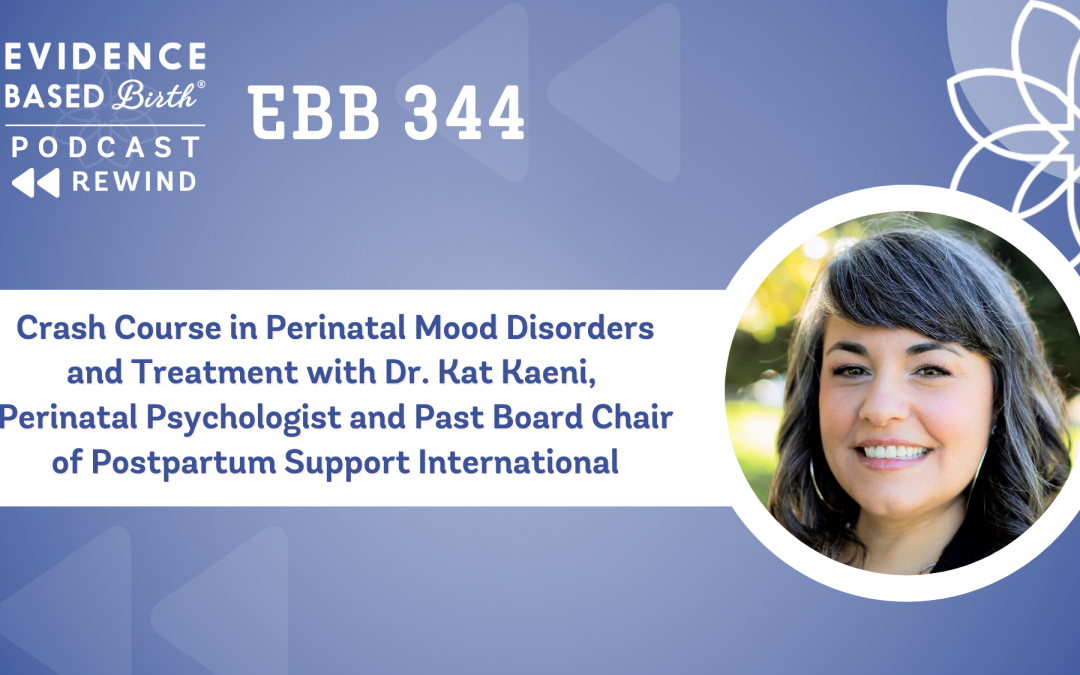
Perinatal mental health is often a misunderstood landscape shaped by stigma, cultural expectations, and invisible struggles that touch entire families.
In this replay episode, Dr. Rebecca Dekker sits down with Dr. Kat Kaeni, perinatal mental health certified psychologist, author of The Pregnancy Workbook, and host of the Mom & Mind podcast, to break the silence around postpartum anxiety, depression, OCD, and psychosis. Drawing on her professional expertise and personal experience, Dr. Kat reveals why shame and isolation are so common, how symptoms really show up for new parents, and what makes perinatal mental health distinct from other forms of mental illness.
They discuss the myths that keep parents suffering in silence, the real impact of mental health on babies and families, and how therapy and support groups, including free resources from Postpartum Support International, can empower families on the path to healing.
Content Warning: This episode includes discussions of perinatal mental health disorders, including postpartum depression, anxiety, OCD, and psychosis. Sensitive topics such as intrusive thoughts, stigma, feelings of guilt and shame, and the potential for harm to self or others are addressed. Listener discretion is advised, and we encourage anyone who may be affected by these topics to reach out for support through Postpartum Support International or a trusted healthcare provider.
Resources
For more information about Evidence Based Birth and a crash course on evidence based care, visit www.ebbirth.com. Follow us on Instagram and YouTube! Ready to learn more? Read Dr. Dekker’s book, “Babies Are Not Pizzas: They’re Born, Not Delivered!” If you want to get involved at EBB, join our Professional membership (scholarship options available) and get on the wait list for our EBB Instructor program. Find an EBB Instructor here, and click here to learn more about the EBB Childbirth Class.
Chapter Guide
Transcript
Dr. Rebecca Dekker – 00:00:00:
Hi everyone, on today’s podcast, we’re going to talk with Dr. Kat Kaeni about perinatal mental health disorders, treatment regimens, and resources. Welcome to the Evidence Based Birth® Podcast. My name is Rebecca Dekker, and I’m a nurse with my PhD and the founder of Evidence Based Birth®. Join me each week as we work together to get evidence-based information into the hands of families and professionals around the world. As a reminder, this information is not medical advice. See ebbirth.com/disclaimer for more details. Hi everyone, and welcome to today’s episode of the Evidence Based Birth® Podcast. Before I get started, just a reminder that registration for the 2025 EBB conference opens to the waitlist only today. If you didn’t get a chance to get on the waitlist yet, but you still want early access, so you can take advantage of the bonuses and exclusive ticket bundles before they sell out. Then go to the waitlist page on EBBirth.com/waitlist and signup to get the link to register sent to your inbox immediately. Also, I am excited to let you know that today’s podcast guest, Dr. Kat, is one of the featured speakers at the conference. You are not going to want to miss this event in March 2025 where we will journey together through the seasons of birth, and cover the evidence on topics ranging from fertility and pregnancy, through labor, birth, postpartum, and infancy. So again, go to EBBirth.com/waitlist. If you want to get started now with early registration for the EBB conference before some of our special ticket options go away.
And now I’d like to introduce our honored expert on today’s podcast, Katayune Kaeni, aka Dr. Kat, has her doctorate in psychology, is a perinatal mental health certified psychologist. Dr. Kat is the author of The Pregnancy Workbook: Manage Anxiety and Worry with CBT and Mindfulness Techniques. And since 2016, she has been the host of Mom and Mind, the longest running perinatal mental health podcast covering personal stories and expert interviews related to perinatal mental health. Dr. Kat is also the immediate past board chair of Postpartum Support International©. She began specializing in perinatal mental health after her own experience with postpartum depression, anxiety, and OCD more than 14 years ago. And Dr. Kat continues today to offer psychotherapy virtually to clients across California. We are so excited to have you here, welcome to the podcast.
Dr. Kat Kaeni – 00:01:37:
Thank you so much for having me. I’m just in awe of the work that you do and the resources that you provide for people. So I’m really glad to be able to contribute.
Dr. Rebecca Dekker – 00:01:47:
Well, same. I mean, the Mom and Mind podcast and also you work at Postpartum Support International© has been so impactful. So I was wondering if we could start off, you know, because I think storytelling is so important and tell us your own story about your journey with postpartum mental health conditions. And how did that shape your approach to treatment and everything that you do today?
Dr. Kat Kaeni – 00:02:12:
Yeah, thank you for that question. About 14 years ago, after the birth of my daughter, I experienced postpartum depression, anxiety, and OCD. And I was already in the field as a psychologist. I had been working for five years or so. I had heard about postpartum depression and that that was a thing that could happen to people. And it was like way, way in the back of my mind, like a worry for me. One of the pressures, I guess, at that time of being a psychologist and already working in the field is that I was supposed to be on top of things. Or so I thought. I knew something wasn’t right, but because there’s a really strong and inherent sense of shame and guilt around not being happy and joyful all the time, that felt very silencing. And I didn’t want anybody to know that I was actually suffering. I went for quite a long time in that state before, I kind of broke down and had to come to terms with things myself. You know, I give out these screening questionnaires all the time, the PHQ-9, which is a depression screening tool. And I decided to kind of give it to myself, really as honest as possible. And, you know, the kind of score, the screening score for it came back as moderate to severe depression. I kind of needed to just see the truth of it so that I could begin to go down the path of understanding what was going on and get to healing.
Dr. Rebecca Dekker – 00:03:45:
How did you find a place of healing? You know, did you get yourself into therapy? Did you seek out medication? Like what was, what ended up helping for you?
Dr. Kat Kaeni – 00:03:55:
Yeah, I did go back to therapy to get support from a therapist that I had been meeting with before. I thought I was depressed and I was talking to them about it and they said, I don’t think you’re depressed. And that was, that kind of shut me down. And I kind of withdrew a bit. There wasn’t any further questioning or anything like that. So I was meeting with somebody who didn’t know how to recognize a perinatal mental health condition. So I started to go other routes. I went to a naturopathic doctor to make sure my thyroid wasn’t okay. And I went to like an energy healer. And I tried all of these things that were outside of therapy and some were marginally helpful. What I know now is that I would have really greatly benefited from medication. But the shame and stigma, even for me as a psychologist who’s like… You know, very comfortable with supporting people using medication. It was shameful for me. Again, the pressure of thinking I should be able to figure this out because this is what I help people with. But I didn’t know. I actually don’t help people with this because I didn’t realize that perinatal mental health was its own specialty.
Dr. Rebecca Dekker – 00:05:11:
Tell us more about that stigma because you said that you felt shame. Is that still fairly ever present? And what does it look like?
Dr. Kat Kaeni – 00:05:21:
Unfortunately, there’s still quite a bit of shame and stigma. So there’s a lot that goes into the sense of shame and stigma. And I think for mental health in general, we haven’t as a culture society come to terms with like that this is very common, that people have mental health struggles, mental health diagnoses, and that kind of everybody’s dealing with something at some point. So that hasn’t been normalized for one, but especially when somebody is pregnant or postpartum, just had a baby, there’s an additional layer or layers of pressure are fueled basically by some myths of motherhood, essentially what it’s supposed to be like. You know, you’ve heard it. Oh, you’re glowing. Oh, this is what your body was meant to do. You should be so happy, you should be so grateful and there’s no space for anything. But these like, saccharine, very sweet and happy feelings. So when people are experiencing negative feelings, sadness, anxiety, or other things, they don’t feel comfortable sharing it because they don’t want to be judged. And for the more severe symptoms, they’re not sure how people are going to respond to them. They’re going to think I’m a bad mom, or I don’t know what I’m doing, or some sort of judgment will come from it. So all of that is very silencing. And contributes to the shame and further contributes to the stigma because it makes people not talk about it.
Dr. Rebecca Dekker – 00:06:52:
And then we have higher rates of untreated and undiagnosed perinatal mental health disorders as a result.
Dr. Kat Kaeni – 00:06:58:
For sure. It’s hard to estimate what those numbers actually are.
Dr. Rebecca Dekker – 00:07:03:
Because we don’t have accurate. Like recordings of it.
Dr. Kat Kaeni – 00:07:07:
We have those numbers, but I estimate, and other people believe that the numbers are much higher.
Dr. Rebecca Dekker – 00:07:13:
So can you give us an overview of the different types of perinatal mental health disorders? And like you mentioned that perinatal mental health is a specialty. So how might, you know, as you go through these things, if you could kind of point out how it might look different in pregnancy or postpartum.
Dr. Kat Kaeni – 00:07:28:
The same mental health conditions that happen to the general population, I suppose, can happen in the perinatal period as well. So depression, anxiety, OCD, PTSD, bipolar disorder, psychosis, panic disorder, people experience them in varying ways. In the postpartum period, about one in five women and also one in 10 men experience a postpartum depression. So the symptoms are the same. Like if you were to look in the DSM, the symptoms are the same. The onset times are different. The onset for a perinatal mental health condition is within the reproductive time. I should, the asterisk here, it’s not, that’s not all delineated in the DSM. So some of what I’m talking about is what’s known in the field, as opposed to like what has been quote unquote allowed or disallowed in the DSM as a-
Dr. Rebecca Dekker – 00:08:28:
And for people who don’t know what the DSM, can you just briefly explain?
Dr. Kat Kaeni – 00:08:31:
Oh sure, sorry about that. Diagnostic and statistical manual. So these are, this is the kind of book that we go to, to make a diagnosis. It includes symptom sets of certain, of all of the conditions. So when we’re looking to find out if somebody meets criteria for a diagnosis, like depression, the DSM has the symptom sets and onset times and stuff like that. So depression can, just like for everybody, can look like sadness and crying, feelings of guilt or shame, feelings of hopelessness, changes in sleeping and eating, loss of interest in doing things you used to enjoy doing, irritability and anger. Sleep disturbance. Severe symptoms can include thoughts of harm to yourself or to the baby. That is one of the ways it’s different in the perinatal period is that you’re experiencing depression while you’re probably a primary caregiver. You cannot care for yourself in the same way that you would if it was, quote unquote, just you. You’re always in relation and relationship to the baby. Be like, I’m not a good enough mom. I’m not doing a good job. This baby doesn’t like me. Those kinds of…
Dr. Rebecca Dekker – 00:09:56:
Or I’m not bonding with my baby.
Dr. Kat Kaeni – 00:09:57:
Correct. I’m not bonding. The way that it feels is so much more difficult because while you could, you know, if you’re just an adult who has depression, you might have some guilt around, you know, not hanging out with people as much anymore, whatever, your spouse, something like that. But this is a constant. You and the baby are around each other a lot of the time, if not all of the time. I’m supposed to be happy. I’m supposed to be loving this. That must mean I’m a bad mom, as an example. Also because of the inherent sleep deprivation, general mental health conditions, you might have a sleep disturbance. This is compacted pretty greatly because you’re not sleeping and it’s often a contributor to all of these.
Dr. Rebecca Dekker – 00:10:47:
We’re all not at our best when we haven’t had, you know, a couple, even a couple hours of sleep, you know, it’s makes everything seem worse and sadder. Yeah, more anger inducing or depressing.
Dr. Kat Kaeni – 00:11:04:
Absolutely.
Dr. Rebecca Dekker – 00:11:05:
So it makes sense how it could exacerbate or contribute to the depression. And then you mentioned the relationship with the baby. And it’s my understanding research shows that the caregiver’s depression impacts the baby as well. Is that true?
Dr. Kat Kaeni – 00:11:20:
Yes. Yes, it can. This is also where it gets challenging because if somebody’s already feeling depressed or anxious or whatever they’re feeling, they might already be feeling guilty that they’re having some impact on their baby. There’s also some cultural things, cultural-based understandings of like, you know, some cultures think you cannot cry in front of your baby because you’ll make your baby sad. In the more moderate to severe range of any of these conditions, it can impact the baby. It can impact attachment and bonding if they’re, you know, left crying or left unattended or just not being attended to in certain ways. And again, this isn’t every situation, every scenario, but that can happen.
Dr. Rebecca Dekker – 00:12:10:
And yeah, and I don’t say that to, I don’t want to increase the feelings of guilt or shame, but it’s more, I think it underscores the seriousness of undiagnosed and untreated perimental health disorders, because it’s like you said, obviously the postpartum person is critical and important. And then there’s other people that are going to be impacted as well. It doesn’t happen in isolation, but it impacts the whole family.
Dr. Kat Kaeni – 00:12:35:
Absolutely. It does. Yeah.
Dr. Rebecca Dekker – 00:12:37:
So can you explain a little bit more about postpartum anxiety and how that might look?
Dr. Kat Kaeni – 00:12:42:
Well, perinatal anxiety, whether pregnancy or postpartum, can occur in about 20%-ish of the population. And it can present on its own as just anxiety, but often comes together with depression. Anxiety can present as like a constant worry, like ever present worrying about, it could be just kind of everything, a generalized anxiety, a generalized worry, about many different things. Or it could be… a more specific focused concern or concern about a subset of things, like something bad is going to happen to you or to baby, or just in general, a feeling that something bad is going to happen. Anxiety can come with this, like a fidgety sense, like a difficulty being able to be still, feeling restless. You can also have sleep and eating disturbances. And you can experience physical symptoms like nausea or dizziness, hot flashes, sometimes heart palpitations. It comes with a vigilance and a hypervigilance. So like a constant looking out. Anxiety is very, it feels like a sense of fear and worry almost all the time. Not totally inescapable, but kind of ever present.
Dr. Rebecca Dekker – 00:14:01:
And how might those worries look different with perinatal anxiety?
Dr. Kat Kaeni – 00:14:06:
Right. So again, this is kind of about going back to the relationship is that the anxieties are often, not always, but often focused on the baby. So something bad, worrying about something bad happening to the baby. Like when a baby is crying, when somebody is kind of not anxious, they’ll be like, okay, I’m going to go attend to the baby. But somebody who’s anxious could feel like something’s wrong. And have a little bit of a harder time kind of regulating the intensity of response to things, especially if it brings up feelings of fear. When I had postpartum anxiety, I, something I’ve talked about before, but I was so worried that I wouldn’t hear her that I had the, she was in a co-sleeper right next to me. I was so worried I wouldn’t hear her. I had the baby monitor on next to my ear, even though I could literally touch her. It was that intense of like, I’m going to miss something.
Dr. Rebecca Dekker – 00:15:00:
And what about OCD perinatal? How does that look different than anxiety? Or do they have like the same symptoms?
Dr. Kat Kaeni – 00:15:08:
There’s some crossover, really high worry with both anxiety and OCD. You can have what’s called intrusive thoughts, which are, you know, thoughts that just kind of pop into your head. They could be kind of random or they could be connected to something that’s going on. It’s like it’s a very intense, visual, sometimes visceral thought that comes in. A common one is. What if I drop the baby? Even though they might still create anxiety for you, you’re not necessarily also developing a compulsion to manage that anxiety. So with OCD, you are having unwanted repetitive thoughts that feel obsessive. They feel kind of like that ever present. Worry about harm, worry about contamination, like cleanliness or your baby getting sick, not feel satisfied with checking once, you might have to check repeatedly, like to make sure your baby’s okay, that kind of a thing. Another common presentation is reassurance seeking. So asking everybody around you, is this okay? Did I turn that stove off? And again, in a way that’s not just asking once, it’s a repeatedly asking. We could characterize them as irrational or excessive. So the compulsion is meant to, calm the worry.
Dr. Rebecca Dekker – 00:16:29:
But it doesn’t really calm it.
Dr. Kat Kaeni – 00:16:30:
But it doesn’t really calm it. Right.
Dr. Rebecca Dekker – 00:16:32:
Yeah. When you’re talking about the anxiety and the OCD and even a little bit with the depression, it was making me think of how many parents I’ve met. And obviously, I don’t know if they have a diagnosis of anxiety, but they specifically have fears and anxieties about having anybody else provide care for their child. So they never leave the child’s side for like first year of the child’s life or other similar situations. And it seems like one of the treatments would be getting more support. But these conditions tend to make people be more isolated. Do you see that to be the case?
Dr. Kat Kaeni – 00:17:10:
Definitely. They’re avoiding having other people take care of their child. I’m going to generalize here. Because they either think that something bad will happen if they’re not on top of it all the time.
Dr. Rebecca Dekker – 00:17:23:
Or they might get their baby sick. From whoever takes care of them.
Dr. Kat Kaeni – 00:17:28:
Absolutely. Yeah, that happens a lot. They do need more support, but the anxiety makes it so getting the support is difficult or challenging and actually can… they can feel an increased sense of anxiety when they are having the help for some of the reasons you stated. That’s why getting support and therapy for this is so important because it’s one of the harder things as a therapist to support somebody with because trying to help somebody understand that their baby will be okay is… if somebody else is caring for them, their immediate response is, well, you don’t know that. How can you be sure?
Dr. Rebecca Dekker – 00:18:10:
It makes sense that people would have that fear, especially a first-time parent, because it’s like your first time of your life being so responsible for the life and well-being of such a tiny, fragile-seeming human. Parenting is a lot of vulnerability and losing control, but you have this urge to feel more control because you want to protect your child.
Dr. Kat Kaeni – 00:18:37:
Exactly. That’s exactly right. It’s so hard. It’s so hard.
Dr. Rebecca Dekker – 00:18:43:
And then with depression, it seems like with the not wanting to engage in your normal activities, you might become more and more isolated.
Dr. Kat Kaeni – 00:18:50:
There’s a lot of isolation and loneliness. There already is in the early postpartum. You know, maybe you have some help for the first couple of weeks, maybe. Then everybody leaves, goes back to work. And then there you are by yourself trying to figure it out. And if you have a diagnosed or underlying or developing mental health condition, then that could be kind of some fuel that increases your symptoms.
Dr. Rebecca Dekker – 00:19:19:
Can you explain a little bit about the baby blues and how that differs from postpartum depression specifically? And how do you know if it’s just a temporary transient baby blue thing that will go away on its own, versus something more serious?
Dr. Kat Kaeni – 00:19:36:
Great question. So the baby blues occur in about 80% of postpartum.
Dr. Rebecca Dekker – 00:19:42:
Okay, so that’s almost everybody.
Dr. Kat Kaeni – 00:19:44:
That’s almost everybody, right.
Dr. Rebecca Dekker – 00:19:45:
Okay.
Dr. Kat Kaeni – 00:19:45:
So the baby blues is around a two-ish week period of time after birth where you might have some tearfulness, some sadness, maybe some worry. So you’re not quite feeling like yourself. It really feels like you’re in a transition. You don’t, you know, you’re trying to find your feet. You’re trying to figure out what’s what. So there could be some mood changes, but they’re typically not intense. Let’s say if you’ve had PMS and it’s kind of like a mildly bad PMS where you have some tearfulness and whatnot, but you kind of know it’s going to go away.
Dr. Rebecca Dekker – 00:20:18:
You know it’s going to go away and you, and it kind of, that feelings come and ebb and flow.
Dr. Kat Kaeni – 00:20:23:
Right. And during that time, you can access happiness. You can access joy. Just might not be all the time. You could have some mood fluctuation. However, if during that two-week period of time, your symptoms are very intense or you’re not able to, you know, access any of that joy or happiness. If your symptoms feel more than kind of mild, then you might be looking at something like a perinatal mental health condition. These conditions can have an onset anytime during the first year postpartum. It doesn’t have to be that you’re experiencing them right in the first couple of months after birth. There are a lot of changes that happen that can contribute to a perinatal mental health condition developing a little bit later, or at least noticing it later. If you have sensitivity to hormone changes and you restart your period, that could stoke a perinatal mental health condition. If you’re changing breastfeeding, going from nursing to not nursing, especially if it’s like a sharp cutoff, you could have an experience of hormonal fluctuations. And for people who don’t get treatment and support, those symptoms can continue and even peak at around four years postpartum.
Dr. Rebecca Dekker – 00:21:40:
And then you mentioned a couple others that are less common, but I was wondering if you could just briefly define some of them like postpartum psychosis and rage. Like, how often do you see that and what would those symptoms look like?
Dr. Kat Kaeni – 00:21:53:
In terms of rage, rage can come with depression and come with anxiety as well. It often comes with… the more sleep deprived somebody is, the more ragey they can feel. It can also come with PTSD. Around 50% of people who have a bipolar disorder are first diagnosed in postpartum.
Dr. Rebecca Dekker – 00:22:12:
Oh, wow.
Dr. Kat Kaeni – 00:22:13:
Yeah. It’s a huge number. Postpartum psychosis was historically considered rare, but we know that it’s not actually rare. It happens. And what I mean by that is one to two out of a thousand… deliveries, somebody can experience a postpartum psychosis. That’s less than one in five for sure. But especially people who’ve experienced postpartum psychosis have specifically talked about, please don’t call it rare because it makes people then not consider that that’s what’s happening. It’s so important to be able to recognize if it’s happening and when it’s happening because postpartum psychosis is an emergency. It needs to be attended to right away, as soon as possible. They can be experiencing hallucinations, seeing things that, you know, that aren’t there. They could be experiencing like flat affect, meaning like it looks like they have no feelings. There’s typically a decreased need for sleep or no sleep. So when I say decreased need for sleep, that’s different than not being able to sleep. They can be experiencing paranoia, rapid mood swings, difficulty concentrating. The symptoms can wax and wane. So somebody could be in a state of psychotic type state for a period of time and then go out of it and feel like their normal selves. And then go back into it. That’s not the case for everyone. Sometimes it starts and goes. While this is a condition that can also start later on postpartum, most of these symptoms start within the first couple of weeks, three weeks or so. Again, that’s not everybody. Sometimes it can start later for other reasons. This is a departure from themselves. They are not themselves, not feeling like themselves, not behaving like themselves. They might be saying things that sound strange. And what’s challenging here too is that partners or family members might be like trying to make sense of what they’re saying and like make connections like, oh, maybe she meant that. And then miss the signs or symptoms that something’s happening for her.
Dr. Rebecca Dekker – 00:24:36:
When you say it’s a mental health emergency, does that mean you call 911, you go to the emergency room? Like, what do you mean by that?
Dr. Kat Kaeni – 00:24:44:
Yes, sometimes 911 is needed depending on the state of the person. I would say that’s not my first call. First, I would take them to the hospital. If somebody is in a psychotic state and you tell them I’m taking you to the emergency room. They might not want to go. It’s overwhelming for them and they’re not able to like grasp on to what you and I would be calling reality at that time. You know, people have to say like, oh, we’re going to go visit your mom and then actually be going, but we’re going to stop off here real quick to do X, Y, or Z. People have to kind of use creativity to get their loved one to safety. And if they can’t, then of course, 911. They can be at a risk of harming themselves because they’re not. In the, like I said before, the same reality that we are in. They’re hearing things and seeing things that might be telling them to do things. And related to this, out of that one to two in a thousand, four to five percent of that one to two in a thousand end up harming their children or there could be infanticide. That’s part of the reason why it is such an emergency, too. Even though out of that one to two in a thousand, that’s a very small percentage, it is still a risk. We don’t know what’s going on for us on the outside, I should say. We don’t know what’s happening for them internally, what they’re responding to. So getting them to safety is so important.
Dr. Rebecca Dekker – 00:26:14:
Thank you for sharing that information about how to handle that emergency. You know, it’s very scary. Everybody take some deep breaths. It just makes you realize how much of this must be chemical in the brain. You know, it’s not like people are choosing to have these conditions.
Dr. Kat Kaeni – 00:26:31:
No, no, no, not at all. The four to five percent of that one to two in a thousand is the the more rare outcome, but as it is devastating. But even for people who’s… mental state didn’t go to that place or reach that level, it is still devastating for them. They are losing time. They sometimes don’t have memories of that chunk of time with their baby. So they are often having like a secondary, if they’re in the healing process. Finding out either what happened while they were in that state. They could be experiencing trauma.
Dr. Rebecca Dekker – 00:27:08:
Yeah, for the partner too, I can imagine.
Dr. Kat Kaeni – 00:27:11:
Yeah, definitely, definitely.
Dr. Rebecca Dekker – 00:27:12:
Let’s start with non-medication strategies first for helping manage perinatal mental health disorders. And so in your book, The Pregnancy Workbook, you’re talking about Cognitive Behavioral Therapy and mindful techniques. And I know from my training in my PhD, I studied a lot in Cognitive Behavioral Therapy. I got to go to the Beck Institute to learn how to do it and the research. Yeah. I mean, there are just decades and decades of research on the effectiveness of it. So can you talk a little bit about how some of these exercises or strategies that are part of Cognitive Behavioral Therapy, how that can help someone either during pregnancy or postpartum?
Dr. Kat Kaeni – 00:27:53:
So when somebody is experiencing depression, anxiety, or any of those conditions that we’re talking about, not necessarily bipolar disorder or psychosis, thoughts or behaviors and our actions are connected. And when we’re depressed or anxious, those thoughts and behaviors and feelings can be distorted. That’s just what depression and anxiety do to our thought processes. They distort them, typically make them more judgmental. Typically make them more negative. So when we’re using a cognitive behavioral strategy, we’re looking at, okay, what’s happening with your thoughts and your feelings and the behaviors that you’re having. So for instance, a thought could be I should be happy. A should is a cognitive distortion.
Dr. Rebecca Dekker – 00:28:45:
It’s like a judgment.
Dr. Kat Kaeni – 00:28:47:
It’s a judgment. Yeah.
Dr. Rebecca Dekker – 00:28:48:
Yeah.
Dr. Kat Kaeni – 00:28:48:
Yeah. So if you’re telling yourself, I should be happy, that’s a thought. Well, what’s happening to your feelings then? Maybe you’re starting to feel like… sad or guilty because you have that thought. Worthless.
Dr. Rebecca Dekker – 00:29:01:
Yeah.
Dr. Kat Kaeni – 00:29:02:
And behaviorally, you could be doing any number of things. It could just, you could launch into crying, which is common, or you could be doing things like trying to manage your feelings by, let’s say, like eating or cleaning or doing something that is in response to the feelings and thoughts. Typically, the behavior doesn’t make you feel better. Like, let’s say you go for like, you know, eating a bowl of ice cream and then you have like guilt about that. Like, now I’m eating ice cream and I shouldn’t be doing that. Or just as an example. So what we’re trying to do with cognitive behavioral therapy is first notice that that is happening, that we’re in a pattern, that we’re using a cognitive distortion, like I should be happy. Meaning it’s not some fundamental truth about you. It is related to the anxiety or the depression that you’re feeling. And the anxiety and the depression is what is making your thought process more negative. Then we go to offering ourselves an alternative thought. Like, maybe I’m not a bad mom. Even if you can’t find something positive to say about yourself, you can find something neutral. You can tell yourself it’s okay to not be happy all of the time. And to give yourself a little bit of permission, a little room to have more than just one set of feelings. So what’s challenging about our thought processes is that they are so fast. It just happens like lightning fast. You go down the spiral of negative thought process very quickly. So if you do this exercise, you label, you notice, you label, and you offer yourself an alternative. Two seconds later, you could have the same thought again. So it’s not like… magic wand. It’s something that you have to practice over and over, recognizing that you’re having the thought and offering yourself a positive or neutral alternative.
Dr. Rebecca Dekker – 00:31:01:
I think it’s important though, that a lot of the power in it is recognizing that you’re having it. Because a lot of people, when they’re depressed or anxious, they notice the feelings, like maybe a sinking feeling. Or a feeling of worthlessness, and they don’t know where it came from. But if you stopped and asked yourself, in this moment, what am I thinking about? They’ll say, I was just thinking how I’m never going to have my life back, you know, or something really sad. And that’s what gave you that sinking or worthless feeling. And it’s almost like you don’t even know that you were having that thought. So it kind of forces you to pause and recognize the effect your thinking is having on your symptoms.
Dr. Kat Kaeni – 00:31:43:
Absolutely. It’s, yeah, those thoughts are super sneaky. And especially with-
Dr. Rebecca Dekker – 00:31:48:
You’re fleeting, and you don’t even know you’re having them sometimes.
Dr. Kat Kaeni – 00:31:50:
Yeah, and very exactly. And then you feel all those bad feelings.
Dr. Rebecca Dekker – 00:31:55:
Cognitive behavioral therapy is really focused on changing your thoughts and also some of your behaviors too, right? So what are some behaviors somebody might be doing as part of their Cognitive Behavioral Therapy if they’re dealing with, let’s say, depression after their baby is born?
Dr. Kat Kaeni – 00:32:10:
Depression tends to feel really heavy and makes people sort of feel like they’re moving through molasses or even kind of stuck, not being able to do things. So behaviorally, when you feel that way, you feel worse. Giving yourself an activity that you can do that sort of forces you out of that molasses that you’re in, that like slogging through the day. So that could be something as simple as like walking around the block. Just one thing that it alters from your normal pattern in the day. That can help boost you a little bit. It could be going outside and doing some deep breathing in fresh air. It doesn’t have to be super intense. You can start small.
Dr. Rebecca Dekker – 00:33:03:
How does somebody know when they need to either combine therapy with medications or go straight to medication treatment?
Dr. Kat Kaeni – 00:33:12:
The intensity and duration of symptoms is mostly what we’re looking at. Symptoms that are in the mildish range, therapy can be enough. Sometimes people want medication and that’s fine too. Your symptoms are impacting your functioning. Like you can’t shower. Or it’s hard to get up out of bed. You can’t sit still. Those kinds of things that where you’re functioning throughout the day is really impacted to the point where you just, you can’t get through the day like you want to or need to. Then we can consider medication as an option. So that would be the intensity part. Duration is if you’re experiencing symptoms for two weeks or more. And it doesn’t feel like they’re waning, it doesn’t feel like they’re going away, it feels like they’re there kind of to stay, that feeling of it, or that they’re worsening, then it’s worthwhile to talk to a psychiatrist or sometimes some primary care doctors are also able to prescribe.
Dr. Rebecca Dekker – 00:34:13:
And what are some of the common barriers that parents face when they’re seeking either therapy or medication or both.
Dr. Kat Kaeni – 00:34:22:
Well, one is availability of therapists. In the perinatal mental health field, you know, there are more and more people getting trained to be a specialist, but still there are not enough. We welcome anybody who wants to specialize to come and help, not all therapists take insurance or take all insurances. So for people who need to use their insurance to get therapy, that can be a barrier.
Dr. Rebecca Dekker – 00:34:49:
I was going to say, I think there was a big The New York Times article about this problem about how more and more therapists are not taking any insurance because the insurance is just not paying them. And they’re facing all these barriers to receiving payment. And that’s decreasing the number of therapists that therapy is kind of only being reserved for. People who can’t afford to private pay, which is not equitable. And that misses a whole bunch of parents.
Dr. Kat Kaeni – 00:35:17:
It’s a huge problem. It’s a massive systemic issue that is clearly affecting clients and patients and also the care providers.
Dr. Rebecca Dekker – 00:35:27:
Yeah. The therapists who want to provide care, but can’t. And then as you mentioned earlier, not every therapist is a specialist in perinatal mental disorders.
Dr. Kat Kaeni – 00:35:38:
That’s right.
Dr. Rebecca Dekker – 00:35:39:
Yeah.
Dr. Kat Kaeni – 00:35:40:
Yeah. So, I mean, if you can’t find a specialist going to a therapist who at least, if they’re not a specialist who you feel like is listening to you. And can support you and learn along the way, that’s important. So with psychiatrists, it’s an even harder challenge to get to somebody in a timely manner. The wait lists are very far out. There’s a shortage of psychiatrists.
Dr. Rebecca Dekker – 00:36:05:
And this might be why if something is more urgent, it’s better just to go seek treatment at a hospital rather than, you know, have to get on a waiting list for three or six months to see somebody.
Dr. Kat Kaeni – 00:36:18:
Yeah. primary care doctors are more and more able to prescribe for non-complicated conditions, like depression and anxiety. So you can go to a primary care. And Postpartum Support International© has a psychiatric consult line where any provider who’s a prescriber can call in and get a free consultation on medication.
Dr. Rebecca Dekker – 00:36:40:
Okay. Wow. That’s incredible. Thank you for sharing that. And speaking of that, Postpartum Support International©, can you, with the time we have left, share with us some of the best resources there that people can access?
Dr. Kat Kaeni – 00:36:56:
Yes, they have some fantastic resources, which also supports people in this gap of time where they can’t get to see a therapist. They have a ton of free online support groups, like a lot, a lot. People are so helped and supported by the support groups, being able to hear other people who are experiencing something similar to them to know that it’s not just them. There are other people who are at different stages of healing through this. Those are very powerful. PSA also has a peer mentor program. So if like groups aren’t your thing and you need a one-on-one, they’ll pair you with somebody who has been through something similar to you and you’re like buddies. They can support you through a period of time. I mentioned the psychiatric consult line. That is there for sure. And there’s also a helpline where people can call in and find somebody who’s local to them to help them get connected to resources in their area. We have volunteer coordinators all over the place, hundreds of people who are there and waiting to help you find resources in your local area.
Dr. Rebecca Dekker – 00:38:13:
Yeah, and I want to encourage everyone who’s listening to go to postpartum.net and see some of their new and pre-existing resources. And right when you land on the page, it has all the phone numbers for the helpline in Spanish or English and crisis lines you can call that are run outside of Postpartum Support International© as well. It’s really fascinating that they have, you know, that consult call that you mentioned, there’s lots of different support groups for different ethnic diversities as well. So check that out. And Dr. Kat, we’re so thankful you came to kind of give us this introduction to the field of perinatal mental health. And I want to encourage everyone to check out the Mom and Mind podcast. You can find you at wellmindperinatal.com. Is there anything else you want to share with us before we go?
Dr. Kat Kaeni – 00:39:04:
Anybody who’s listening, if you feel like you might be experiencing some of the stuff we talked about, there is help available. You do not have to figure this out on your own. Just please reach out. And get back to feeling like you want to feel.
Dr. Rebecca Dekker – 00:39:20:
Yes. Thanks everyone for listening. And again, the Postpartum Support International© at postpartum.net. And you can also check out our podcast about addressing perinatal mental health for communities of color at episode 197. That is led by the Perinatal Mental Health Alliance for People of Color. So thanks everyone for listening and for educating yourself on this very important topic. I’ll see you next week. Bye. Today’s podcast episode was brought to you by the online workshops for birth professionals taught by evidence-based birth instructors. We have an amazing group of EBB Instructors from around the world who can provide you with live, interactive, continuing education workshops that are fully online. We designed Savvy Birth Pro workshops to help birth professionals who are feeling stressed by the limitations of the healthcare system. Our instructors also teach the popular Comfort Measures for Birth Professionals and Labor and Delivery Nurses workshop. If you are a nurse or birth professional who wants instruction in massage, upright birthing positions, acupressure for pain relief, and more, you will love the Comfort Measures workshop. Visit ebbirth.com/events to find a list of upcoming online workshops.
 Listening to this podcast is an Australian College of Midwives CPD Recognised Activity.

Get Empowered! Learn more…
REPLAY: EBB 217 – Disability Justice in Birth and Parenting with Stefanie Lyn Kaufman-Mthimkhulu
Don't miss an episode! Subscribe to our podcast and leave a review! iTunes | Spotify | YouTube Ableism shapes birth, parenting, and even the ways our society values whose lives matter. In this replay episode, Dr. Rebecca Dekker talks about disability justice in...
EBB 414 – Evidence on Natural Labor Induction: Acupuncture, Acupressure, and Breast Stimulation
Don't miss an episode! Subscribe to our podcast and leave a review! iTunes | Spotify | YouTube Acupuncture, acupressure, and breast stimulation are popular natural labor induction methods, but what does the latest research tell us about how well they actually...
EBB 413 – Evidence on Migraines and Pregnancy: Frequency, Prevention, and Comfort Measures
Don't miss an episode! Subscribe to our podcast and leave a review! iTunes | Spotify | YouTube Migraines during pregnancy can be debilitating, and figuring out how to prevent or manage them can be especially challenging. In this episode, Dr. Rebecca Dekker...