


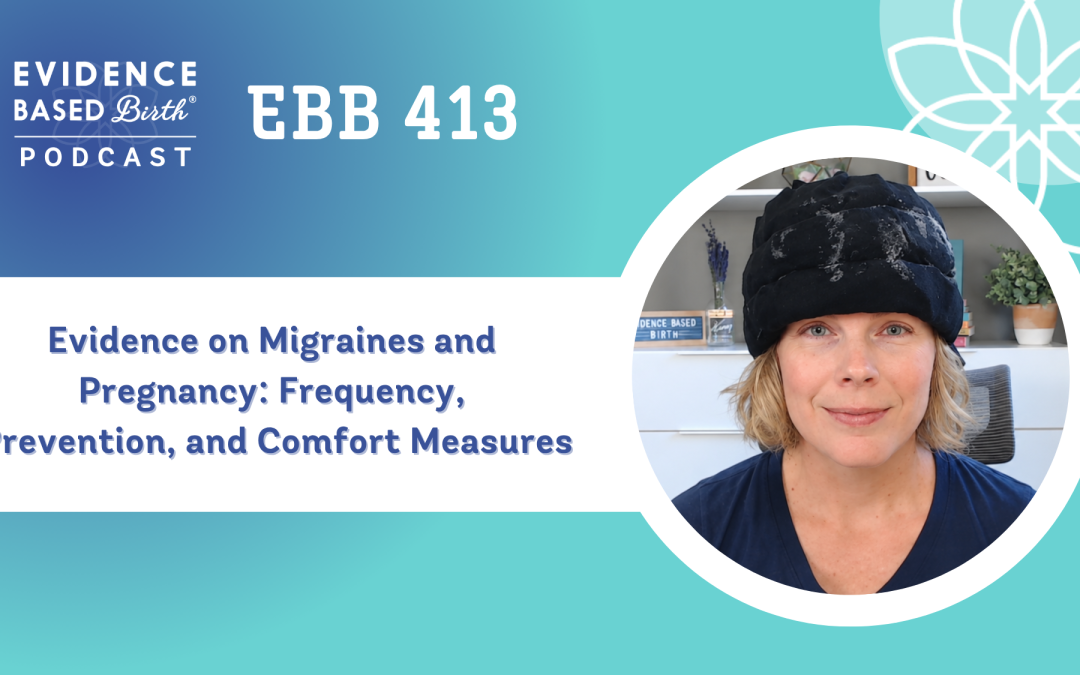
Migraines during pregnancy can be debilitating, and figuring out how to prevent or manage them can be especially challenging. In this episode, Dr. Rebecca Dekker explores the research on migraines during pregnancy, including why they happen, how pregnancy can affect migraine patterns, and why new or changing headaches should be taken seriously. Rebecca also discusses migraine triggers, medication overuse or “rebound” headaches, and strategies for prevention. Plus, drawing from both the research and her own lifelong experience with migraines, Rebecca shares non-pharmacological comfort measures for coping with migraine pain, from hydration and body work to temperature therapy, acupressure, mindfulness, and more.
Resources
Postpartum Support International: https://postpartum.net/
Call 988 for the Suicide Crisis and Lifeline: https://988lifeline.org/
Hear Her campaign with list of maternal warning signs: https://www.cdc.gov/hearher/maternal-warning-signs/index.html
American Headache Society: https://americanheadachesociety.org/
The Headache Hat: https://theheadachehat.com/
Acupressure points for headaches in pregnancy: https://www.youtube.com/watch?v=LNbXWKStr-4
Aculief acupressure device (NOT recommended for pregnancy unless you’ve reached term, as it may cause contractions): https://finance.yahoo.com/news/aculief-reviews-does-migraine-relief-045700296.html
S-shaped massage hook: https://www.bodyback.com/products/body-back-buddy-classic-trigger-point-therapy-self-massage-tool-body-back-company
Renpho eye massager: https://renpho.com/collections/eye-massager
References
For more information about Evidence Based Birth and a crash course on evidence based care, visit www.ebbirth.com. Follow us on Instagram and YouTube! Ready to learn more? Grab an EBB Podcast Listening Guide or read Dr. Dekker’s book, “Babies Are Not Pizzas: They’re Born, Not Delivered!” If you want to get involved at EBB, join our Professional membership (scholarship options available) and get on the wait list for our EBB Instructor program. Find an EBB Instructor here, and click here to learn more about the EBB Childbirth Class.
Chapter Guide
(11:39) Migraines during pregnancy and postpartum
(14:54) When headaches may signal a more serious condition
(23:56) Preventing migraines during pregnancy
(24:32) Medication overuse and rebound headaches
(30:52) Migraine triggers and thresholds
(34:22) Non-medication strategies for migraine prevention
(46:05) Comfort measures for an active migraine
(59:09) Final encouragement, support, and resources
Transcript
Dr. Rebecca Dekker – 00:00:00:
Hi everyone. On today’s podcast, we’re going to talk about the evidence on comfort measures for migraines during pregnancy. Welcome to the Evidence Based Birth Podcast. My name is Rebecca Dekker, and I’m a nurse with my PhD and the founder of Evidence Based Birth. Join me each week as we work together to get evidence-based information into the hands of families and professionals around the world. As a reminder, this information is not medical advice. See ebbirth.com/disclaimer for more details. Hi everyone and welcome to today’s episode of the Evidence Based Birth Podcast. Today we’re going to talk about a subject that is personal to me and so many of you and that is how to cope with migraines during pregnancy. And for those of you who work in healthcare or birth work and might experience migraines as well outside of pregnancy, you might find this info helpful to you. And if you’re listening on our audio podcast, I recommend that you also might want to check out our YouTube channel at Evidence-Based Birth because we have a full video of this episode where I’m also going to share a basket full of some of my favorite comfort measures for headaches. So on today’s episode, we’re going to talk about three main issues. First, how common are migraines during pregnancy and what are the challenges with treating them? Second, we’ll talk about prevention of migraine headaches. And third, we’ll talk about non-pharmacological comfort measures.
A few notes from me before we get started with the content for this episode. First of all, migraine in pregnancy is understudied. So some of the comfort measures I’m going to talk about do not have a lot of research on or sometimes very little research, or maybe they’ve been studied in the non-pregnant population. And in general, I’ll try to disclose that when I talk about each comfort measure. Also, this episode was difficult for me to put together. It affects me personally, and it actually was quite hard for me to sit down and write this episode and film it because it has been a challenging journey for me. I’ve had migraine headaches since I was six years old, and they’ve gotten better in the last 10 years. But when they still happen occasionally, it is still life-altering for me. It’s not easy to live with migraine headaches, and my heart goes out to those of you who also experience these. Some of you may not have ever experienced a migraine headache, and hopefully this episode will give you a little bit of a glimpse into maybe what it’s like and what are some ways you can be helpful to someone who experiences migraines. This episode is not meant to be an exhaustive list on the research on migraines and migraine treatment. I decided not to focus on medications for several reasons, at least in today’s podcast.
First of all, whether or not you take medications and which medications you take in pregnancy or while you’re lactating, that’s a very personalized decision-making process that should be made in conjunction with a healthcare provider. There are basic guidelines on medications, but there is limited research and mixed research findings. Also, research has been changing a lot on medications you can take for migraine and pregnancy, and the guidelines on medications tend to differ depending on whether you’re pregnant, which trimester you’re in, and other factors, such as if you’re postpartum or if you are using your own milk to feed your baby. So I really encourage you to talk with a healthcare provider about medications, whether you want to take them for preventive reasons or to treat an acute headache in pregnancy or postpartum. However, although I’m not going to talk about individual medications, I am going to talk a little bit about medication rebound headaches, also known as medication overuse headaches. That is something I have learned a lot about over the years, and there’s a lack of awareness in the general public about that topic. Also, I’m going to talk more about this in a few minutes, but there are some serious health conditions that can mimic a migraine, which can make it difficult to discuss migraine therapy. Please note that the info in this podcast is for informational purposes. It is not a substitute for an evaluation with your healthcare provider, and please see and talk with a trained healthcare provider about any headaches you may be experiencing during pregnancy, especially headaches you may be experiencing in the third trimester or postpartum, as headaches can sometimes be mistaken for migraines when they can be a sign of a more serious, life-threatening health condition.
Dr. Rebecca Dekker – 00:04:29:
So let’s get started with our first part of this podcast, and that is to talk about what are migraines and how common are they in pregnancy. So a migraine is a genetically influenced, complex neurological problem that features episodes of moderate to severe head pain. It’s typically pulsating and one-sided, although it can sometimes be both sides of the head or a stabbing pain. It’s frequently accompanied by nausea and a heightened sensitivity to light and sound. Migraine episodes can last hours to up to three days, for some people even longer, and they can significantly impact your daily activities and quality of life. Most people experience migraines without an aura, but about 25% of people with migraines experience something called an aura. When an aura happens with a migraine, it generally comes on gradually and it’s temporary. It’s usually only lasting a few minutes, but it could be completely reversed within 60 minutes. The most important point is it should be completely reversible if it’s an aura. The symptoms of an aura are primarily visual, such as seeing spots or bright lines or shapes, but an aura can also involve your other senses, such as feeling tingly on one side of the face or on your limbs, ringing in your ears, or other sensations. When someone’s experiencing migraine, they may often seek a dark place and need to lay down or sleep in order to help resolve symptoms. They may need other interventions as well, such as medications or other comfort measures. Many people with migraine may experience prodromal symptoms or symptoms that preceded the headache the day or so before. This could include neck soreness or a sensitivity to light or sound. And then after the migraine is over, most people also experience a postdrome symptoms or symptoms that continue after the headache pain is gone. They should resolve within about 24 hours, but those postdromal symptoms may include fatigue, sleepiness, difficulty concentrating or feeling foggy, and dizziness. I know that migraines have a strong genetic and family history component, and there’s also a strong relationship with female sex hormones, which we’ll talk more about in a minute. Doctors used to teach that migraines were caused by vasodilation in your head, but we now know that this is incorrect information.
Instead, the pathophysiology of a migraine includes something called a cortical spreading depression or CSD, which is basically a wave through the brain of depolarization, which is a change of the charge in the nerve cells, which then impacts the trigeminal nerve or the nerve that feeds the face, as well as other aspects throughout the brain. Migraines also include an inflammatory component in the brain and the head and the neck and activation of nociceptors or the receptors that sense pain. There are neuropeptides such as serotonin, something called CGRP and also PACAP that are thought to be involved in the pathophysiology of a migraine as it’s occurring. This was a very simplified explanation of a complex topic, but I think the most important point to know about the physiology or the pathophysiology of a migraine is that this is a real phenomenon. It’s not something that people are making up. There are actual changes in your brain and the nerves that impact your face and your head and your neck. And it’s also helpful to know that the earlier in this wave of a migraine, the cortical spreading depression, the earlier that you intervene, whether in the prodromal phase or early in the aura or migraine phase, the easier it is to stop or lessen the progression of that episode. Some people might say, I never get migraines and I’m so happy for you. But really anyone could get a migraine if they experienced a strong enough trigger. For example, let’s say you never experienced migraines, but if you were deprived of sleep for three days and three nights and made to look at bright lights and listen to loud music the whole time, and you weren’t allowed to eat or drink, you would probably have a migraine from that. People who say they never get migraines, likely for genetic or hormonal reasons, have a high threshold for experiencing them, meaning that it would take a ton of triggers for the brain to initiate a migraine episode. But people who suffer more regularly from migraines tend to have what we call a lower threshold for cortical spreading depression. So it takes less of a trigger to initiate that migraine episode. We’ll talk more about triggers and threshold later on in this episode.
Interestingly, migraine is much more common in women than men, with about three women having migraines for every one man who has migraines. Migraines also have a different clinical profile in women. Migraines in women tend to be much more severe, last longer, have more symptoms, lead to a higher rate of migraine-related disability, have a higher burden of other illnesses, such as pregnancy-related conditions we’re going to talk about later. And migraines for women tend to get worse as you age, at least up until after menopause, after which they tend to decline. So why do women have more migraines? It’s thought that the female reproductive hormones increase the risk greatly. One of the main reasons we know this is that migraines tend to often initiate or increase at around the time of female puberty. It’s thought that experiencing migraines during puberty can have a permanent effect on the nervous system and that you kind of create these pathways in your brain for this cortical spreading depression to occur. And then as you continue to live life as someone with female reproductive hormones, those circulating hormones and the fluctuations you experience also increase the risk of having migraine episodes. There is a ton of research that shows that migraines are much more common during your period, right before your period, during it, and for a few days afterwards. And we have research showing that those menstrual migraines or migraines that happen in relation to a period tend to be more severe, have worse symptoms, and last longer than migraines that are not related to your period. On a different note, women are also more likely to have higher levels of life stress due to adverse childhood experiences and intimate partner violence, which are also known risk factors for migraines. If you’re listening to this and you’re a healthcare worker or a birth worker, I think it’s important for you to know that half of all women will experience a migraine in their life. And about 21 to 28% of women of reproductive age experience migraine episodes in a given year. So because it’s so common, it’s probably going to be pretty common among birth workers and healthcare workers, as well as pregnant people. So hopefully this information will be helpful to any of you who might fall into that category and are at risk for experiencing migraines.
Dr. Rebecca Dekker – 00:11:39:
If we dial down a bit more into what’s happening in pregnancy, if you have a history of migraines before pregnancy, there’s about an 80% chance that you will have migraine episodes at some point in pregnancy. About 20% of all pregnant people experience a migraine during pregnancy. And migraines tend to peak in the first trimester. About half of all women who experience migraines report improvement of migraines by the 12th week of pregnancy and 80% are improved by the end of the second trimester. So it’s great news for most people who experience migraines that by the third trimester, you should mostly be pain-free, but there still are a significant percentage of women, about 20%, who may continue to experience migraines throughout most of the rest of their pregnancy. So why are migraines impacted by pregnancy and postpartum? Well, we’ve already talked about how reproductive female hormones are, you know, greatly intertwined with migraines, although not for everyone because some people with female reproductive hormones don’t experience migraines. But in pregnancy with someone who’s experiencing migraines, there are hormonal shifts happening all throughout pregnancy. So it’s thought that the rising estrogen levels lower your threshold for that cortical spreading depression. So it makes you more susceptible to triggers. Something lesser could trigger a migraine, whereas before you were pregnant, maybe it would have taken a bigger trigger for a migraine to happen. Also postpartum, it’s common to have migraines, especially in the first month after giving birth. However, sometimes these headaches in pregnancy and postpartum can be related to more serious and potentially life-threatening health conditions, which I’ll get to in just a few minutes. A less commonly discussed reason for migraines in pregnancy and postpartum is the shift in your posture and stressors of that load of pregnancy on your body that they put pressure and stress on various nerves and muscles. Have a podcast episode with a chiropractor, Dr. Lisa Vawter EBB 331 about how the changes in your neck and back and shoulders and pelvis and hips in pregnancy can lead to headaches. Dr. Vawter explains in her interview that there is a first trimester increase in the hormone known as relaxin. So this hormone is a part of what helps your body shift and prepare to carry a growing fetus. So in addition to estrogen changes and other hormonal changes, there are a variety of shifts that are happening in your body that can contribute to headaches and migraine. And another resource I would recommend for learning about body mechanics and migraines and how this is impacted by pregnancy, there is a physical therapist, Dr. Jono Tates. He’s a headache specialist. He runs a podcast called The Headache Doctor and he has a website and social media page called the noveraheadachecenter.com. And he posts a lot of really helpful videos just explaining the physiology of how the neck and back and everything interacts in pregnancy with headaches. So if you want to learn more about that, I highly recommend following his work.
Dr. Rebecca Dekker – 00:14:54:
Here’s the problem. When I talk about migraines and one of the reasons I was nervous to do this episode is because it can be difficult to distinguish between a regular run-of-the-mill migraine and a secondary headache, meaning it’s secondary to something else that is often a more serious condition. So there was one study that looked at 140 pregnant women who came to an emergency room or labor and delivery triage unit in New York City for evaluation of a headache during pregnancy. Most of the women in the study were African American or Latina. And in this study, they found that in the end, 59% were diagnosed with a migraine and 6% had a tension type headache. But one third were experiencing a secondary headache due to another serious condition, including 18% who had a hypertensive disorder and headache was the symptom that brought them in. Most commonly, preeclampsia was the disorder, but there were several cases of HELLP disorder in that group as well, which is an immediately life-threatening condition. And there were other more rare causes of headaches in the study of pregnant women, including infection, pituitary gland tumor, and intracranial hemorrhage or a brain bleed. Also, a stroke is a rare but serious condition that can cause a severe headache along with other neurological symptoms. So you can see how you might get that confused with migraine with aura, which also has neurological symptoms. So, pregnant women with secondary headache, when someone comes in and it’s a headache due to another condition, they’re more likely to lack a history of headaches. So they’re the type of people that don’t normally get a headache. However, some women who have a history of chronic headaches or chronic migraines. Also end up with these secondary headaches due to another more serious condition. So this is why it’s really important that you keep your healthcare provider aware of what’s going on if you’re experiencing headaches. Some established red flags in the literature when you’re talking about headache diagnoses in pregnancy include signs and symptoms like seizure, high blood pressure, fever, and an abnormal neurological exam. And also some other red flags include if your acute headache attack differs from your previous pattern, if it feels different than your normal headaches. The most common differences are a longer duration of the headache episode, presence of having an aura when you never had an aura before, an increase in the severity, the typical severity of your headache. Some people might say it’s the worst headache of my life or an increase in the frequency of headaches that you’re having or change in the headache location.
So those are some of the red flags that healthcare providers are looking for when someone comes in with a headache during pregnancy. But things that make it difficult to tell the difference between, like I said, your regular migraine or something more serious, nausea, vomiting, and light sensitivity, rates of that are the same between those with migraines and those who had a more serious or life-threatening health condition. And importantly, I wanted to note that all of these conditions we’ve been talking about during pregnancy that are secondary causes of a headache, such as preeclampsia, HELP syndrome, a stroke, or infection, all these can also present in the postpartum period. And in fact, in women who seek hospital care for a headache postpartum, it’s more likely to be non-migraine related than not. In one study looking at 63 women who went to a hospital for a postpartum headache, only 27% of them had a migraine or attention headache. And most of them, 73%, had a severe secondary headache disorder, including postpartum preeclampsia, stroke, and a postepidural headache or a headache related to a spinal or an epidural that went wrong. In addition to the possibility that a migraine could be confused with something serious and life-threatening, such as preeclampsia, migraines also indicate that you’re at increased risk for preeclampsia, stroke, and deep vein thrombosis or clots. In one study carried out in 2020, researchers looked at the medical records of 3 million women in California and looked at whether their medical records indicated a diagnosis of migraine. So women who were noted in their chart as having migraines during pregnancy were more likely to have a hypertensive disorder eventually, 15% versus 7%. The risk of stroke is very rare, but it was higher, 0.15% versus 0.01%. And they were also at higher risk for experiencing a stroke in the postpartum period. Again, very rare, but higher rates in the migraine group, 0.05% versus 0.01%.
So these findings are consistent with what other researchers have found, that migraine does have some association with hypertensive disorders in pregnancy and postpartum. But this study was limited by the fact that they relied solely on migraines being listed in the hospital chart. And it’s possible that only those people with the most severe or the most frequent migraines had a diagnosis officially listed in their hospital record. So this finding might not apply to people with less frequent or less severe migraines. Migraines also increase the risk of deep vein thrombosis or blood clots. And the risk of blood clots increases with both pregnancy and postpartum in general. So if you’re at migraines, and especially if you have migraines with aura, you’re at even higher risks, that’s something just to be aware of. Researchers have also found that pregnant people with migraine are slightly more likely to have low birth weight babies or preterm birth. And migraines are often accompanied with nausea and vomiting, which can lead to dehydration and electrolyte imbalances. This can be a particularly difficult road if it’s combined with pregnancy-related nausea or hyperemesis. Migraines and pregnancy can also make it harder for you to work. You may be more likely to experience pregnancy-related job discrimination, and the ongoing pain can adversely affect your overall mental health, your physical health, and your quality of life. If you have migraines in pregnancy and you have other children, those migraines can make it more difficult for you to care for your children. And suicidal ideation is four times more likely among pregnant women who experience depression and migraines compared to those with neither condition. And I wanted to mention the impact of migraines on mental health because we already have an elevated risk of mental health disorders in pregnancy and postpartum. And I wanted to remind everybody that we now have the Postpartum Support International Hotline that offers services for those who are struggling, as well as the Suicide and Crisis Lifeline available at 988.
So we just went over a lot of problems with migraines, right? The fact that they can be severe and debilitating, and also they can be confused with headaches related to something that could be life-threatening. Because of this, all of these reasons and more, it’s considered an essential part of prenatal care for your healthcare provider to treat migraines in pregnancy and to help you with this condition. So if you have a provider who’s dismissing your migraines or doesn’t seem to have helpful suggestions, that would be a sign that maybe you need to seek a second opinion. And I have found that sometimes you have to do that. If you’re pregnant with migraines, you might need to seek help from more than one care provider. Because some care providers are just, especially if they don’t experience migraines themselves, they don’t get it always and they don’t stay up to date on the latest info. And so they may refer you to a neurologist, but then that neurologist might not be as comfortable with pregnant patients. So you’re going to find yourself sometimes searching for the right person to give you guidance. In one survey of pregnant women in Australia, researchers found that out of everyone in the study, 16% of them experienced migraines and pregnancy, and 67% sought help from a healthcare provider. So a substantial minority were not talking with their provider about their headaches. And those who sought help, 72% of them only saw one practitioner, while 27% sought care from two or three practitioners, including family physicians, obstetricians, chiropractors, midwives, massage therapists, and rarely acupuncturists, and herbalists or naturopaths.
Dr. Rebecca Dekker – 00:23:56:
So that was the first section of this podcast, kind of about the background behind migraines, how often they occur, who might experience them, and why. Now I want to move on to talking about the prevention of migraines. It can be challenging to treat migraine pain with medication in pregnancy for several reasons. So this makes prevention or lowering the frequency or severity of migraines even more important in pregnancy. In fact, the first line of treatment often recommended by doctors may be lifestyle changes that help you avoid migraines.
Dr. Rebecca Dekker – 00:24:32:
Before we get into all the prevention methods, I want to talk about how one of the most important reasons for migraine can be rebound headaches from frequent use of over-the-counter or prescription medications used to treat migraine pain. So this information I’m going to share is not meant in any way to shame or discourage the use of medications for those of you with migraines. First of all, we know that over-the-counter medications and prescription meds, most of them for migraines are not addictive. But I think it’s helpful to know that there is a little disgust but common side effect of frequent or sustained use of medications to treat migraine pain. And that side effect is rebound headache pain. Rebounds are sometimes called withdrawal headache. I don’t like that term because you’re not really withdrawing from medications. They’re not addictive. That’s not what’s going on. And others call it, you might more frequently hear it called a medication overuse headache. I don’t really like that term either, but I think that’s better than withdrawal headache. I like to call it a rebound headache because that’s what it feels like. Having experienced it personally, it’s like you take a medication to treat your migraine, you feel a bit better, you recover, and then 24 hours later, it’s like that migraine hits you smack back in the head again, and sometimes it’s worse than before. So what you’re seeing here in those situations is that there are a variety of medications that can cause rebound headaches, including acetaminophen, NSAIDs, which include ibuprofen or naproxen, triptans, which may include imatrex or subtriptin, any of those medications. Butalbatol in the past was a popular medication for migraine and pregnancy, but you see it less commonly now. So what happens is if you take these medications frequently for the acute pain of a headache and you initially feel better, but then maybe 24 hours later, the headache returns and the pain may feel worse and the medications don’t work as well the next time, then it could be a rebound headache.
Traditional treatment of rebound headaches includes stopping or lessening the use of the overuse medication. This is really, really difficult to do. And I encourage you, if this is something you’re thinking you might need to do, talk with your healthcare provider to help build a bridge to get you through that process, because you would need to figure out how you will lessen or stop the use either gradually or all at once. And you need to have a lot of non-medication measures lined up to help get you through the initial period of experiencing pain related to not taking medication. And you may also want to combine all that with starting preventive measures, including some possible preventative medications for migraine. One of the problems in the field of headaches is that many patients and doctors are not aware or they don’t believe that rebound headaches, rebound migraines are a real thing. I’ve read recent articles by neurologists that say it’s anecdotal, but there have been writings by practitioners and patients on this topic for more than a hundred years describing the phenomenon of rebound headaches. And it’s interesting how it’s rarely discussed by neurologists. I think it’s hard because, you know, pain medications are the tool that they tend to use. And it can be hard to believe, hard to stomach that the very medicine you’re prescribing people for pain may cause the pain to keep coming back more frequently. But rebound headaches due to medication overuse are one of the most common reasons for the development of something called chronic migraines, which is when you have more than 15 migraine pain days per month. I lived through this myself.
At one point, I was having 20 migraine days per month. And I finally figured out from a different neurologist what rebound headaches were, and then everything clicked and it made sense. I had to get through that transition of reducing the medications. My goal was to go from taking NSAIDs and triptans, you know, maybe 15 times a month down to maybe one or two per month. And that was not easy, but it was a really necessary step in order for me to reduce my migraine days. I had to tackle that problem because so many of my headaches, my migraines were being caused by the very medication I was using to treat them. And so I had to rely on preventive medications and preventive lifestyle steps and learn how to cope with migraines more quickly and more easily without resorting to NSAIDs. And the good news is now that I no longer have that medication overuse, when I do have to take an NSAID, it usually works pretty well. Again, I want to emphasize that these over-the-counter meds and safe prescription meds, they’re not addictive. They are safe. However, NSAIDs are typically not recommended in pregnancy, with the exception that some healthcare providers may give the okay to use it in the second trimester only. But rebound pain is a real physiological thing that can happen in your brain. It’s due to complex structural and functional changes in your brain involving serotonin, inflammation, and changes in your pain sensation. And rebound headaches can happen to anyone, ranging from children to the elderly. I will link in the show notes to a Stat Pearl’s article about medication overuse headache if you’d like to learn more. Again, this is not an easy process to tackle. If you have chronic migraines, it can be overwhelming to try and tackle this. I suggest talking with a healthcare provider if you think you might have. This medication overuse headache or rebound headache syndrome. I had overused over-the-counter meds and triptans for probably 20 years, so it was an extremely difficult process to overcome, but it was a necessary part of my healing from migraines. So now that we’ve gotten through that rebound area, which I thought was important to tackle as we’re talking about prevention, because for some people with frequent migraines and frequent medication use, they might need to address the rebounds.
Dr. Rebecca Dekker – 00:30:52:
Let’s move on to talking about your migraine threshold and your triggers. So if you’re like me and you easily get a migraine, it means you have a low threshold, that the littlest things can trigger a migraine. And for me, everything in my life seemed to be like a trigger, especially when I was pregnant or postpartum. It can definitely be helpful to know the things that might trigger a migraine. So I’ll list some of the ones that I’m aware of and you might be thinking about if you do have migraines, what are your triggers? I’ll list them in alphabetical order. We have dehydration is a known trigger. Emotional distress, including bottling up your emotions and not expressing your emotions. Food. Everyone’s triggers may be different. Some people may find, for example, that beverages with caffeine help their migraines. And if they withdraw from caffeine, that triggers a migraine. But for me, it was the opposite. If I consume anything with caffeine in it, it’s a trigger for headaches. Hormones. We’ve already talked about hormones, but premenstrual, the start of your period, the end of your period, your ovulation, pregnancy, the return of your period after you’re pregnant and shifts during perimenopause can also trigger migraines. Migraines. Muscle tension or muscle adhesions or muscle trigger points. Those can be found anywhere in your body. But common ones that can be contributing to migraines include in your hips, your legs, under your arm, your upper chest, your pecs, your neck, your scalp, your shoulders. There can be trigger points in there that can trigger a migraine. And in fact, one of the things I like to do when I get a migraine is I kind of like palpate all the areas of my body where I know might have a trigger. A strange one is under the armpit and kind of down your side between your back and your chest. And if you feel like a really painful point, it could be a trigger point that is related to your migraine.
Sleep disturbances, including lack of sleep, which happens a lot in pregnancy and postpartum, but also sleeping in. Too much sleep was a big trigger for me when I was pregnant. And changes in your waking and bedtimes. Stimulation, sensory overstimulation, such as odors or scents, lights, noise. Temperature, lots of people could give me a migraine if I was in a big crowd. Stress, so an increase or a decrease in stress. I often would get… A migraine on a Friday night. After my work week was over, when I worked a Monday through Friday job, the stress would start relieving and I’d immediately get a migraine. And it was due to kind of the shifts or changes in stress. Travel was very stressful for me as well. And I used to get migraines every time I traveled. And then finally, W for weather, lightning, thunderstorms, humidity, heat, cold, pressure changes, including due to the weather or due to air travel, wildfire smoke, air pollution, including exposure to secondhand smoke or other fumes. And I know I’ve just listed a lot of things. Sometimes it felt like life itself was a trigger for me. And that’s a difficult feeling. When you feel like everything’s a trigger, it’s probably because your threshold is too low. It’s too easy for things to trigger a headache.
Dr. Rebecca Dekker – 00:34:22:
So let’s talk about some non-pharmacological measures that you can take to prevent migraines. Some of these may raise your threshold so that it’s less likely that a trigger will affect you. And then some of them have to do with avoiding triggers. Again, I’m going to go through these alphabetically. So I’ll read them all to you so you kind of know what I’m going to talk about. But for prevention, we have acupuncture, body work, hydration. I’ll talk briefly about medications, meditation and mindfulness, nutrition, probiotics, psychotherapy, sleep, stress regulation, walking and other physical activity, water therapy and yoga. So let’s go through each of these briefly one by one.
Acupuncture for preventing migraines. So in the non-pregnant population, there’s a Cochrane review on acupuncture for this. They found moderate quality evidence that there is a moderate reduction of headache frequency with acupuncture treatment compared to no treatment. And there was a smaller decrease in headache frequency when they compared. Acupuncture with fake or sham acupuncture. Acupuncture was also found to decrease the number of headaches by half for at least 50% of the people studied, which is a better effect than a lot of preventive medications out there. But we don’t have long-term research on benefits and whether these preventative effects can be maintained after you complete a course of acupuncture. Acupuncture has been studied in pregnancy and it’s generally considered to be safe in pregnancy, but there’s been only one small study on acupuncture for migraines in pregnancy. In this study, researchers looked at the medical records of 47 women who were given acupuncture to treat migraines and they did not find any increase in rates of preterm birth. They found reports that symptoms during treatment were mild and temporary and included a feeling of relaxation, pain at the insertion sites, mild bleeding, and tingling. Next is body work and this is one of my favorite preventative methods. To me, body work includes, you know, whichever feels right to you. It may be seeing a chiropractor, a massage therapist, an osteopath, a craniosacral therapist, or a physical therapist, or a pelvic floor specialist in physical therapy. I’ll go through some of these briefly.
Chiropractic care has been shown to decrease the need for pain medications in pregnancy. Massage has also been shown to be effective for that purpose. Craniosacral therapy, for those of you who are not familiar with it, is a non-invasive, very light touch body work discipline that does have research showing that it results in a decrease in headache episodes and severity in the non-pregnant population. I did not find research in the pregnant population. Whatever type of body work you pursue for migraine prevention, I have found it’s best to find a practitioner who is skilled and experienced in both treating migraines and providing services specifically to pregnant clients. One of the problems is price. So body work can be pricey. It may be one of the main barriers to accessing this as a prevention modality. I have had success in the past getting one or more massage treatments, having my partner learn some of the basic techniques. So that they can work on me at home, they can work on some of my trigger points and other areas that seem to cause trouble. Insurance may be more likely to cover care from a chiropractor in the United States or an osteopath who is a type of doctor or a physical therapist. So you might see if you qualify for those services, they can be very helpful. I’ve also had wonderful body workers teach me various stretches and muscle strengthening exercises so I can do preventative work at home. And they’ve also taught me self-massage techniques that are also very helpful. Hydration, I think it goes without saying that it’s especially important in pregnancy and postpartum to stay hydrated, but especially if you’re trying to prevent migraines.
Briefly, medications. There are safe medication options for pregnancy to prevent headaches. So it’s something you wanna talk with your healthcare provider about. There are also safe preventative medications if you are lactating. Meditation, mindfulness, biofeedback, all these mind-related modalities. There is some newer research in the non-pregnant population showing that meditation, mindfulness, and biofeedback might not lower the frequency of headaches, but it does improve quality of life, lowers depression, and lowers rates of disability related to migraines. In terms of nutrition, the quality of evidence on eating a specific diet to avoid headaches is low. I think this is something that can often be very personalized. Some general advice that I’ve seen work for some people anecdotally, common sense strategies include avoiding huge spikes or huge drops in your blood sugar. So not skipping meals, eating small, regular frequent meals if you’re pregnant, avoiding large amounts of high sugar foods or drinks, eating whole foods that are rich in vitamins and minerals. The ketogenic diet has been used with success by some migraine sufferers, but it’s often not considered appropriate or healthy in pregnancy. So that would be something you need to talk with a dietician about. Another common sense thing that a lot of doctors recommend is avoiding foods that you have found trigger your migraines in the past. For example, in the last couple of years, I found out I was lactose intolerant. And so eliminating dairy with high levels of lactose did help lower my frequency of migraines. And some people may also find success with eating a low inflammation diet or going gluten-free. But all that can be difficult in pregnancy and something you can talk with a healthcare provider or a dietician about.
Probiotics. Some newer research has been exploring the role of the microbiome gut-brain access. In the pathophysiology of various neurological disorders, including migraines. So it’s thought that migraines, part of that is mediated by inflammation in the gut. Talk with your healthcare provider about the potential of taking probiotics if that’s something you’re interested in. Psychotherapy is something that could help you address the root causes, especially if you suffer from severe or frequent migraines. It may be you need to work through some trauma you’ve experienced in the past or some anger that you’re suppressing or depression. Or maybe you are highly empathetic and you care for everyone but yourself. I have found a lot of people who have migraines who fit that profile. And just meeting with a therapist regularly to release some of that and to have some care for yourself and talk about how you can prioritize yourself can be helpful.
EMDR for trauma can help you release tears or grief or deep emotions from old experiences, including adverse child experiences, which increase the risk of migraines. Next is sleep. You know, it is hard to sleep when you’re pregnant. We’re hoping to do a podcast on that later in the next year. But trying to sleep on a better, more regular schedule, adjusting your pillows, getting lots of pillows to make a cozy nest for yourself so you can have a better sleep posture while you’re pregnant. Also, lavender essential oil has been shown to help with sleep and pregnancy and postpartum. Stress regulation is next on my list for migraine prevention. And I always laughed when doctors told me to lower my stress because it’s not always possible to control your stress level. I get it. You know, control what you control. Maybe there are some optional things in your life that you can now opt out of to help lower your stress. But stress is not always controllable. And that’s one reason why beta blockers have been decades shown to prevent migraines. I’m not going to go into detail about beta blockers, but just know that it is an option you can discuss with your provider for preventing migraines. And there is lots of research on that that you can talk with your provider about. But there are many other medications for prevention and stress regulation that are not considered safe in pregnancy. However, you know, there is this kind of concept of stress management. A lot of things we’ve already talked about can help lower stress levels. Mindfulness, meditation, getting enough sleep, eating regularly, taking care of yourself, things like that.
But yeah, maybe pregnancy is a good time if you’re having pregnancy and migraines. It’s a good excuse to like say, I’m not doing that volunteer work anymore, or I need to not attend that because I need to lower my stress levels. It’s a good time to kind of look at what’s on your plate and see what you can take off of it. Walking and other physical activity, research in the non-pregnant population has found that strength training is actually more effective than aerobic exercise at preventing migraines. And I also wanted to mention that sometimes your reaction when you’re having migraines in pregnancy is to do less physical activity and to rest more. But getting out in nature, walking outside if you can, being physically active can also be helpful. Water therapy, including swimming and water aerobics, was first recommended to me by my favorite neurologist that I ever saw. I had never thought of this idea and he suggested it. And prenatal water aerobics classes have been shown in research studies to be safe for pregnancy. And they’re often recommended for a variety of musculoskeletal complaints, such as back pain and water therapy or water aerobics may be helpful for migraine prevention. Although there’s no research on this for pregnancy specifically, I found that being in the water was very soothing for my nervous system. And yoga. There’s no research specifically of the effects of yoga on pregnancy-related migraines, but in the non-pregnant population, yoga has been shown to be a good option as an add-on therapy for regulating the nervous system. And it’s been used for thousands of years to reduce migraine frequency. And it’s also been shown in research studies to reduce the frequency of headaches, the pain intensity, and disability related to headaches. And the deep breathing involved with yoga practice is also thought to be helpful. In pregnancy, yoga has been evaluated in many randomized control trials. It’s shown to be safe and have many benefits, including lower rates of depression and anxiety and a lowered risk of cesarean. Finally, there are some supplements and herbs people may use safely when they’re not pregnant to help prevent migraines. But some of these can be dangerous in pregnancy. For example, the herb feverfew, it’s a really pretty flower I grow in my garden just outside this window. It looks very similar to chamomile, but it’s different. And you can make teas out of it to prevent migraines. But feverfew is a known herb that can cause miscarriage. So it should not be used in pregnancy. And in fact, most herbs and supplements for prevention of migraines are considered dangerous in pregnancy or are controversial or have no safety data. For example, magnesium is controversial. It is a supplement that is very commonly used in non-pregnant people as a migraine preventative supplement. But there are mixed opinions on its safety in pregnancy. So talk with your healthcare provider if that’s something you’ve been taking in the past.
Dr. Rebecca Dekker – 00:46:05:
We have gone through a lot of information about migraines and about prevention. So now let’s get to one of my favorite topics. And that is comfort measures for migraines because I need the tools. I need all the tools for the migraines. If you’re watching this on YouTube, you now see that I have on my favorite migraine hat. I keep this in the freezer and wrap it around my head when I feel a migraine coming on. And it just envelops my brain in a refreshing sense of cold. And actually, I was feeling kind of hot talking about the stressful subject. So I just put my headache hat on and I feel so much better. As we talk about treatment for migraines in pregnancy, don’t forget, if you have a migraine episode, get evaluated if you have any concerns. If it all seems different from your normal headache or your normal migraine, if it’s a new headache, you don’t normally have headaches, or if it’s a new type of headache or a new type of headache pain for you, if there’s a change in severity or the symptoms or the length of your headache, or if your headache is associated with high blood pressure, fever, or any other signs or symptoms that you’re not used to, always reach out to your provider with any concerns you might have. Whenever we’re talking about pain management at EBB, I like to remind people of the three mechanisms of pain management. So when you’re talking about non-pharmacological tools or ways of managing pain, there are three major ways that they can work. One is the gait control theory. And that’s like what I’m doing right now with my headache hat. I’m flooding my nerves with non-painful stimuli that can reduce the amount of painful signals that get through. Another example would be holding your thumb after you hit it with a hammer or getting into a tub of water or gentle massage. Those can all help kind of prevent the pain signals from taking over.
The second mechanism of pain management is central nervous system control. It is possible to alter your central nervous system, i.e. Your brain and your spinal cord, so that you interpret sensations as less painful. So examples of that might be relaxation or meditation or deep breathing. A third method of pain management is called diffuse noxious inhibitory control. And what that means is you deliberately create a painful stimuli to trigger the release of endorphins, which are natural morphine-like hormones that can relieve pain. So an example of that would be like painful or a more intense massage. Have you ever had a massage where it felt so bad that it feels so good? It feels so good that it feels so bad. I don’t know how to describe it, but it’s just like joy you get from the pain being worked on. Acupressure is another method that uses diffuse noxious inhibitory control as well as other mechanisms. Most importantly, you have to start comfort measures early with a migraine. As soon as you suspect that a migraine is starting, I have found that it is possible to reverse a migraine or lessen the severity if I address it early. Unfortunately, if you have a job or if you’re caring for small children, it’s not always possible to just lay down and rest and focus on your comfort. If you can, it’s great if you can make it a priority, but I understand if you can’t.
So I’m going to show you some comfort measures that can be used, some of them if you’re lying down and resting, and others if you can’t lay down. Acupressure is something simple that you can do right when a migraine is starting. A common point that they teach for migraine pain is large intestine 4, which is located on the hand. Unfortunately, this is discouraged in pregnancy because it can encourage contractions, and you want to avoid contractions before term. So you wouldn’t want to use this point unless you were closer to giving birth. There are, however, alternate acupressure points that can be located in the feet that you can do to yourself or you can have a partner help you with. For example, gallbladder 41 is thought to be helpful for headaches, especially for headaches located behind your eye, and I’ll link to a free YouTube video on how to find that point. Also, acupressure can be helpful for nausea that may accompany a migraine. So there is a spot on the wrist, pericardium six, and I love using a good seasick band that I’m displaying in the YouTube video. Putting it on that point, just be careful not to fall asleep with this on. I have found it can cause a bruise if you leave it on for many hours. So you could switch wrists from time to time. You can also massage that point while you’re wearing the seasick band. So I always keep one of these in my purse in case I get a migraine when I’m away from home. Could not find any research on acupressure for headaches and pregnancy, but there is research on acupressure and acupuncture for treating migraine episodes in the general population. If you’re postpartum and experience a migraine, it should be safe to resume using large intestine four on the hand. And I have my favorite little tool from my basket that I also keep in my purse or handbag. It’s an acu-leaf tool and I can kind of put it on my hand and walk around and do whatever I need to do while I’m doing the acupressure on LI4. Again, don’t do that while you’re pregnant. Most acupuncturists don’t recommend it during pregnancy unless you’re in your term, but you can use it in postpartum or if you’re a birth worker or healthcare worker who’s not pregnant. It also can be really helpful for menstrual pain as well as menstrual headaches.
I’m going alphabetically through my comfort measures for an active headache. Affirmations can be helpful for me. That’s because it’s really easy to talk negatively to yourself during a migraine. So instead of saying really negative things, um, like I’m feeling really depressed about this headache, um, I would say instead, this will pass. I will get through this. This pain is not stronger than me because it comes from inside me. Release into the pain, things like that. Just like you would talk positively to yourself during labor. For aromatherapy, some people may find essential oils helpful during an active migraine episode. Others may not. I have found this to be quite individualized for different people. Um, those headache roll-ons, some people swear by them, but for me, they make the pain worse. Um, and sometimes though, if it doesn’t work for the pain, maybe you can find something that helps with the nausea that may accompany a migraine. I talked about cold and using a headache hat. Sometimes though, I crave heat. And in those cases, I do have big old rice socks. This one, I think it takes me about two minutes to warm up in the microwave and it’s covered in flannel. So it kind of stays warm longer. And that one I like to put and rest behind my neck if I’m having neck pain or shoulder pain that goes along with my migraine. So that’s how I use the rice socks for heat. But I also keep one by my bedside that I just keep at room temperature. And this one has more of like a cotton lining. And this one feels cool. So if I wake up with a migraine, I can put that on my forehead and it feels soothing. A cool wet washcloth can also do the trick. If you catch a migraine early, put a cool wet washcloth on your head if you don’t have access to an ice hat or anything like that. A tale as old as time is finding a dark, quiet room when you’re getting a migraine. Again, this may not be reasonable or possible for some people, but if you don’t treat a migraine early, it might get to the point where you have to lay down in a dark, quiet room. And I just consider it my little cave where I’m going to kind of like nurse my migraine until it goes away. It’s not my favorite thing to do. And in fact, sometimes again, I struggle with the negative thoughts that I’m laying here doing nothing. I can’t even think it hurts so bad. And so then I will try some more meditation techniques that I’ll talk to you about in a minute.
Hydration is really important. If you are in the middle of a migraine, just whatever feels good to you. Maybe you want hot tea or maybe you want something very cold, like a small, a few bites of ice cream. It just really depends on how you’re feeling and what you feel like drinking. Also, I forgot to mention, if you can’t access a dark room, you might want to consider keeping an eye mask with you in your work bag or wherever it is you are located because that will instantly create a dark environment for you. For example, if you’re on a road trip in a car, I always keep one of these with me because travel is a trigger. Massage can be really, really helpful, especially at the beginning of a migraine, also at the end when you’re trying to get over the last of the symptoms. So utilizing your partner or another member of your family or one of your friends to get those spots that you know are really hurting. Often they might be in the neck or the shoulders or the back. There are also self-massage tools you can use. You can put a tennis ball in a sock or something like that, throw it behind your back, and then stand back up against a wall and put pressure on that tennis ball to get different trigger points in your back shoulder area. There are also more powerful self-massage techniques such as an S-shaped hook or different massage tools that you can use. Another thing I have found helpful is giving yourself a facial massage but also using light touch, like very light touch when you have a migraine, just barely brushing your face and just like giving yourself loving light touch on your face. That stimulates a different type of nerve receptor and can sometimes help distract you from the pain. I don’t think I’ve said this yet, but I feel like I’ve tried everything for migraine prevention treatment.
But another tool I like is this Renpho eye massager. So it’s kind of like a mask that you put on on your face and then you push a button and then it starts using air compression to compress the area around your eyes. It also has a heating setting that you can turn on or off. It has a vibration setting, which I hate and I never turn on. And it also can play. Like nature sounds if you like, which I usually leave off. So that has sometimes helped if I’m having a lot of intense pain around my eyes during a migraine. And another cheap and easy tool to use is a scalp massager. I don’t think people realize how much pain you can have in little areas in your scalp during a migraine. Sometimes you feel mostly the pain here, but there’s actually other spots that are also creating pain. So working on a scalp massage can be helpful. Sleep or naps can help stop a migraine or lessen the severity, although not always. It’s not foolproof, but I have found that the earlier you lay down and try and take a nap, if at all possible, the better that works for shortening a migraine episode. Stretching or other movements that have been recommended by a physical therapist or a chiropractor or massage therapist can be helpful. One that I have found particularly helpful is doing child’s pose with my palms up on the floor. There is something about stretching around, for me at least, my shoulders and my arms that seems to help with migraines.
Water therapy is commonly used by people who have migraines. So taking a shower or a bath, not getting in a hot tub where the hot water is constantly circulated, but it is considered safe in pregnancy to take a normal bath where the water can gradually cool down over time. One of the reasons hot tubs are not recommended is because the water stays so hot the entire time. Some people like to wear an ice wrap around their head while they’re taking a warm or a hot bath. If you’re experiencing a weather-related migraine, visualizing and releasing the electricity of the thunderstorm, for example, imagining that electricity going out through your feet or up to the top of your head can sometimes help when you feel like you’re trapping all of that energy from a weather event in your body. So that, to me, is a form of visualization. There are some visualizations that help when I’m having pain. They don’t take the migraine away, but they help me cope better. So And then just know that after the migraine pain is over, the post-migraine, the post-drome syndrome is real. This is the final phase of the migraine in your brain, and you may feel very sleepy, groggy, or fuzzy. So in the post-drome phase, you want to hydrate, take care of yourself, sleep if needed, re-nourish yourself with healthy foods. You might need to tell your family that you need to go to bed early or take a nap. So we’ve covered a lot today, starting with what migraines are, how common they are in pregnancy, the importance of staying in communication with your provider about your symptoms, and non-pharmacological comfort methods of preventing migraines and ways to cope if one occurs.
Dr. Rebecca Dekker – 00:59:09:
So I wanted to share with you just a few final words of comfort. First of all, if you experience migraines, I know it’s hard. I’m so sorry it’s been difficult for you. It can be really easy to slip into negative thoughts, and that pain, living with chronic pain especially, will make you go to some really depressing places. You might feel like you’re stuck, and this will never end. Remember that even if you have migraines, your worth is not based on your productivity. Your worth is not based on your ability to be healthy today. You are valuable. You’re a person of worth in and of yourself, and it’s okay if you have days where you can’t do anything but lay there. You can’t even think. If you’re having concerning emotional symptoms related to your migraines or just in general, your migraines or just in general, please talk with your support people, your healthcare provider, and get resources from somewhere like the hotline at Postpartum Support International. In contrast to the negative self-talk, you know, it helps me to talk positively to myself. And I wanted to let you know that there are ways to safely prevent and treat migraines, even in pregnancy, even if you’re lactating. There are medication options and there are many non-medication options that you might need to use in combination. You know, we focus on the non-medication options today, but talk with your provider about medication strategies. Also, migraines are a part of my life. I’ve learned a lot of lessons, so I try to be grateful for the lessons I’ve learned. I’ve learned that I’m not just my productivity. I’ve learned that it’s okay to have good days and bad days, and it’s okay to be kind to myself and take care of myself on the bad days. I’ve learned a ton of comfort measures, some of them I didn’t even show to you today, that are useful in other areas of life. And I’ve learned a lot over the years that helps my children avoid some of the problems I had, like medication overuse or rebound headaches. The truth is, if you have migraines, they can get better. Just feeling like you have more control can help. And knowing that you have more things you can put into your comfort measures toolkit. Seek help for migraines. Talk with someone. Don’t be afraid to get a second opinion or to seek help from body workers who have expertise in treating migraines. Neurologists and obstetricians have not yet found the cure for migraines. Healthcare providers can be helpful to talk with about your symptoms and about seeking medication, but they’re often not familiar with other non-pharmacological ways that you can address migraines. Remember that you are a whole person and your entire body is connected and there can be pain or other issues in your body that are causing that migraine pain. Know the warning signs for preeclampsia, stroke, and blood clots.
And don’t wait to seek help if the pain you’re feeling feels at all concerning to you, different or worse than your typical migraine. Get your partner or other family involved in caring for you. You’re probably the one who’s taking care of everyone else all the time, despite the fact that you have migraines and you also deserve to be taken care of and to be treated with kindness and to be given assistance and support when you’re in pain. If you have migraines and you’re struggling with it, maybe ask your partner if you have one to listen to this podcast and talk with you about it afterwards. In fact, I’ll even list some discussion questions in the show notes that you could talk with your partner about after you listen to this episode. Finally, I want to end with a few visualizations that have helped me get through some migraine episodes. We know that in pregnancy and in other times of our life when hormones are affecting us, it can feel like we don’t have control over the migraines and you do kind of have to ride the waves, which can be really hard to do when it feels like you’re in a boat and a stormy ocean and the waves are crashing over you. So a couple of things help me when I’m feeling like that. If the migraine is feeling like a storm in my brain, I visualize myself instead of on top of the ocean at the bottom of the ocean. I imagine that I’m down there and I can stay calm and still in my soul and I’m still there and I’m safe and I’m okay, even though there’s a storm raging above in my head. Another visualization I’ve used that helps when I’m deep in the throes of a migraine is to focus for three seconds on the pain. Then for the next three seconds, I direct my attention to a part of my body that doesn’t hurt, like my elbow or a foot or my knee. And then I keep going back and forth between noticing the pain in my head and noticing that non-painful part of my body. I also affirm to myself to not fight the pain, to relax into it. And it’s sort of like experiencing a kind of labor, except it’s in your brain and your head and your neck and your shoulders instead. And if the pain is so bad that I’m having to use these visualization techniques, it usually means I have taken medication and I’m waiting for the medication to kick in. And these methods are helping me get through to the other side. So I know this has been a long episode. I hope I’ve been able to offer as much information as possible. I do have about 20 references that I’m going to link to in the show notes for the evidence on these different comfort measures. And for some other places you can go to learn more about migraines. Again, please don’t delay talking with a healthcare provider about headaches, if that’s something you’re experiencing during pregnancy or postpartum. Thanks everyone. May we all have many migraine-free days in the next week. Bye. Today’s podcast was brought to you by the signature articles at Evidence-Based Birth. Did you know that we have more than 20 peer-reviewed articles summarizing the evidence on childbirth topics available for free at evidence-basedbirth.com? It takes six to nine months on average for our research team to write an article from start to finish. And we then make those articles freely available to the public on our blog. Check out our topics ranging from advanced maternal age to circumcision, due dates, big babies, pitocin, vitamin K, and more. Our mission is to get research evidence on childbirth into the hands of families and communities around the world. Just go to evidencebasedbirth.com, click on blog. And click on the filter to look at just the eBB signature articles.
 Listening to this podcast is an Australian College of Midwives CPD Recognised Activity.

Get Empowered! Learn more…

EBB 113 – The Evidence on VBAC
Don't miss an episode! Subscribe to our podcast: iTunes | Stitcher The Evidence on VBAC In this episode, we share the evidence on vaginal birth after Cesarean, or VBAC. We have received many requests at Evidence Based Birth® to cover this topic, and we're excited...
EBB 112 – How Evidence Based Birth®️ Changed Me as a Nurse with Jessica Hazboun
Don't miss an episode! Subscribe to our podcast: iTunes | Stitcher In this episode, I am joined by Evidence Based Birth Instructor Jessica Hazboun, a childbirth educator and registered nurse with a background in labor and delivery. Jessica created her own birth...
EBB 111 – Positioning Breech Babies with Dr. Elliot Berlin
Don't miss an episode! Subscribe to our podcast: iTunes | Stitcher In this episode I am joined by Dr. Elliot Berlin, an award-winning prenatal chiropractor, childbirth educator, and labor support body worker. He is the co-founder of Berlin Wellness Group in Los...