

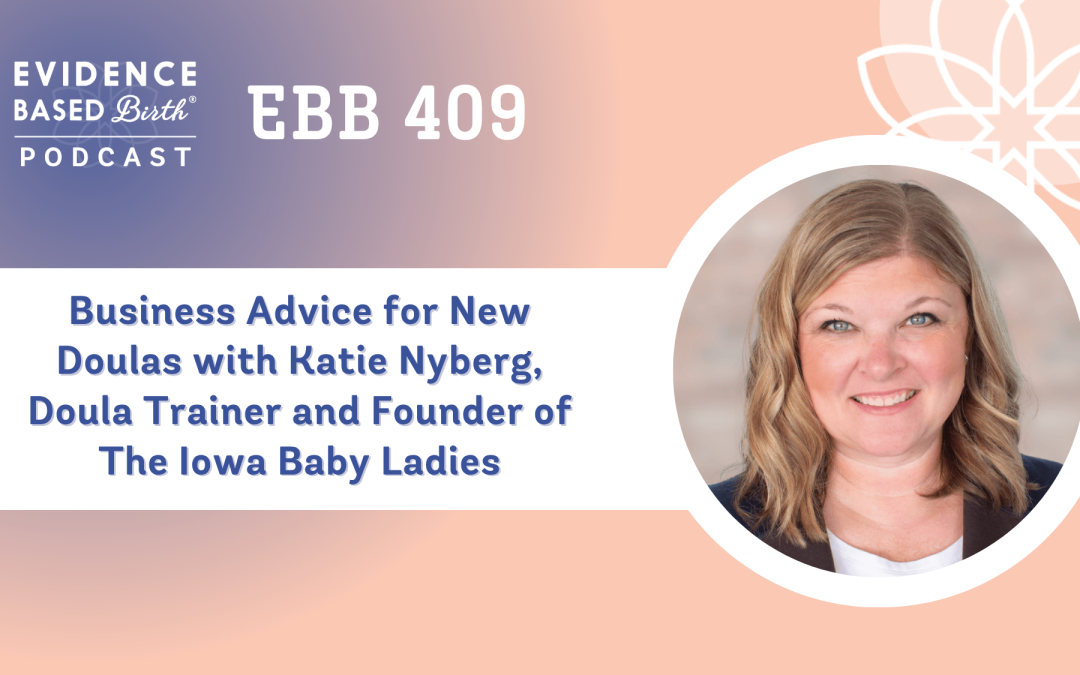
A passion for supporting families during birth is the foundation for a career as a doula. But once that foundation has been laid, it takes business skills, boundaries, and collaboration to be sustainable.
In this episode, Dr. Rebecca Dekker talks with Katie Nyberg, founder of The Iowa Baby Ladies, about her journey from fifth-grade teacher to doula, trainer, and owner of one of Iowa’s largest doula agencies. Katie shares the early lessons she learned about setting fees, communicating with clients, and navigating the unpredictable realities of on-call work. Katie also opens up about the exhaustion that once made her consider leaving birth work altogether, and the changes that helped her build a more sustainable career. She discusses how recognizing the root causes of burnout, diversifying income, creating intentional seasons of work and rest, and building supportive relationships with other doulas keep her going.
Resources
- Learn more about the EBB Instructor Program: https://evidencebasedbirth.com/become-an-evidence-based-birth-instructor/
- Find an EBB Instructor: https://evidencebasedbirth.com/find-an-instructor-parents/
- Follow Katie on Instagram: https://www.instagram.com/theiowababylady/
- Learn more about the Iowa Baby Ladies: https://theiowababylady.com/
- Evidence on: Doulas
- EBB 364 – How to Prevent and Heal Birthworker Burnout with Doctoral Student Ihotu Ali and Grace Flannery, Certified Professional Midwife
For more information about Evidence Based Birth and a crash course on evidence based care, visit www.ebbirth.com. Follow us on Instagram and YouTube! Ready to learn more? Grab an EBB Podcast Listening Guide or read Dr. Dekker’s book, “Babies Are Not Pizzas: They’re Born, Not Delivered!” If you want to get involved at EBB, join our Professional membership (scholarship options available) and get on the wait list for our EBB Instructor program. Find an EBB Instructor here, and click here to learn more about the EBB Childbirth Class.
Chapter Guide
(04:55) Early lessons in business, fees, and communication
(07:21) Setting healthy boundaries with clients
(11:40) Navigating childcare and the on-call doula lifestyle
(14:02) Preparing for long births and using backup support
(19:53) Recognizing and addressing doula burnout
(25:45) Saying no and making space for rest
(27:05) Growing The Iowa Baby Ladies
(33:41) Advice for new doulas getting started
(37:02) Overcoming imposter syndrome through education and experience
(43:13) Advice for building a lasting doula career
Transcript
Dr. Rebecca Dekker – 00:00:00:
Hi everyone. On today’s podcast, we’re going to talk with Katie Nyberg about building a sustainable career as a doula and avoiding burnout. Welcome to the Evidence Based Birth® Podcast. My name is Rebecca Decker, and I’m a nurse with my PhD and the founder of Evidence Based Birth®. Join me each week as we work together to get evidence-based information into the hands of families and professionals around the world. As a reminder, this information is not medical advice. See ebbirth.com slash disclaimer for more details. Hi, everyone, and welcome to today’s episode of the Evidence Based Birth® Podcast.
Today, I’m so excited to welcome Katie Nyberg to talk with us about building a sustainable career as a doula and avoiding burnout. Katie Nyberg is the founder and owner of the Iowa Baby Lady, one of Iowa’s largest doula agencies serving families across the state with birth doula, postpartum doula, child birth education, and newborn support services. Katie is an Evidence Based Birth® instructor, a doula trainer, and a board member at Perinatal Professionals Association. As a former fifth grade teacher, Katie never set out to become a business owner and had no formal business training when she began working as a birth doula in 2010. Since then, Katie has built her business by learning through experience, asking questions, making mistakes, and figuring things out one step at a time. Today, Katie leads a team of more than 20 doulas and is recognized as a trusted voice in the birth community. She’s also the founder of Nurtured Doula Trainings and Professional Education, where she helps prepare new doulas for the profession and mentors new doulas as they start their perinatal professional career. Katie is passionate about entrepreneurship and creating sustainable businesses that make a big impact within their communities. Katie, welcome to the Evidence Based Birth® Podcast.
Katie Nyberg – 00:02:01:
Thank you, Rebecca. I am just so excited to be here today.
Dr. Rebecca Dekker – 00:02:05:
Yeah. And I am so excited to pick your brain and get some wisdom for all of our listeners. Meeting you at the Evidence Based Birth® Instructor Retreat was really fun. And I just remember thinking, wow, you know, you cover like basically the whole state of Iowa with your services, which is really unique for a doula. So I was wondering if you can take us back to the beginning and tell us how you went on that journey from being a fifth grade teacher to becoming a birth doula.
Katie Nyberg – 00:02:34:
Yes. So way back in the beginning, I have my college degree in elementary education, and my first job out of college was teaching fifth grade in a public school. And if you had asked me then, I would have said, I am going to retire a fifth grade teacher. I am going to have really great retirement benefits through the school district. I’m going to have years of insurance coverage. And this was going to be my life. And I would have been fine in one classroom teaching fifth grade for the rest of my life. After the birth of my second son, though, I had this realization that if I go back to work, I am going to have to return to that staff bathroom to pump. And I wasn’t a doula then. I didn’t know there were laws. But basically, I was told I can pump in the staff bathroom and they would provide me a desk. And I could do it over my lunch hour. And so the thought of doing that after he was born was just horrendous to me. I couldn’t even wrap my head around having to go back and do that. It was actually a blessing because I decided to be a stay-at-home mom for a while and then eventually returned back to that same fifth grade classroom and that teaching experience. However, in the process, my sister-in-law found out she was pregnant with twins and she got put on bed rest at a local hospital. And I started visiting with her and just, you know, listening to how the pregnancy was going. I got to know the nurses and the doctors that were taking care of her. And then she asked if I would be her birth coach because she wanted an unmedicated hospital birth of twins. Now, we all know in this birth field that that’s probably not the easiest thing to do. But at the time I was like, oh, sure, I can absolutely help you do that. So I took a doula training. I went two hours away, got a hotel room, first night away from my babies. And I remember sitting in that doula training going. Oh no, I really love this and I may not go back into teaching. And since then, well, she did have an unmedicated birth of twins. I was there as her doula, and that was amazing. That was my first birth experience as a professional. But since then, I have just decided to say yes to any opportunity that comes my way, whether it’s birth doula, postpartum doula, all those things that you just listed in the bio. I just keep saying yes, and here I am
Dr. Rebecca Dekker – 00:04:55:
today. And, you know, as you started getting clients, like what did you discover about the field of doula work? Like what were your first lessons learned?
Katie Nyberg – 00:05:05:
I think in the beginning, I really was trying to. Say that I was a stay at home mom, and then maybe had this little bit of a hobby of being a birth doula. And I wish I could go back in time and tell that version of Katie that, hey, this is going to be a wild ride. You need to embrace the business side of things earlier on. But at the time, The doula field looked a lot different. And I know it hasn’t been that long ago, but doulas weren’t really charging a lot of money in our community at the time. And many of them weren’t charging anything at all. So in the beginning, when I was starting to get clients, Learning to find my voice and talking about payments and fees and retainer fees and service agreements, I had to really get brave and talk about those things. It wasn’t easy for me. My background wasn’t in business. So being able to meet with expecting families and present myself as a business owner was something I wish I could go back in time and embrace a little bit earlier. I think there was a big part of that that was imposter syndrome too, where… I was a fifth grade teacher five months ago. And now here I am saying, let me come and help you through this birth experience. And. Pay me money. And, you know, at the time it wasn’t much. I think my first birth fee was $325. It was pretty low, but it was something and it was more than what a lot of people in the area were charging. So early on, I wish I had just embraced that business side of things. And kind of. Went with it a little bit faster. And did you leave your job right away? Or was this something you were trying out on summer break or something like that? Oh, good question. No, I was going to take a couple of years off from teaching, at least till I got through breastfeeding. That was kind of my timeline. And I thought, well, if we could make it work for at least one school year. So my youngest son was born in April. If I could get through to that next school year and then those twins, that process started in November. So I did my doula training and then I just thought, oh no, I’m not going back into the classroom.
Dr. Rebecca Dekker – 00:07:21:
Were there any other lessons from those early days that you wish you knew?
Katie Nyberg – 00:07:25:
Another one that I learned pretty quick was boundaries because I don’t think I saw myself as necessarily a business owner or as an entrepreneur, businesswoman, anything like that. I was willing to be their friend. And and that’s good. We want to be friendly with our families, of course. And I am friends with many, many clients still to this day. However, in the beginning, I remember specifically one time I got a text at 2 a.m. And my client had just finished painting her nursery and she wanted to show me what the colors looked like or something like that. And I remember waking up as we all do as birth doulas when we get that notification in the middle of the night, just, whoa, is this go time? And it was pictures of her nursery. And I was thankful she shared them with me, but maybe not at 2 a.m. So I learned, especially with communication boundaries. I also had a really hard time saying goodbye to clients after that postpartum follow-up visit. And so I basically just said, hey, keep in touch and ask me any questions you have about your baby in your first, you know, as your baby grows. And then I started getting questions about… Puree recipes and I quickly learned that, oh boy, this could spiral really quick here. So nothing really drastic, but learning to set those boundaries and then also communicate, whether it was about payments or communication, those were all skills that I had to learn that I hadn’t really been exposed to before.
Dr. Rebecca Dekker – 00:09:31:
It really kind of strikes me, you know, like doula work is often very heart centric. Like you’re, you’re serving people with your whole self and yet there’s this whole business aspect to it. If you’re accepting payments and like you said, there’s boundaries. It reminds me of how like a workplace might say, oh, we’re all family here, but it’s not really family. Right. So there has to be some kind of healthy boundary other, otherwise it can start to, like you said, devolve into where you’re starting to feel resentful or unsure of what you’redoing. So how did you eventually kind of build a business where you felt more balanced and you felt like more confident in yourself?
Katie Nyberg – 00:09:41:
I think experience with that is definitely a big part of it. So the more I had those conversations, it really helped. I also find a lot of value in collaborating with other doulas within the community. One way I did that was through getting to know my backup doula better. So when I first began in the doula career, I went to a local doula association meeting and I met another doula there who was just starting her career. And we decided to go for coffee and become each other’s backups. And over the course of probably five years, my backup doula and I, her name was Jacqueline. Jacqueline and I got to know each other better. And then also as we were meeting, we realized that as she was growing her business, I was getting her overflow. And as I was growing my business, she was getting my overflow. So instead of being in competition with each other, we were growing these two businesses side by side. Well, in addition to that, we decided to get together every Thursday and we hired a mother’s helper to watch our little kids. And we worked on business together. And, you know, I didn’t give her all of my trade secrets and vice versa, but it was really nice to be able to talk about. Different conversations we were having with our clients. We were talking about how births went, of course, with confidentiality and all of those things in mind. But it was really nice to have somebody to bounce ideas off of because she was going through the same things too. She was learning to start a business and we were talking about. Taxes and website design and all of those things that come along with owning a business. So that collaboration just really helped me to grow and develop the business from those early days.
Dr. Rebecca Dekker – 00:11:40:
You mentioned hiring a mother’s helper to watch your little kids while you’re meeting with Jacqueline. Can you talk a little bit about the realities of child care as a doula who’s also a parent? Because I hear that a lot and I see it in my local community that a lot of doulas, especially new doulas, have trouble understanding or figuring out how they’re going to arrange child care.
Katie Nyberg – 00:11:56:
That’s definitely a huge concern. And it was for me. When I was teaching, I had child care, but then when I wasn’t teaching, it wasn’t in the budget for us to continue with that child care. So we had to get creative. Splitting a mother’s helper was a really great way to have every Thursday afternoon dedicated to business time. And it was affordable because I shared it with another doula and this mother’s helper just came to the home. I don’t think we paid her very much for a few hours to just watch the kids. And we were there. I also got creative as far as the on-call lifestyle goes. So my best friend and I made an arrangement that if I was at a birth and I needed help picking up kids from school or taking them to hockey or anything like that, she was willing to help in exchange. Anytime there was a school break where there was maybe an in-service day or holiday or winter break, I would watch her kids for free when she didn’t have daycare. And so that was our trade-off. That way I didn’t have to come up with any extra money out of pocket. But I knew that somebody would be there to help pick up my kids from. School or activities and help them out. My parents were helpful. My husband was helpful too, but she was right there in town where my kids were. So that worked out pretty well. I’ve seen doulas do collectives and cooperatives where they do more of like an on-call rotating schedule. I’ve seen doulas trade daycare services or drop-in daycare. Of course, you know, depending on what’s available in different communities, that gets a little bit more challenging. We had to get creative. And I found that whether it’s looking at child care or other things in the doula career, there’s not a lot of information out there about it. So we’ve had to invent a lot of things along the way and get creative and try things out and make adjustments. But I think that’s where it’s different because, you know, as a doula, we have to drop everything and go sometimes. And that’s hard when you’ve got kids. So it definitely, in my case, took a team to approach to do
Dr. Rebecca Dekker – 00:14:02:
that. And it’s not just like the spontaneity of I have to go right now to a birth, but it’s also the length of a birth can matter. Can you talk a little bit about some lessons you learned as a newer doula with longer births?
Katie Nyberg – 00:14:17:
Yes, I am still learning those lessons. I think they’re just hard. In the beginning, I was so eager to go to a birth and I really didn’t want to miss a moment that I probably went sooner than needed. And I think that’s very common in births. Now I’m much better with my wording with clients as far as saying, you know, when you’re in really early labor, I’m happy to offer phone call and text support. We can talk through options. You can ask questions. And then, of course, when you’re actively coping through those contractions or the intensity is increasing, then I’m happy to join you at home or hospital. And we can, you know, and we, of course, talk through all those scenarios. I think during those prenatal appointments, explaining why it’s important to wait until that active labor makes sense to them. It’s just not something parents know about yet. They want somebody there the whole time so that way they don’t have to worry. But explaining why it’s good that we come in rested makes a lot of sense to them. They just haven’t heard that before. And then the other part of that, too, that I think really helps with arriving at the right time is making sure parents feel really confident in their early labor skills. So spending time talking about what exactly does this look like in your home? Or we talk through inductions and what that might look like in early labor in the hospital. I really love helping parents use birth balls. That’s something that they can do, you know, switch positions every 20 to 30 minutes with a birth ball. If they know three or four birth ball positions, that gives them a really good chunk of time where they can confidently. Navigate early labor without necessarily needing me there to help them through that process. So helping them find confidence. And then of course, there are those just really long births where Doulas are just going to be there for a long time. Calling in a backup is okay, even if it’s just to rest, I think is really important. Protecting yourself as far as like sleep when you get home and recovery and not taking on too many clients, because if you have two or three really long births back to back, that’s just going to be really hard on your body, your mind, your career longevity. So trying to put some of those things in place ahead of time, I think can be helpful.
Dr. Rebecca Dekker – 00:16:34:
What are some other things you’ve learned about what it takes to turn doula work from a passion into like a sustainable long-term career? Because I know there’s a saying in the birth world that the shelf life of a doula is five years, but you’ve been doing this since 2010. And tell me like, what are some of the secrets to making it work?
Katie Nyberg – 00:16:54:
Probably the biggest contributor to the longevity is relationships. And I have found that relationships will create your reputation. And, so being able to afford to be able to do this, I need a steady stream of clients coming in all the time. We have, of course, in the birth world, turnover every nine months. My husband’s a chiropractor and he gets a patient. He does a really good job and he gets to keep that patient for a long time. Ours is constantly turning over. So we need some strategies in place. So for me, relationships has been the heart of the longevity part of the doula work. Relationships with clients, of course, first and foremost, being really good at communicating with them, making sure that I’m listening specifically to their goals for birth, their philosophies. Not coming in and saying, this is how it should go. Just really trying to take them from where they’re at and what their hopes and dreams are for birth. And then moving them a couple steps forward. In that process. I try to, I think there’s a saying like under promise and over deliver. I’m very clear in the very beginning about these are what my services include. And then if I need to meet up with them for another meeting or a coffee, then I can add on that extra prenatal appointment or that check-in. And that seems like I’ve gone above and beyond for my clients. So I try to first and foremost, give really good support to my clients. And that’s, you know, of course, the heart of why we do what we do. It’s also really good for referrals and making sure that I do have that stream of income or new families coming in. And then referrals from healthcare providers is also a big part of establishing those relationships, whether it’s from doctors and midwives or chiropractors or yoga instructors or whoever in our community, establishing really good relationships with them also helps build up your reputation within your community. And so I think those types of things have helped. And then the final part is kind of like what I mentioned with Jacqueline, the relationship part of it with other doulas is really important. Jacqueline is no longer a doula. But I have another doula friend that has also been in this a really long time now. And so she and I get together and talk about birth every usually every two weeks. We talk about any changes that we’ve seen in the birth field. We talk about some of those difficult challenges or conversations maybe we’ve had over the last few weeks. But building that relationship with her is also very healing for me to be able to have somebody to talk to about this life as a doula, because there’s nothing else like this where we don’t know when we’re going to work. We don’t know how long we’re going to work. We’re on call 24 hours a day, seven days a week. We don’t know how we’re going to be treated when we do go into work. Hopefully it’s, you know, a really great birth experience. But we don’t know how those providers are going to react to us. That’s hard. And that’s where it’s nice to be able to collaborate with other people that understand what’s happening.
Dr. Rebecca Dekker – 00:19:53:
Yeah. What do you think are some of the biggest contributors to burnout among doulas? You’ve been doing this a long time. You’ve seen a lot of people come and go. And maybe for some people, it’s just, you know, they’ve changed or their life circumstances have changed and doula work is no longer what they want to do. But for other people, they love the job, but they leave it because of burnout or because of trauma. Can you talk a little bit about what you think are some of the biggest contributors to people leaving the profession earlier?
Katie Nyberg – 00:20:22:
Yes, there was a time in full transparency where I was absolutely ready to be done with birth. It was about six years in. It fits that average that you said. And I remember telling, I think it was my dad. I remember saying, I’m done. My body hurts. I can’t do this anymore. And I remember him saying, you know, you’ve worked really hard to build up this business, this clientele. You know, it seems like you’re doing really well. Why would you consider leaving at the peak of doing this? And I just said, I’m tired. I hurt. I don’t want to do this anymore. I said, I don’t think I can do this anymore. And he said, well, what if… You know, what if somebody offered you a million dollars to be a doula, would you do it? And I said, yes, I would absolutely take a million dollars and go be somebody’s doula. And I, you know, would really enjoy it. And he said, what about half a million? Yes, of course. A hundred thousand. Yes, of course. What about $50? And I said, no, it’s not. I can’t do this for $50. And he said, any chance you’re not charging enough. To be able to continue in this work. You know, and I thought about it and I said, well, I don’t know what that number would be, but it’s probably higher than everybody else in the community. And he said, well, what’s the matter? You’re talking about walking away anyway. And so I sat on that for a while. And of course, I’m still in this. I did raise my fees. And then I really, for me, took a look at why I was feeling that way. And I was really filling up my calendar. I had a hard time saying no to people. So I was working and going to births probably 10 months, 11 months out of the year, doing three or four births a month. Anywhere from two to four births a month. And I thought, well, what if I started looking at my calendar with seasons? We have in our house a fall birth season and a spring birth season. So from August to December 1st, I will take three clients a month or whatever fits in the schedule. And then from January to May, same thing. And then I take the summer off and December off. One thing that has helped with that is to diversify my business a little bit. And that seems like a big, funny financial word. But I come from Iowa, not to stereotype us. I live in a city, but we have a lot of farmers in our state. And it’s kind of like the idea that they don’t all just grow one crop. You know, most farmers will have corn and soybeans or livestock. And that’s because if something isn’t going well, they’ve got something else to fall back onto. So for me, adding in postpartum doula work was such a great move because then I could still bring in income. But I didn’t have to be living that on-call lifestyle. So those are some of the lessons I’ve learned. I think for each doula that’s facing burnout, it’s important to look at why. And it could be related to fees. I actually don’t think that that was my problem. I think mine was more of, I was just exhausted.
Dr. Rebecca Dekker – 00:23:24:
Exhaustion.
Katie Nyberg – 00:23:25:
Probably, yeah. But it could be physical exhaustion. It could be that they’re not charging the right fees. Like I mentioned, sometimes doulas live in communities where they’re not treated well at births. By providers or nurses. And that could be part of it. There was a time where I didn’t attend births with one particular practice group because of how they were treating me and other doulas in the community.
Dr. Rebecca Dekker – 00:23:47:
So you had to kind of set up that boundary.
Katie Nyberg – 00:23:49:
Yep.
Dr. Rebecca Dekker – 00:23:50:
Because it’s either I leave the profession or I just stop working with this practice.
Katie Nyberg – 00:23:56:
Right. And for me, it worked for a while. It gave me enough of a break from this practice. And then down the road, you know, things change, providers change, all that kind of stuff. And so that was a much needed boundary at that time. It could be the on-call life. It could be too much time away from family. It could be not understanding the business side of things either. So I think understanding why that burnout is existing or why those thoughts are starting to creep into our head is really important. And that’s where having a doula friend to talk to can sometimes help, especially for people that like to verbal process through things. And then… Something that I have found accidentally over the years is to have a plan in place. So we want our clients to do birth plans and postpartum plans and induction plans. Breastfeeding plans, lactation plans. I think it’s important for doulas to have a plan for how to take care of ourselves, especially after those long births, how we’re going to prevent burnout. And it’s going to look different for each doula. I have found that I need personally, I need to figure out how I can create joy and rest in my life. And those are the two things that I really focus on, especially when I’m in. Um, the birth. Seasons where I’m constantly taking care of other people, my clients, my family, my kids, my husband, business stuff, colleagues, doulas on our team. I need to figure out how I can be responsible to create joy for myself and rest, whether it’s exercise, eating well, talking with friends and family, scheduling sleep is a big one, making sure I have time that I can actually dedicate to sleep and rest and slowing down, reading books. Things like that.
Dr. Rebecca Dekker – 00:25:45:
Yeah, this conversation reminds me a lot of episode 364 with Dr. Yehoto Ali and midwife Grace Flannery. We talked about how to prevent and heal birth worker burnout. And a lot of it revolved around rest and also learning how to say no. So did you end up starting to say no to more things? How did you handle like as your business grew? How did you continue to kind of set boundaries so you could have time to take care of yourself and to sleep?
Katie Nyberg – 00:26:11:
Definitely a skill. That was something I had to learn over the years. I learned that saying no could be reframed into saying yes to something more positive. So, for example, if I decided I’m going to take December off, I’ve learned I have to stick with that. I didn’t in the beginning. And now I learned it’s non-negotiable. Even when you get those potential clients that that are, you know, you just really, really, really want to take them on, being able to refer them on to somebody great is really great. But instead of saying no, I see it as I’m saying yes to rest my family time off, giving my backup family support time off. And so I’m trying to reframe it into saying yes into a better decision. And that’s OK for us as doulas to be able to say yes to ourselves and our own families once in a while, too.
Dr. Rebecca Dekker – 00:27:05:
That makes sense. So tell me about how you grew the Iowa Baby Ladies into one of Iowa’s largest doula agencies. How did that process begin and where is it now?
Katie Nyberg – 00:27:19:
I became a doula trainer first and I had the opportunity to travel around to different states and do different trainings in different areas. And I quickly realized I could not be on call for births and be a doula trainer in the same month. That wouldn’t be fair to one or the other. So I got together with a couple doulas that I knew in the area and said, hey, I’m thinking of maybe starting an agency model where I was able to take a lot of these referrals that were coming into me. And instead of saying no to them, I thought, well, maybe we can create this small team approach. So that was how it got started. It was just myself and two other doulas. And eventually as their calendars filled up and we were still getting more requests and our team reputation grew, then we started adding on another doula. And to this day, that’s how we operate as a team is we just go by inquiries and requests and the doulas all get to pick their own amount of clients that they work with, whether it’s birth or postpartum clients, they can pick their own, how many births they want to do a month. And we do our best to help them match that. But that’s kind of how we go is by need and inquiries. And again, that’s not something I work hard, you know, at networking and the marketing part of things. But also just being able to say, yes, like, yes, we’ll take on more families and we’ve got more doulas. And so that’s a little bit of how we got started. Not intentional. I never set out to own an agency.
Dr. Rebecca Dekker – 00:28:52:
I was going to say, are you the owner then? Like how does that agency model work that you’re using?
Katie Nyberg – 00:28:57:
Yes. So I am the owner and founder of the Iowa Baby Ladies. And we currently have a team of independent contractors. And so that’s where in the model that we have, they are getting referrals or leads from the agency, myself and the agency. And then they can choose whether or not to work with that family or take that lead. Each of them gets to pick. And set their availability by month and how many clients that they’re willing to take or how many clients they’re willing to be a backup for. The tricky part as an agency owner with that is as independent contractors, they can take their own private clients, market their own businesses. And in the beginning, I thought, oh, this could get sticky. But now on our team, we have a handful of doulas that have very thriving local businesses as well as taking clients through us. And so we basically are like a referral type of agency is how. That looks from the higher level picture.
Dr. Rebecca Dekker – 00:30:00:
I imagine that helps like with you wanting to take December off. Then there was always somebody else who was perhaps willing to work for those holiday babies as I had two of them. You would hope there’d be some doula in town who would take you as a client.
Katie Nyberg – 00:30:15:
Yep. I had a December 27th baby. I get it, which is why I don’t do December births. And it just every December I’m like, oh, I know they need doulas. So one of my favorite days of the week is payroll day where I get to see all of the prenatal appointments that happened, all of the birth support that was provided, all of the daytime and overnight shifts. And thinking about doing that on my own. There’s no way at most I could maybe do one or two overnights a week or a handful of daytime shifts or maybe a birth. But it’d be really hard to be on call for births and doing overnights. So having this agency model is really great because. Families are able to get a lot of comprehensive support. They can have it all. They can have birth support. They can have daytime postpartum support. They can have overnights. And we help them select a really great team that’s able to care for them from start to finish. And then I also love the part of it where on payroll day, I get to see the doulas. Living out this passion of becoming a professional doula. And some of them, like I said, have their own businesses and they’re doing the business side of things. But for a lot of the doulas on our team, they maybe just want to take one or two births a month and they don’t want to worry about social media and marketing and networking and all of that. And we help hopefully alleviate some of that burden so that they’re able to just do what they love and kind of going back to that longevity piece of it. Hopefully this really helps create a structure where doulas are able to be more sustainable instead of having to do it all on their own. Even our doulas that have their own private practices. They still benefit from having collaboration with other doulas in the area, networking with other health care providers that happens through our agency. So it really is, I feel like, helping this community feel of doulas helping families and families getting really amazing support.
Dr. Rebecca Dekker – 00:32:17:
It’s just like that whole teamwork makes the dream work. You can have a thriving business as a solopreneur, but in terms of sustainability, having teammates and coworkers, et cetera, makes it like more enjoyable sometimes. I mean, I’m sure there’s challenges too, but knowing that you’re not alone would be really important.
Katie Nyberg – 00:32:37:
I think when we see those Facebook posts where doulas are saying, for those of you that have been doing this for 10 years, 15 years, you know, what’s your secret? When I read through those, almost all of it is collaboration, getting together with other doulas. It’s not doing this in isolation. It’s not easy, especially if you’re not somebody that understands business or is new to the doula world. It’s really nice to collaborate with other people and ask questions. And if you don’t have that in your area, then I would look towards things like your training or certifying organization. See what they have. There’s so many opportunities in many of these organizations for things like Zoom meetups and mentoring hours and online conferences where sometimes you can get into breakout rooms or do some of these activities where, you know, Evidence Based Birth® has some really great stuff where you can join in and actually meet. Other people doing the same work. And, you know, hopefully those conversations continue beyond those platforms.
Dr. Rebecca Dekker – 00:33:41:
Can you talk a little bit then for somebody who’s listening, who’s perhaps a newer doula or exploring the idea, starting to think about becoming a doula, you know, what are some tips or advice you would give them as they’re getting started?
Katie Nyberg – 00:33:55:
I would say if you’ve been trained and you’re looking at getting started right away, I wouldn’t wait after your training to join in and get started and get experience. I was lucky that I am from the area where I started. So my first clients weren’t random strangers from a search engine. They were friends of friends. I was thinking it was going to be more friends and family, but a lot of them weren’t having babies at that time, but it was their friends of friends. So I was able to offer a discount, not free, but offer a discount and able to help people that didn’t necessarily know they wanted a doula, but were willing to allow me to come try out the doula thing in their births. And if there is mentorship and doula mentoring, in-person mentoring at a birth, definitely take advantage of that. I know that’s a little bit more rare in the birth community, but if it exists, for sure do that. But I tell new doulas all the time, remember, there’s that study that shows families without doula support, families with a doula in the room, and families with an active doula. And just having a doula in the room can make a difference. And we know doulas aren’t just going to be in the room. They’re going to be helping with at least some positioning and some comfort measures. So right away from the very beginning, you can make a difference. I tell doulas all the time, that family is going to be better off with you there than without you there or better off with a doula than without a doula. So just jump in. And then as you’re looking at the upcoming first year, second year in this work, just know that it takes time. And that’s the truth in any industry, whether you’re starting long care or hair care or doula care, it takes time to build and grow a business. So if there’s an opportunity to do some nonprofit work or join an agency or something like that, that may be another way to get some experience right away. But don’t wait. Jump in, you were called to that training for a reason or called to this work for a reason, don’t wait on it. I for sure had imposter syndrome in the beginning and it held me back from really jumping in. I wanted, and then I also wanted everything to be just right. I wanted my website to be just right. I wanted my social media to be just right. I wanted my business cards to be just right. And there are certain things you definitely need to get started, a service agreement and liability insurance. But beyond that, just jump in. If your business cards don’t look great yet, or you haven’t come up with like the best business logo, who cares? Just jump in and start supporting families.
Dr. Rebecca Dekker – 00:36:30:
And by jumping in, you mean just starting to let people know that you’re taking doula clients?
Katie Nyberg – 00:36:34:
Yes, absolutely. Spread the word that you’re taking clients. Ask if there’s anybody that you happen to know that’s expecting. If you can be a part of their birth as a doula. Of course, I always tell people like no pressure, but I’m a new doula. And if this is something that you think could benefit you, I would love to chat more about what this might look like. I’m offering a discount in the beginning as I gain experience. I think just jumping in and going for it.
Dr. Rebecca Dekker – 00:37:02:
You’ve mentioned imposter syndrome a couple of times. And I’m thinking back to 16 years ago when you started, not as many people knew what a doula was or what their worth and value was. How did you overcome that imposter syndrome and to being confident in yourself as like a valued member of the team?
Katie Nyberg – 00:37:21:
I think in the beginning, the imposter syndrome came from calling myself a business owner. I think it was my second or third year in business having… My business open that I thought maybe I’ll join the local chamber of commerce. And I remember walking into that chamber of commerce meeting and it was a bunch of bankers and lenders and insurance agents. And they were all in suits and ties and formal business wear. And I was there about 10 minutes before I got so nervous and everybody was already kind of talking and in groups, they all seem to know each other. And I walked right out and I thought, oh no, I can’t own a business. That’s what I thought it was, was doing all the businessy things. And over time, again, getting together with other doulas and learning from them, but also going to things like conferences, retreats, those are all really great ways to overcome some of that. For me, I feel more confident in pretty much any situation in life when I have a little bit of education. And shout out to Evidence Based Birth®. That has definitely helped over the years where the more I learn about something, the more confident I feel. And with that confidence, it replaces that imposter syndrome. Whether I’m talking about business skills or I’m helping somebody plan for their induction, it helps me in the birth room. When I know what the evidence says and I know what the information says, I am definitely much more confident in my doula skills than if I’m just like, oh, I think I heard that once. So education for me is really important in overcoming that collaboration. And just experience for sure.
Dr. Rebecca Dekker – 00:39:06:
I know as an EBB instructor, you have access to basically like the full range of EBB resources. What are some of the resources that you have found most helpful or that you pull out all the time with your clients or with your doulas and your agency?
Katie Nyberg – 00:39:18:
Personally, I use the one on doulas a lot.
Dr. Rebecca Dekker – 00:39:21:
The evidence handout on doulas?
Katie Nyberg – 00:39:23:
Yep. And then the website as well. I actually have that saved as a quick key command so that I can just type that in and it automatically pulls up a link. I also use anything on the induction. I use that one quite a bit and we use vitamin K quite a bit. A lot of times parents have questions. And so being able to just. Send off those resources are such a great thing, great tool to have.
Dr. Rebecca Dekker – 00:39:47:
With your website, which is the iowababylady.com, you have a lot of resources and trainings available. Can you talk a little bit about what you offer?
Katie Nyberg – 00:39:59:
So I kind of divide up my, the Iowa Baby Lady is the main business. I divide that up into two parts. So we have the Iowa Baby Ladies. That’s the doula agency side of things. And we do earth doula support, postpartum doula support, daytime and overnight support, and then classes. So we offer online pre-recorded classes. We have EBB, like Savvy Birth class in there, Savvy Birth 101. We have classes for expecting parents as far as like the new parent prep stuff. There’s a lactation portion to that class as well. And then for the other part of the Iowa Baby Lady business is doula trainings. And so I’ve trained through a couple different organizations before, and I do a lot of work within the state of Iowa and different Medicaid programs. And so I wanted to be able to have the flexibility to take the information that these organizations want and put it into a doula training. It’s been really fun for me because my background is in education and curriculum. So being able to work with each organization and the curriculum they want has been really nice. So those are kind of the two main portions of that. And then I do birth doula trainings and postpartum doula trainings under that.
Dr. Rebecca Dekker – 00:41:14:
I always wonder, you know, for someone new thinking about going to doula work there, I know there are like full spectrum trainings that cover both birth and postpartum doula work, but what would you tell someone who isn’t sure if they want to focus in one or the other? Like I want to attend births or I want to do postpartum or I want to do both. Are there any pros and cons of those different paths?
Katie Nyberg – 00:41:39:
I think talking to people who are doing each of those things or doing a combination is important. Talking to multiple people about that. Talking to the trainers ahead of time. That’s something I recommend to everybody. If you’re looking at a training in your area, reach out to the trainers and ask them those questions too. They probably will have really good insight and you’ll get a feel if they’re going to be a trainer that you resonate with. A lot of people end up doing both. In my experience recently, it hasn’t always been that way. But I’m finding a lot of people are being trained in both. And then in my own agency, though, a lot of them are coming in with being trained or certified as both birth and postpartum. But after they do the work for maybe a year, two years, they really focus in on one of those. They still maintain and can do the skills of the other thing. But I don’t know if there’s a rhyme or reason why. I think it just there’s something about it that resonates for me personally. I really loved adding postpartum doula work to my birth doula work because it gave me that chance to not be on call. But still continue working with families for other people. They’ve said, you know, overnights are just too tough. And of course, you don’t have to do overnights as a postpartum doula. You get to decide what you do. But they said, you know, I’d rather be on call for births. And I just think, wow, it’s amazing that we’re all so different in this career. And I’m so thankful for that. But I don’t get it. I’m happy that you are excited about birth. But I don’t get it as far as choosing to be on call versus knowing what nights you’re going to be working.
Dr. Rebecca Dekker – 00:43:13:
Yeah, you’re right. It’s a good thing that we’re all different so that families can find the support they need. Katie, thank you so much for sharing your wisdom with us from your career. And are there any final words of wisdom or advice you have for doulas out there?
Katie Nyberg – 00:43:28:
Sure. Families don’t need perfect doulas. They need doulas who are willing to jump in, meet them where they’re at. And then I would say this is coming from, to wrap it back up to me being a fifth grade teacher, education is important. So learn about running a business. See if there’s any business classes in your own communities or at your local colleges. And then continue building your skills within the doula field. Attend conferences and online conferences and retreats and get to know the doulas. Don’t do this in isolation.
Dr. Rebecca Dekker – 00:44:01:
That makes perfect sense. Thank you again, Katie, for sharing with us
Katie Nyberg – 00:44:05:
And you.
Dr. Rebecca Dekker – 00:44:06:
Today’s podcast episode was brought to you by the online workshops for birth professionals taught by Evidence Based Birth® instructors. We have an amazing group of EBB instructors from around the world who can provide you with live, interactive, continuing education workshops that are fully online. We designed Savvy Birth Pro workshops to help birth professionals who are feeling stressed by the limitations of the healthcare system. Our instructors also teach the popular Comfort Measures for Birth Professionals and Labor and Delivery Nurses workshop. If you are a nurse or birth professional who wants instruction in massage, upright birthing positions, acupressure for pain relief, and more, you will love the Comfort Measures workshop. Visit ebbirth.com/events to find a list of upcoming online workshops.
 Listening to this podcast is an Australian College of Midwives CPD Recognised Activity.

Get Empowered! Learn more…

EBB 261 – Mini Q&A on Group B Strep
Don't miss an episode! Subscribe to our podcast: iTunes | Stitcher | Spotify In this bonus episode, we wrap up our 2-part series on Group B Strep in Pregnancy, where I answer some of your questions following the first two episodes. Here are the questions answered...

EBB 260 – Midwifery, Community Birth Work, and Plant Medicine in Louisiana with Ms. Divine Bailey-Nicholas, the Founder of Divine Birth Wisdom
Don't miss an episode! Subscribe to our podcast: iTunes | Stitcher | Spotify In this episode, we're going to talk with Ms. Divine Bailey-Nicholas, midwife apprentice, doula, certified lactation counselor, and master herbalist about her career in birth work,...

EBB 258 – A Hospital Waterbirth Story with Cord Avulsion featuring EBB Childbirth Class Graduate, Samantha Reisz, PhD
Don't miss an episode! Subscribe to our podcast: iTunes | Stitcher | Spotify In this episode we talk with Dr. Samantha Reisz, EBB Childbirth Class graduate about her experiences taking the class and preparing for a waterbirth in a hospital with her “Golden...