

 |
 |
Rebecca Dekker
PhD, RN |
Sara AilshireMA |
Evidence on: Vitamin K for Newborns
Published on March 18, 2014, and most recently updated on February 19, 2025, by Rebecca Dekker, PhD, RN and Sara Ailshire, MA. Please read our Disclaimer and Terms of Use. For a printer-friendly PDF, become a Professional Member to access our complete library.
Shortly after most babies are born, they receive supplemental Vitamin K—either in the form of the routine intramuscular (IM) Vitamin K shot, or oral Vitamin K drops. In the U.S. and in many places around the world, this practice has been commonplace since the early 1960s. Why would a newborn baby need Vitamin K, and why is it given so soon after birth?
In this Evidence Based Birth® Signature Article, we review the evidence on providing Vitamin K to newborn babies. We will discuss why newborns need Vitamin K, and the role that Vitamin K supplementation plays in preventing a rare but dangerous condition called Vitamin K Deficiency Bleeding. We will also answer questions and provide evidence-based information to address hesitancies that some parents may have about this common care measure.
Podcast Transcript
Dr. Rebecca Dekker:
Hi everyone, on today’s podcast, we’re going to talk about the updated evidence on Vitamin K. Welcome to the Evidence Based Birth® Podcast. My name is Rebecca Dekker, and I’m a nurse with my PhD and the founder of Evidence Based Birth®. Join me each week as we work together to get evidence-based information into the hands of families and professionals around the world. As a reminder, this information is not medical advice. See ebbirth.com/disclaimer for more details.
Hey everyone, and welcome to today’s episode of the Evidence Based Birth® Podcast. Before I get started with this episode all about Vitamin K, I have an important announcement for you. The day this podcast is coming out, February 19, 2025, is the last day you can get early bird tickets for the Evidence Based Birth® Conference happening virtually in March 2025. You are not going to want to miss this incredible event that you can join from your desk, your couch, or even your car, wherever you are. Our keynote speakers are midwife Mama Shafia Monroe, dietician and author Lily Nichols, and we will have research experts on home birth, gestational diabetes, the RSV shot in pregnancy, and much more. If you want to learn more about our speakers and topics, or if you already know you want to attend, go ahead and grab your ticket and join us while you can at ebbirth.com/conference.
Now today, we’re going to be talking about the updated evidence on Vitamin K for newborns. This content was co-authored by Sara Ailshire, a doctoral candidate in anthropology and an EBB research fellow. Sara couldn’t be with me here on the podcast today, but I wanted to acknowledge all the hard work she’s put into preparing this Signature Article update, as well as the updated handout you can get and this podcast episode that you’re listening to. If you want to access any of the handouts or scientific references that go with this episode, as well as the full transcript and full Signature Article, it’s super simple. Just go to ebbirth.com/vitamink, and everything is there waiting for you. As a content note, I understand that Vitamin K is a controversial subject. Here at EBB, we are no strangers to this controversy since we’ve been publishing on Vitamin K for more than 10 years. But just so you know, today we will be talking about topics such as infant bleeding, newborn complications and serious illness, injections, and statistics on infant mortality. Now our last podcast on Vitamin K was all the way back in episode 84 of the EBB Podcast. So this is a really big update for you now that we’re on episode 347. Here at EBB, we originally published the evidence on Vitamin K in March 2014. And back then, so many people were anxious to get the first news of what we said about Vitamin K that it kept crashing the website. We last updated the article in 2019. And today we are releasing the updated evidence on Vitamin K in 2025.
So who might be interested in listening to today’s episode? Well, you might be listening if you’re a parent who’s considering your options when it comes to supplemental Vitamin K for babies. Or maybe you’re a doula or a childbirth educator and your clients have questions and want to see the research for themselves. Or maybe you’re one of the many nurses, doctors, or midwives around the world who regularly works with parents who are hesitant about Vitamin K or who have come across misinformation on this topic. In today’s episode, hopefully we’ll help all of you out by covering what Vitamin K is. We’re going to talk about a condition called Vitamin K deficiency bleeding or VKDB. We’ll talk about why it’s recommended that newborns receive supplementary Vitamin K shortly after birth. I’ll go over the different options and I’ll share some recent research findings on Vitamin K. Something else that we do in the Signature Article and I’m also going to do on this podcast is debunk some of the common myths and misinformation about Vitamin K that we’ve seen circulating on social media. And of course, we’ll end by talking about the bottom line. So are you ready to get started? Let’s go.
I’m going to start off by explaining what Vitamin K is. Vitamin K is a fat-soluble vitamin needed for blood clotting and keeping our bones healthy. Vitamin K is named after the German word for clotting, koagulation, spelled coagulation with a K. There are different types of Vitamin K that are important to our body’s ability to clot. We get Vitamin K1 from leafy green vegetables. We get Vitamin K2 from bacteria that live in our intestinal tracts. Vitamin K1 from plants, makes up about 90% of our overall Vitamin K levels, while Vitamin K2 from bacteria makes up about 10% of our overall Vitamin K. Foods that are rich in K1 include leafy green vegetables, broccoli, cabbage, cauliflower, turnips, brussels sprouts, avocado, banana, kiwi, and soybean oil. Now, the clotting systems in our body are very complicated and there’s a name for it. It’s called the clotting cascade. I’ll link in the show notes to an interesting YouTube video that goes into depth about how complex this system is. What Vitamin K does is it helps our blood clot by activating certain molecules, also known as clotting factors, that help form clots. When it comes to newborns, they’re born with very low levels of Vitamin K. Now, newborns have the normal numbers of blood clotting factors, but these factors are not fully activated due to the low levels of Vitamin K. So, if a baby does not have enough Vitamin K, they cannot activate these molecules fully. So, a deficiency in Vitamin K makes an infant’s blood less able to clot. Most of the time, a baby’s blood can clot even with low levels of Vitamin K. However, there are rare cases where a baby’s blood cannot clot due to low levels of Vitamin K, and this can lead to spontaneous bleeding. There’s no way to predict if it will occur or when it will occur. Next, I want to talk about Vitamin K deficiency bleeding and what this is.
So, a baby who does not have enough Vitamin K can start to bleed suddenly without warning. And this is a rare condition known as Vitamin K deficiency bleeding or VKDB. VKDB can be idiopathic, meaning that it occurs for an unknown reason, or secondary as a symptom of another illness or condition. Idiopathic VKDB is the most common kind, and virtually all cases of this happen in babies who are exclusively fed human milk. Secondary VKDB is rarer and occurs in babies with underlying conditions, such as gallbladder disease, cystic fibrosis, or due to medication side effects. Most babies who have secondary VKDB are also exclusively fed human milk. So Vitamin K deficiency bleeding can follow one of three patterns, early, classic, and late. Early VKDB happens in the first 24 hours of life, and it’s usually seen in babies born to mothers who took medicines that interfere with Vitamin K. These medicines might include Warfarin or Coumadin, seizure medications, and tuberculosis medications. The bleeding usually happens in the skin, brain, or abdomen. Classic VKDB is also sometimes called classical VKDB. This would happen in days 2 to 7 of life, usually during days 2 to 3 after birth. This is when Vitamin K levels are naturally at their lowest. And common bleeding sites include the gastrointestinal system, the umbilical cord site, skin, nose, and circumcision site.
The official cause of Classic VKDB is usually listed as unknown, but breastfeeding or insufficient intake of milk are major risk factors. Late VKDB happens after the first week of life, usually during weeks three to eight, but it can occur any time in the first six months before infants begin taking in vegetables. The bleeding usually happens in the brain, skin, or digestive tract. Bleeding in the brain is often the first sign of late VKDB, and this can happen in infants exclusively fed human milk who did not receive supplemental Vitamin K. Some infants may also be at higher risk if they have undetected gallbladder disease, liver disease, or if they have cystic fibrosis, chronic diarrhea, or are on antibiotics. So for as long as people have been writing about birth and babies, we’ve known that this type of bleeding exists. But scientists did not always know what caused it. In 1930, a Danish biochemist found that Vitamin K deficiency was the cause of unexpected bleeding in baby chicks. In 1944, a definitive Swedish study was published that included more than 13,000 infants who were given 0.5 milligrams of Vitamin K, either orally or by injection, on the first day of life. The researcher found that infants who received Vitamin K experienced a five-fold decrease in the risk of bleeding to death during the first week of life. It was estimated that for every 100,000 full-term infants who were born, Vitamin K would save the lives of 160 infants per year. In 1961, after nearly two decades of research had accumulated and been published, the American Academy of Pediatrics recommended giving Vitamin K shots after birth. And this recommendation has become the standard of care in the United States ever since.
So in this podcast and the Signature Article, we cover all forms of VKDB, but we’re really going to focus on late VKDB because it’s the most dangerous kind. Although it’s also the most rare type of VKDB, late VKDB has consequences that can be catastrophic. More than half of infants who develop late VKDB will have bleeding in their brain. The mortality rate is approximately 20%. One study found that of infants who survive late VKDB, about 40% have long-term brain damage. In low-resourced countries, many babies, with late VKDB, may die before reaching the hospital. And because their diagnoses and deaths are undocumented, these cases are not usually counted in any VKDB statistics. In high-resourced countries, where parental refusal of Vitamin K is on the rise, we really don’t have accurate reporting on how many infants are not receiving Vitamin K after birth. However, we do know that the trend of parents refusing Vitamin K is increasing. So before we go into more detail about giving Vitamin K, I want to talk about signs of VKDB that clinicians, birth workers, and parents should know about. One of the biggest problems with VKDM is that it often occurs with no early symptoms. This means that you might not recognize signs of illness until it is too late. As we all know, newborns can’t really speak to us, and early symptoms of brain injury can be subtle. Symptoms include difficulty feeding, lethargy, fussiness, bulging soft spots on a baby’s head, unexplained bruising or pooling of blood under the skin, easy bruising, especially around the baby’s head and face, bleeding from the nose, skin, a circumcision site, gums, or the umbilical cord site, a paler than usual skin color, or for babies with darker skin tones, pale appearing gums, yellow eyes after the baby is three weeks old, blood in the diaper or stool, black tarry stool at three days of age or older, or vomiting blood. Now, as you might have guessed from me listing these symptoms, those first couple of symptoms, difficulty feeding, kind of sleepiness, fussiness, those can often be confused with other common newborn symptoms.
And that’s one reason why giving Vitamin K to all babies is important because it’s kind of hard to… Identify when this type of bleeding is starting. Some people may wonder why babies who are exclusively breastfed are at higher risk for VKDB. And I do have to acknowledge that human milk has very limited amounts of Vitamin K. Levels in human milk and colostrum, which is the first drops of milk, are similar, about one to nine micrograms per liter. So virtually all babies with late VKDB are exclusively fed human milk. Now when researchers look closely at infants who develop late VKDB, they found that lactating parents of these babies had the normal levels of Vitamin K in their milk supply, meaning that they are not lacking this nutrient in their milk compared to the average amount present in other breastfeeding parents. It’s thought that maybe some of these babies have a problem with absorbing that average amount of Vitamin K from their parents’ milk. On the other hand, there are virtually no reports of VKDB occurring in infants who are formula fed. This is because in contrast to human milk, formula has much higher levels of Vitamin K, about 55 micrograms per liter. I know that in the past, some people have been offended by our discussion of levels of Vitamin K in human milk. Some readers believe that human milk or breast milk is nature’s perfect food, and they may be surprised or upset by this conversation. Please know that at EBB, we always advocate for increased access and support and encouragement around lactation, and we also honor and support families who want, or need to use formula to feed their baby, evidence shows that providing sufficient amounts of Vitamin K to prevent the very rare cases of Vitamin K deficiency bleeding is a benefit of formula, but not human milk.
Some people ask us about gallbladder or liver problems, and it is true that another rare risk factor for late VKDB is this, undiagnosed gallbladder and liver problems. These two organs, the gallbladder and liver, play an important role in your body’s ability to absorb and use Vitamin K. So if a baby has a gallbladder problem or liver problem, they may have trouble absorbing Vitamin K and other fat-soluble vitamins. However, these conditions are quite rare. They have no relationship to adult gallbladder or liver disease, so you can’t use your own family history of gallbladder or liver disease to predict if your baby might have this problem. Also, a lot of people don’t realize this, but the first sign of an infant gallbladder or liver problem is usually a bleeding in the brain from Vitamin K deficiency. So most parents won’t know that their baby has this health problem until their baby starts bleeding. That’s why Vitamin K supplementation after birth is a preventive strategy for reducing BKDB in all infants. Whether or not they have liver or gallbladder problems. So we know that Vitamin K supplementation at birth can help prevent VKDB. Next, I want to explain what types of Vitamin K supplements are available. So I already mentioned the most common type of Vitamin K supplementation offered around the world to infants, which is the Vitamin K shot. Usually this is a shot that contains one milligram of Vitamin K, a fat-soluble vitamin, and it’s injected into the large muscle in a baby’s thigh. This is called intramuscular, or IM. And this dose and route of giving Vitamin K was tested in many, many studies, starting in the 1960s and continuing on into the 21st century. It’s thought that giving Vitamin K as an injection into the muscle leads to the vitamin being temporarily stored in the muscle and gradually released into the baby’s system over the next several months. This delayed release would explain why the shot protects babies from both classic and late Vitamin K deficiency bleeding. However, I have not seen any research specifically confirming this deposit of Vitamin K in the muscle.
Now, preterm infants are born with even lower Vitamin K levels than term infants. They also have immature liver and circulatory systems that puts them at a greater risk of complications from Vitamin K deficiency. Preterm babies may also have delays or difficulties in feeding or repeated exposure to antibiotics, and this may interfere with the baby’s ability to maintain healthy levels of Vitamin K. Right now, the research and professional guidelines suggest that preterm infants or low birth weight infants who weigh less than 1,500 grams or less than 3.3 pounds should receive a 0.5 milligram injection instead of 1 milligram. There’s also a lot of regimens using oral Vitamin K drops for infants, and these regimens also can be evidence-based. We go into a lot more depth in the Signature Article about the different regimens using oral Vitamin K drops. But one regimen, which consists of three doses of two milligrams oral Vitamin K1, lowers the chances of VKDB to less than 1 in 100,000 births, but it probably does not eliminate the risk as well as the shot. Other regimens involve weekly or daily dosing throughout the first six-month period. And in fact, some of the newer research on oral Vitamin K seems to be trending towards showing the benefits of these more frequent dosing regimens with the oral drops. Two recent studies published in 2024, one from Japan and one from Italy, looked at weekly dosing regimens and found that they compared more favorably than the three-dose regimens. In the United States, where a lot of our listeners are, there is currently no FDA-approved oral version of Vitamin K for newborns. Parents who are interested in pursuing an oral Vitamin K drop option are left only with supplements for sale in food stores or at compounding pharmacies, and these are not regulated. This means that while whoever is selling the Vitamin K drops may say it contains a certain amount of milligrams of Vitamin K, there’s no independent testing or third-party verification to determine that this is true.
We found in doing our research and updating this article that the oral Vitamin K option is more common in countries where health systems provide postnatal or postpartum home health visits. So with oral Vitamin K drops, there’s a couple things you have to consider. The drops have to be given correctly or they will not work to prevent VKDB. So having a trained health professional, such as a nurse, who can give the doses or guide parents in how to provide doses correctly helps ensure that the oral Vitamin K has the best chance of working. Oral doses will not be absorbed well if the infant has an empty stomach or if the baby spits up shortly after the dose is given. In addition, in order for it to work and prevent VKDB, you have to remember to give it, so you have to adhere to the regimen. So in general, the Vitamin K shot, given as an injection in the muscle, is the preferred method.
In most places around the world, for several reasons. First the shot is absorbed more easily and reliably than the oral version. It has a delayed release effect that protects against both classic and late bleeding. It only has to be given one time. When the shot is used, the chance of an infant experiencing late VKDB is close to zero, although it does not completely eliminate the risk. And when there is no approved oral version of Vitamin K drops available, then the shot is the only regulated version that is verified by a third party. Now, I’m going to take a step back and just kind of summarize for you the pros and cons of each form of Vitamin K supplementation for infants. So let’s start with the Vitamin K shot. The pros or the benefits are that it is highly effective at preventing classic and late VKDB, resulting in rates of late VKDB that are close to zero. Vitamin K is slowly released over time from the injection site, which provides enough Vitamin K1 until the baby begins eating solid foods. The cons or the drawbacks of the shot include that it causes pain, which can be minimized by holding or nursing your infant during the injection. It can also cause bleeding, redness, irritation, or bruising at the injection site. And the shot may not be 100% effective in cases of undetected gallbladder or liver disease, although it is still more effective at preventing VKDB in these situations than oral regimens would be. And then let’s compare that to the pros and cons of oral Vitamin K drops for infants. A lot of parents really like that the oral drops are non-invasive, so it’s a pain-free method of preventing late VKDB. Giving 3 doses of 2mg of Vitamin K at birth and then again several times in infancy lowers the risk of both classic and late VKDB to under 1 per 100,000, but it’s probably still not as effective as the injection, which results in rates closer to zero. And then another benefit is that giving oral Vitamin K drops weekly seems to protect infants with undiagnosed gallbladder problems just as well as the shot. So what are the cons or the drawbacks of oral Vitamin K drops for babies.
Well, some babies may not absorb it well, for example, if they have a diarrheal illness or if it was given on an empty stomach or if they have undetected gallbladder disease or if they spit it up. Speaking of undetected gallbladder disease or undetected liver disease, the three-dose regimen of oral Vitamin K probably won’t protect them as well as the shot would. And then one of the other drawbacks to oral Vitamin K drops is that it requires that parents commit to giving at least three doses at specific times or weekly doses. Next, I’m going to go over some of the common questions around Vitamin K that we answer in the article. So there are a ton of Q&A’s in the Signature Article if you go to ebbirth.com/vitamink. I’m going to go over some of the most important ones or most common questions we receive. So one of the most frequent questions or misperceptions that we hear about Vitamin K is whether or not you need Vitamin K if you have a gentle birth. So a lot of people who follow EBB are looking to avoid medical interventions and have as safe a birth as possible while limiting medical interventions. And so they believe if their baby is having a truly gentle trauma-free birth, then the baby does not need Vitamin K because they are not exposed to any potential injuries. Others have read myths online that Vitamin K was only needed in the mid 1900s because this was during an era when babies were delivered via forceps, had immediate cord clamping, and were routinely kept away from their mothers with no breastfeeding at all.
However, there is no evidence to support the theory that Vitamin K is only needed with quote-unquote traumatic births. This myth continues to be perpetuated online and across social media without any supporting evidence or references to back up these claims. There’s no evidence to support the theory that infants born via forceps or vacuum assistance or by a Cesarean are at higher risk for Vitamin K deficiency bleeding. Vitamin K deficiency bleeding, especially the kind that is in the late period, is spontaneous. It happens without warning. It’s not caused by any injury. And Vitamin K deficiency bleeding can happen to any infant who is breastfed, whether they are preterm, full term, male, female, had a traumatic birth, or a gentle birth. Researchers have not been able to identify exactly which infants are most likely to experience this type of bleeding. Because of this, doses of Vitamin K are typically given to all infants. Also, if you just use some of your common sense, late VKDB can happen as late as six months after the birth. That is much too late to be impacted by the type of birth or any jostling the baby experienced during the delivery. And late VKDB tends to be the type of bleeding that we’re more worried about because it tends to happen in the brain. Another question that has been coming up a lot recently has to do with whether or not Vitamin K causes jaundice. So I often see people incorrectly claim online that the Vitamin K gave their newborn jaundice.
So, we’ve talked about newborn jaundice here on the podcast a couple of times. We also cover it in our Pocket Guide to Newborn Procedures. But newborn jaundice, also known as newborn hyperbilirubinemia is caused by the buildup of bilirubin in the blood and skin. Bilirubin is a waste product from the breakdown of red blood cells. And jaundice from this buildup of bilirubin can cause a yellow-orange tint to the skin, to the sclera, or the whites of the eyes, and the lining of the mouth. Jaundice is quite common. It affects about 80% of preterm and 60% of all full-term babies. Of all newborns who have jaundice, most, or 75%, have cases that are mild or go away on their own. This is called benign jaundice, and it’s due to the immature liver still coming online. However, about 25% of babies with jaundice have severe or pathological jaundice that must be treated in order to avoid a dangerous brain condition called kernicterus. So it makes sense when a parent receives a diagnosis of jaundice in their baby that the parent might be looking for a cause or a culprit for the jaundice. And some may incorrectly connect a shot they saw their baby receive at birth that perhaps they were worried about to begin with with the baby developing jaundice a few days later. However, this is an error in thinking. Just because two things happen does not mean that one is the cause of the other.
Another example of this failed logic would be to make a statement such as, we gave our baby a bath, and then our baby developed jaundice. Just because a baby received bath does not mean the bath caused jaundice. We do know most of the causes of pathologic jaundice that requires treatment. So the causes of this condition include Rh blood incompatibility, which I’ll link to the podcast we did on that in the show notes. Inadequate milk intake, bruising from birth trauma, Down syndrome, infection, a baby that was born large for gestational age and their parent had diabetes, prematurity, some prenatal medications, and liver or gallbladder disease. One of the most common causes of severe jaundice is something called G6PD deficiency, also known as fava bean syndrome, an inherited condition that occurs more often in male infants with African, Middle Eastern, Latin American, Asian, or European Mediterranean ancestry. You can learn more about this common condition at g6pddf.org. So back in the 1940s through 1960s, when researchers were first developing and giving the Vitamin K shot in studies, there were some instances of severe jaundice that they did connect with the shot. Scientists realized that this was because the dosing of Vitamin K was too high. It was much higher than the current Vitamin K1 dose of 1mg. Back then, in some research studies, they were giving shots with doses as high as 25-30mg. And the formulation was incorrect. They were using water-soluble injections, but Vitamin K1 is fat-soluble. They also saw that this risk of jaundice was highest in preterm babies. So eventually they settled on the dose of 1mg because it prevented VKDB, but did not increase the risk of pathological jaundice in clinical trials. And so today’s formulation of Vitamin K1 in a fat-soluble injection at a dose of 1mg has not been shown to increase the risk of jaundice in full-term babies.
So in the Signature Article, we go into a little bit more depth about misinformation and controversy surrounding Vitamin K. And I first wrote the original version of this article 11 years ago now. And so I wanted to talk with you a little bit about the myths that I saw back then in 2014 and the myths that stand out to me now in 2025. But when I first published the article on Vitamin K, I got a lot of pushback. In fact, a lot of people were really angry with Evidence Based Birth® and with me in particular. I will never forget having someone call my workplace at the university and yell at an administrator on the phone saying then that Rebecca is a tyrant and she shouldn’t have said what she said about Vitamin K. That was an interesting experience. I also received a lot of horrendous hate mail and emails related to this subject. To be honest, I had no idea back then that this would even be a controversial subject. I ended up realizing that a lot of people thought Vitamin K was unnecessary. People were lumping it in with a lot of other medical interventions that probably really were happening at unnecessarily high rates. There were a lot of concerns about toxins and leukemia and the subject of leukemia has been well debunked. I go into more depth in the article about that. After I published the article, I got a lot of positive feedback though from midwives, especially home birth midwives, who were relieved to have a good evidence-based source they could send their clients to, when they had questions about Vitamin K today, what I see happening are more myths, misinformation and confusions about specific newborn symptoms and blaming them on the Vitamin K shot.
For example, jaundice which I already spoke about people claim that the shot caused their baby to have eczema, again, there, it seems to be like the scapegoat for a host of common newborn conditions. And although I explained there is that failed logic at play, it still doesn’t take away somebody’s belief that something caused something else. But if you need one more example of how that logic is not necessarily accurate, I think back to before I started EBB, Jessica Simpson was dating the Dallas Cowboys quarterback Tony Romo. And when she went to his football game and the Dallas Cowboys lost, there was this sexist myth perpetuated in the media that Jessica caused Tony Romo and the Cowboys to lose. Again, just because two things happen in conjunction does not mean that one is cause and the other is effect. But people do seem to have a natural fear towards needles and injections, so Vitamin K becomes an easy scapegoat. Another thing that I saw back then and I’m still seeing today. Is people are really stuck in their belief that low Vitamin K levels in newborns, that this is natural or it’s God’s design and thus it should not be addressed. I’m not here to argue with anyone’s faith in God or a higher power. However, if you look at it in terms of looking at nature, nature does not need 100% of babies to survive in order for the human species to continue. So if you’re looking at it from an evolution standpoint or survival of the fittest, this is a pretty rare condition. Especially late VKDB, and so there’s no pressing need for nature to evolve to not have VKDB. Also, although we don’t know why babies are born with lower levels of Vitamin K, we do know that we have a relatively simple solution that can almost always prevent this type of bleeding from happening. But even with saying that, people still want to know why is there low levels of Vitamin K in the baby. Why does it not cross the placenta? And so Sara wanted to research that for you all a little bit.
So I’m going to share some of what she found. So in the article, Sara talks about how the placenta protects the fetus from the gestational parent’s immune system, which might attack the fetus as a foreign presence in the body. But the placenta also is there to transfer oxygen and nutrients from the parent to the baby. So for this reason, the placenta is quite selective in what substances it allows to pass to the fetus during pregnancy. And this selectivity is built into the placenta through a special layer of cells. This layer of cells is pretty solid except for a few small scattered defects. So in order for any substance to reach the fetus, it must be transported across this barrier. Now, Vitamin K can be transported across in a process called facilitated diffusion, meaning that it passes from an area of higher concentration in the maternal blood stream, to an area of lower concentration in the fetus across special proteins that act like little doors through that cell wall. Yet, even though there are special doors for this Vitamin K to transfer through, very little Vitamin K gets through the placenta to the baby. And we still don’t know why. In grownups, Vitamin K is mostly stored in the liver and in other tissues like the brain, pancreas, heart, and bone. And there’s very little Vitamin K circulating in your bloodstream. So it’s possible that there’s just not enough Vitamin K in our bloodstream to enter the placenta and get to the baby in higher amounts. But because of how facilitated diffusion works with no other barriers in place, we might expect to see Vitamin K levels be the same on both sides of the placenta, on the mother’s side and the baby’s side. But this is not the case. Vitamin K is usually not detectable in fetal blood, while it can be detected in low levels in the maternal bloodstream. And there’s a lot of uncertainty why Vitamin K does not go through its special protein doorway through that cell wall to cross into the baby as easily as other vitamins like vitamin D. So one theory is that the fetus does not have enough fatty lipids in their blood to pick up whatever fat-soluble Vitamin K might try to cross the placenta.
Another theory is that the Vitamin K may come across in pieces rather than one whole piece, and the fetus does not have the ability to assemble the Vitamin K in its body yet. Another theory is that vitamins that are absolutely necessary for fetal growth during pregnancy, like vitamin D, are actively helped across this special cell layer, while Vitamin K, which is less important in utero, does not get this special treatment. What we do know is that Vitamin K does not easily pass from parent to child during pregnancy. Compared to their pregnant parent, a fetus can have as little as one-tenth the concentration of Vitamin K in their body. And researchers are continuing to study the placenta, so hopefully someday in another update we’ll have more information on why Vitamin K does not easily make it across the placenta. Another concern that people have is related to the boxed warning. So a boxed warning in the United States is the highest safety-related warning that the FDA can issue on medications. Boxed warnings were first implemented in the 1970s and have since been applied to more than 400 commonly used medications. The purpose of the boxed warning is to raise awareness of risks of a medicine, so with a boxed warning, certain contraindications or reasons not to give the medicine or serious warnings about side effects are required to be outlined by a box on the label of the medication. This helps remind providers who are administering the medication of the potential for complications and ways to avoid those adverse effects. There is a boxed warning for Vitamin K. It tells us that rare but serious side effects, including death, have occurred with administration of this medication. What this boxed warning does not go into detail about is that nearly all of these serious adverse events happen in adults in critical care who are receiving infusions of intravenous Vitamin K. Now, adverse events, while extremely rare, have occurred across all methods of administration of Vitamin K. And so this boxed warning helps providers weigh the risks and benefits when it comes to how and when to give Vitamin K. Evidence has consistently shown that the benefits of Vitamin K for newborns far outweigh the potential risks of an adverse event. And professional health guidelines around the world continue to be consistent in recommending the use of Vitamin K for newborns. Some people may be concerned about the risk of a serious allergic reaction. This is extremely rare. In fact, I’ve only been able to find one published case report of a serious allergic reaction in recent history using the current formulation of Vitamin K. Something that’s actually probably more likely to happen is that your baby doesn’t receive the Vitamin K.
There have been rare cases where a healthcare worker, documents that they gave the Vitamin K, but the dose was not actually given. Because of this, some parents may want to watch the injection being given to ensure that the baby received their Vitamin K. A great way to do this is to have the Vitamin K injection given during skin-to-skin time or while you’re nursing your baby, which has the added benefit of reducing pain during the injection. One more issue with the boxed warning that I want to talk about is that some parents may refuse an intramuscular injection of Vitamin K due to the warning recommending subcutaneous or under-the-skin injections. So parents, again, might not be familiar with the purpose of boxed warnings, ask why is the provider disobeying the box? And the reason is because an intramuscular injection into the large muscle in the thigh ensures that the Vitamin K becomes available quickly while also providing that delayed release effect for months. So this is why professional organizations around the world recommend intramuscular injections of Vitamin K for infants. Unfortunately, though, inaccurate information about the black box continues to circulate on social media. The authors of these social media posts about the boxed warning, they don’t communicate the meaning or the definition of the warning, they don’t explain the context, and they often emphasize the term black, taking advantage of some stereotypical and historically racist connotations of the word black to mean bad or dangerous. So if you see that, the technical term in the government literature is a boxed warning, not the black box warning. But speaking of myths and hesitancy around Vitamin K, there is actually quite a bit of new research about parents declining Vitamin K that we were able to include in this updated article. Some of the recent research on parents declining Vitamin K found that the most common reasons for refusals include the belief that the risks of the shot are greater for the child than the risk of not accepting the shot, the belief that oral Vitamin K is more natural or less painful, mistrust of medical providers or the pharmaceutical industry, trusting social media or friends for infant health advice over more medical sources of information, concerns about vaccines in general, leading to concerns about any injections, and then concerns about ingredients in the Vitamin K shot. And just so you know, if you’re interested in learning more about the ingredients, we do cover that in the full-length Signature Article at ebbirth.com/vitamink. In one study that was published in 2019, researchers interviewed parents who gave birth in hospitals in California and Connecticut, and all of these parents had initially declined the Vitamin K shot. The researchers found that perception of risk, preference for alternatives, and levels of trust and communication with providers were key factors that shaped their decision-making on Vitamin K. The parents in this study, incorrectly believed that a gentle, uncomplicated vaginal birth or the decision to not circumcise their child meant that their child would never experience VKDB. The parents also stated the influence of social media and a belief in doing your own research was important in making your decision to decline Vitamin K.
Ultimately, three of the 19 parents changed their minds and agreed to the Vitamin K shot. Two did so after speaking to their pediatrician and learning more about Vitamin K and VKDB and one did, so in order to have their child circumcised, because many providers will not offer circumcision, if your child does not have Vitamin K. In general, when we looked at the research on hesitancies and parents who are declining Vitamin K, or are misled by misinformation online. I’ve really found it interesting, just the wide range of reactions to the Vitamin K subject. And it just, is a great example of how we all come to healthcare with our own biases and pre-existing beliefs. One of the things we wanted to do with this Signature Article was present the information in a way that does not really clearly favor the Vitamin K shot over the drops. So although the Vitamin K shot is likely more effective at preventing late VKDB than the regimens of oral drops, the oral drops of Vitamin K can be a good alternative. And so we made a lot of changes in the article. We added a lot of information about the oral Vitamin K drops. If you want to learn about the different dosing and regimens, that’s all in the article for you, along with the research evidence supporting those options. That being said, I understand that it’s still difficult to pursue oral Vitamin K drops safely in the United States due to a lack of FDA regulation on this particular medication. One more thing that you can find in the Signature Article is a summary of the professional guidelines when it comes to Vitamin K. So we looked at professional organizations from many different countries, as well as the World Health Organization. All of the professional organizations that we looked at recommended Vitamin K supplementation at birth. We did see variation in what different countries recommended as acceptable forms of Vitamin K supplementation. So some countries exclusively recommend the Vitamin K shot, like in the United States, while other countries are open to oral supplements as an alternative to the shot. There has been a trend globally towards favoring the Vitamin K shot, and in countries where both options are available, the shot is always preferred. But notably, the oral Vitamin K in those countries is recommended as a viable alternative to parents for whatever reason do not prefer the shot. And with that, I’m ready to share our bottom line with you.
So the bottom line on Vitamin K for newborns. Vitamin K deficiency bleeding is a rare but potentially deadly complication that can occur in newborns, and young infants who are exclusively fed human milk. Late VKDB, which can happen between seven days of life and six months, can almost always be prevented by giving supplemental Vitamin K after birth, either in the form of a Vitamin K shot or through regular administration of oral Vitamin K drops. Formula-fed babies are protected from late VKDB because formula is highly fortified with Vitamin K. Human milk, though, contains very limited amounts of Vitamin K, so human milk-fed babies are at an increased risk for late VKDB if they do not receive supplemental Vitamin K after birth. The Vitamin K shot is seen by organizations and researchers around the world as the most effective form of Vitamin K preventative treatment of Vitamin K available. The only known adverse effects of the shot are pain, bleeding, redness, and bruising at the site of the injection. Out of many millions of injections around the world, there has only been one recent published report of a serious allergic reaction published in 2014. Holding your baby skin-to-skin or nursing them while they’re receiving the shot can help reduce pain during the injection. If you choose the Vitamin K shot, we also encourage you to witness that your baby actually receives the injections, as there have been rare cases of the shot being documented but not actually provided. Some parents who are hesitant to accept the Vitamin K shot may prefer an oral drop regimen. There is no FDA-approved version of oral Vitamin K droplets for babies in the United States. In countries where oral Vitamin K is regulated and available for newborns, researchers have found that oral Vitamin K regimens can be highly effective at preventing late VKDB. Careful attention must be paid to ensure that babies receive the oral dose close to a meal to help with absorption, that they receive the entire dose, in other words, that they don’t spit it up, and that they receive all regularly prescribed oral doses. Receiving just one dose of oral Vitamin K or a three-dose regimen of one milligram Vitamin K orally is less effective than the Vitamin K shot at preventing late VKDB.
Research has been published on the effects of more regular regimens of oral Vitamin K drops given weekly or daily. A weekly or daily oral regimen has been shown to offer similar protection as the shot against late VKDB for infants at higher risk, those who are exclusively fed human milk, and or have undiagnosed gallbladder disease. And you can learn more about those regimens at ebbirth.com/vitamink. Unfortunately, myths and misinformation about Vitamin K continue to circulate, on the internet and on social media, here at Evidence Based Birth®, we believe that all parents should have evidence-based information about Vitamin K options so that their decision about supplemental Vitamin K is fully informed. All parents should also know the warning signs for VKDB and should feel empowered to contact their care provider if something does not seem right with their infant. So that wraps up our updated evidence on Vitamin K podcast. Don’t forget to go to ebbirth.com/vitamink. Get your free one-page handout on this subject, and you’ll be able to read on the blog the full article with all its references and resources. We have some new tables in there that cover international guidelines and an updated resource guide. Thanks again for listening, and I’ll see you next week. Bye!
Today’s podcast was brought to you by the Signature Articles at Evidence Based Birth®. Did you know that we have more than 20 peer-reviewed articles summarizing the evidence on childbirth topics available for free at evidencebasedbirth.com? It takes six to nine months on average for our research team to write an article from start to finish. And we then make those articles freely available to the public on our blog. Check out our topics ranging from advanced maternal age to circumcision, due dates, big babies, Pitocin, Vitamin K, and more. Our mission is to get research evidence on childbirth into the hands of families and communities around the world. Just go to evidencebasedbirth.com, click on blog. And click on the filter to look at just the EBB Signature Articles.
Vitamin K supplements as a long-established treatment
Vitamin K Deficiency Bleeding (VKDB) is when newborns or young infants experience unpredictable and dangerous bleeding, or hemorrhage, caused by not having enough Vitamin K in their bodies.
In 1961, when the American Academy of Pediatrics (AAP) first recommended that all newborns receive a Vitamin K injection, there had already been more than two decades of research showing that Vitamin K injections or oral doses of Vitamin K can prevent VKDB (AAP 1961; Majid et al. 2019).
In the more than 60 years since the initial AAP recommendation, the number of studies and quality of research on the benefits of giving Vitamin K to newborns has only grown stronger. All around the world, researchers and medical providers have worked to find better ways of giving newborn babies Vitamin K, developing different formulations, methods, and doses. However, the evidence has always shown that giving newborns Vitamin K shortly after birth is a safe, effective, and evidence-based way to prevent harmful bleeding.
Because the existing research is already so strong, new research updates in this EBB Signature Article focus more on understanding why Vitamin K levels are so low at birth, as well as better understanding why some parents may be hesitant to accept Vitamin K for their babies, particularly in the form of an injection. The purpose of this article is to help families and health care workers have more informed conversations about how to best support a baby’s health, while addressing and alleviating concerns around Vitamin K supplementation.
Note: Lactation and Inclusive Language
Here at EBB, we seek to honor and celebrate all families and to provide evidence-based content that supports you in your pregnancy and parenting journey. The research on Vitamin K levels in newborns often focuses on the relationship between how babies are fed and the risk of VKDB, particularly those who are fed human milk. Whether the milk is pumped or fed directly from breast/chest does not make a difference. However, many of the studies we cite on this topic use the term breastfeeding. When discussing results from studies, we will use their terms to ensure we are as accurate as possible as we share research with our community.
When we are not citing the literature directly, we may use inclusive terms for lactation, such as nursing and breastfeeding/chestfeeding. For more information on inclusive language in lactation, see our Signature Article on Skin to Skin Care after Cesarean.
Human milk naturally contains low levels of Vitamin K, meaning that babies fed human milk depend more on Vitamin K supplementation after birth to protect them from VKDB. We acknowledge that some readers believe that human milk is nature’s perfect food, and may be surprised or offended by a discussion of how human milk contains limited amounts of Vitamin K. At EBB, we advocate for increased access and support around lactation, and we also honor and support families who want or need to use formula to feed their baby. Evidence shows that providing sufficient amounts of Vitamin K to prevent rare cases of Vitamin K deficiency bleeding is a benefit of formula, but not human milk.
What is Vitamin K, and what does it do in the body?
Vitamin K is a fat-soluble vitamin needed for blood clotting. It also plays an important role in helping keep our bones healthy (NIH 2021). Vitamin K is named after the German word for clotting—koagulation. We cannot make Vitamin K ourselves, and we don’t store it very well in our body.
We get Vitamin K1 (also known as phylloquinone) from leafy green vegetables. We can also get Vitamin K2 (menaquinone) from bacteria that live in our intestinal tracts. Vitamin K1 from plants makes up about 90% of our overall Vitamin K levels, while Vitamin K2 from bacteria makes up about 10% of our overall Vitamin K (Shearer 2009; Lippi & Franchini 2011; Wallin & Hutson 2011).
Foods that are rich in Vitamin K1 include:
- Leafy green vegetables, such as spinach, kale, Swiss chard, and collards
- Broccoli
- Cabbage
- Cauliflower
- Turnips
- Brussels sprouts
- Avocado
- Banana
- Kiwi
- Soybean oil
Vitamin K is necessary for our bodies to activate certain molecules (also known as clotting factors) that help the blood to clot. Blood clotting factors are there in normal numbers at birth, but not fully activated due to low levels of Vitamin K. If a baby does not have enough Vitamin K, then they cannot activate these molecules. So, a deficiency in Vitamin K makes an infant’s blood less able to clot.
For the most part, an infant’s blood can continue to clot appropriately with low Vitamin K levels. However, if Vitamin K levels get lower and lower, an infant can suddenly reach a point where their blood can no longer clot, and they could start to bleed spontaneously. The level that Vitamin K has to get down to for bleeding to start varies from person to person. When this type of spontaneous bleeding will occur is completely unpredictable, and it is not related to trauma, falls, or injury (Shearer 2009).
Why is Vitamin K low in newborns?
At birth, babies have very limited amounts of Vitamin K. Their levels are lowest at days 2 and 3 of life, and they do not reach mature levels of Vitamin K until about 6 months of age, when they begin eating foods that contain Vitamin K.
The main reasons why babies do not have enough Vitamin K in their system at birth are:
- Very little Vitamin K1 transfers from the birthing parent to the baby through the placenta (Ilyés et al. 2023).
- Newborns do not have enough bacteria in their intestines to make Vitamin K2.
We talk more about the “why” of low Vitamin K in the Q & A section of this article.
What can happen if a baby does not have enough Vitamin K?
A baby who does not have enough Vitamin K can start to bleed suddenly, without warning. This rare condition is known as Vitamin K deficiency bleeding.
Vitamin K deficiency bleeding can be idiopathic, meaning that it occurs for an unknown reason, or secondary, as a symptom of another illness or condition:
- Idiopathic VKDB: Virtually all cases of idiopathic VKDB happen in babies who are exclusively fed human milk (Shearer 2009).
- Secondary VKDB: Secondary VKDB is rarer and occurs in babies with underlying disorders such as gallbladder disease, cystic fibrosis, or due to medication side effects. Most babies who have secondary VKDB are also exclusively fed human milk (Shearer 2009).
Vitamin K deficiency bleeding can follow one of three patterns: early, classic, and late:
- Early VKDB happens in the first 24 hours of life. Early VKDB is usually seen in babies born to mothers who took medicines that interfere with Vitamin K. These medicines may include warfarin (Coumadin), seizure medications, and tuberculosis medications. The bleeding usually happens in the skin, brain, and abdomen (Shearer 2009).
- Classic VKDB (sometimes referred to as classical VKDB) happens in days 2-7 of life, usually during days 2-3. This is when levels of Vitamin K are lowest. Common bleeding sites include the gastrointestinal system, umbilical cord site, skin, nose, and circumcision site. The official cause of classic VKDB is listed as “unknown,” but breastfeeding and/or insufficient feeding (<100 mL milk/day or <3.4 ounces milk/day) are major risk factors (Shearer 2009).
- Late VKDB happens after the first week of life, usually during weeks 3-8, but can occur anytime in the first 6 months. The bleeding usually happens in the brain, skin, and gastrointestinal tract. Bleeding in the brain is often the first sign of late VKDB. Late VKDB can happen in infants exclusively fed human milk who did not receive supplemental Vitamin K. Some infants may also be at higher risk if they have undetected gallbladder disease, cystic fibrosis, chronic diarrhea, and antibiotic use (Shearer 2009).
What is the history of giving Vitamin K to newborns?
- In 1894, a Boston physician named Dr. Townsend described 50 cases of bleeding in newborns. He called these cases “Haemorrhagic Disease of the Newborn (HDN).” Dr. Townsend was the first person to figure out that there was a connection between poor or insufficient breastfeeding and bleeding in newborns (Shearer 2009).
- In 1930, a Danish biochemist found that Vitamin K deficiency was the cause of unexpected bleeding in baby chicks (Lippi & Franchini 2011).
- In 1944, a definitive Swedish study was published including more than 13,000 infants who were given 0.5 mg of Vitamin K (either orally or by injection) on the first day of life. The researcher found that infants who received Vitamin K experienced a 5-fold decrease in the risk of bleeding to death during the first week of life. It was estimated that for every 100,000 full-term infants who were born, Vitamin K would save the lives of 160 infants per year (Lehmann 1944; Majid et al. 2019).
- In 1961, after nearly 2 decades of research had been published, the American Academy of Pediatrics recommended giving Vitamin K shots after birth. This practice has been the standard of care in the U.S. ever since (AAP 1961). Outside the U.S., other professional bodies have recommended giving Vitamin K to babies shortly after birth as a shot and/or through an oral regimen.
- By 1999, the name HDN was changed to Vitamin K deficiency bleeding (VKDB) to indicate that that this condition is caused solely by Vitamin K deficiency. The new name also reflects the fact that some infants begin bleeding later in infancy—after the four-week newborn period is over (Shearer 2009).
Table 1: Newborn deaths due to bleeding before and after Vitamin K was introduced on September 1st, 1940 (Lehmann 1944).

What should I know about classic Vitamin K deficiency bleeding? Is it dangerous?
Classic VKDB—bleeding that occurs in the first week of life—is more common than late VKDB. Information from older studies shows that 0.25% to 1.5% of newborns (250 to 1,500 out of 100,000) will experience classic VKDB if they don’t receive Vitamin K at birth, while more recent reviews show that the number is closer to 0 to 0.44% (0 to 440 out of 100,000) (Marchili et al. 2018). We saw rates of 0.4% to 1.7% reported in several reviews. The Centers for Disease Control and Prevention (CDC) in the U.S. reports these numbers as the combined rate of early and classic VKDB (CDC 2024). Classic VKDB is usually mild and involves bleeding at the umbilical cord site or a circumcision site. However, blood loss can be significant.
The mortality rate of classic VKDB is very low in high-resource countries. However, the risk of death from classic VKDB is probably higher in countries when there are scarce medical resources and longer delays between when babies start to bleed and when they receive treatment. For example, in Ethiopia, researchers reported a mortality rate of 25%. (Lippi & Franchini 2011).
How common is late Vitamin K deficiency bleeding?
Late bleeding (after the first week of life) is the most dangerous kind of VKDB, because it usually starts with bleeding in the brain (Shearer 2009):
- When infants do not receive any Vitamin K at birth, statistics from Europe show that 4.4 to 7.2 infants out of 100,000 will develop late VKDB.
- When infants receive 1-3 mg of oral Vitamin K once at birth, anywhere from 1.4 to 6.4 infants out of 100,000 will develop late VKDB.
- When infants receive 1 mg of oral Vitamin K at least three times during infancy (typically at birth, one week, and four weeks), about 2.6 infants out of 100,000 will develop late VKDB.
- When infants receive 2 mg of oral Vitamin K at least three times during infancy (at birth, 4 to 6 days, and 4 to 6 weeks) or 2 mg of oral Vitamin K after birth and 1 mg of oral Vitamin K every week for three months, statistics from Germany, Switzerland, and Denmark show that somewhere between 0 to 0.9 infants out of 100,000 will develop late VKDB.
- When infants receive the Vitamin K shot at birth, anywhere from 0 to 0.4 infants per 100,000 get late VKDB. The shot doesn’t prevent every case of late VKDB, but most countries report incidence rates of zero or close to zero. For example, between 2006-2008 in England, there were four cases of late VKDB out of 1.7 million births (0.24 per 100,000).
Table 2: Rates of late Vitamin K deficiency bleeding in infants with no Vitamin K, different regimens of oral Vitamin K, and Vitamin K shots

Note: IM = Intramuscular (Vitamin K shot). MK-4 is a type of Vitamin K2 that is not available in most countries. Data from the UK, Sweden, Switzerland (1986-1988), Germany (1988-1989), Japan, Vietnam, and Thailand were compiled in one paper by Shearer, 2009; data from the Netherlands, Germany (1993- 1994), and Switzerland (1995) were compiled in one paper by Cornellisen et al. (1997); data from Germany (1997-2000), Switzerland (2005-2011), the Netherlands (2014-2016), New Zealand (1998-2008), Australia (1995-2000), Canada (1997-2000), and England (2006-2008) were compiled in one paper by the Health Council of the Netherlands, 2017; data from Denmark (1992-2000) were compiled by Marchili et al. (2018); data from the Netherlands (2005-2011) were compiled by Mihatsch et al. (2016); data from Australia (1993-2017) were compiled by Zurynski et al. (2020).
Overall, late VKDB is rare in high-resource countries, in large part due to the routine use of Vitamin K as a result of national health policies. In low- and middle- resource countries, access to Vitamin K can be limited, even if there is a national health policy to give Vitamin K at birth. This limited access can be due to a variety of factors, such as home births where Vitamin K is not available, limited access in local health centers, or a lack of routine use of Vitamin K regardless of national health policy (Coffey & Gerth-Guyette 2018).
In some Asian countries, such as Japan, Vietnam, and Thailand, rates of late VKDB have been quite high when Vitamin K was not given (Chuansumrit et al. 2013; Danielsson et al. 2004; Hanawa et al. 1988; Mihatsch et al. 2016). For example, in one study in Thailand, researchers looked at rates of VKDB among infants born in the 1980s and who did not receive Vitamin K at birth. At that time, researchers reported that 72 out of 100,000 infants developed late VKDB.
Researchers don’t know why rates of late VKDB are higher in some Asian countries, but it could be related to a combination of environmental (diet) and family history factors (Hanawa et al. 1988; Danielsson et al. 2004). Some researchers suggest that late VKDB occurs more frequently in some East Asian nations because there is a 6-fold higher rate of gallbladder problems in Asia compared to Western Europe (Mihatsch et al. 2016). Later in this article, we will talk about how the gallbladder plays an important role in the absorption of Vitamin K.
Is late VKDB dangerous?
Although late VKDB is rare, the consequences can be catastrophic. More than half of infants who develop late VKDB will have bleeding in the brain. The mortality rate for late VKDB is approximately 20% (Lippi & Franchini 2011; Shearer 2009). One study that looked at 131 cases around the world found an overall death rate of 14%. Of the surviving infants, about 40% had long-term brain damage.
In low-resource countries, many babies with late VKDB may die before reaching the hospital, and because their diagnoses and deaths are undocumented, these cases would not be counted in any of the VKDB statistics (Shearer 2009). In high-resource countries where parental refusal of Vitamin K is on the rise, there is a lack of reporting of how many infants do not receive Vitamin K after birth (Zurynski et al. 2020). However, the trend of parental refusal of Vitamin K is increasing. In Australia, 57% of all cases of VKDB were associated with infants not receiving Vitamin K, and aside from rare cases of hospital error in not giving the Vitamin K shot, most cases were associated with parental refusal of Vitamin K (Zurynski et al. 2020).
The biggest danger with VKDB is that it frequently occurs with no early symptoms (CDC n.d.) In cases where there are symptoms, parents may not recognize signs of illness until it is too late. Infants cannot tell us what is going on, and early symptoms of brain injury can be subtle.
While extremely rare, there have been isolated incidents where infants who received Vitamin K have still developed VKDB (Zurynski et al. 2020). There have also been rare cases where a health care worker documented that they gave Vitamin K, but the dose was actually never given. Therefore, regardless of whether your child received Vitamin K after birth, it is very important for all parents and caregivers of young infants to be aware of the signs and symptoms of VKDB.
Symptoms include (CDC 2024; CDC n.d.):
- Difficulty feeding.
- Bulging soft spots on a baby’s head.
- Unexplained bruising or pooling of blood under the skin.
- Easy bruising especially around the baby’s head and face.
- Bleeding from the nose, skin, circumcision site, gums, or umbilical cord.
- Paler than usual skin color, or for babies with darker skin tones, pale appearing gums.
- Yellow eyes after the baby is 3 weeks old.
- Blood in the diaper or stool, black tarry stool at 3 days of age or older, or vomiting blood.
Unfortunately, a brain bleed may reach a critical size before parents realize they need to seek medical attention. And it can take even longer for health care professionals to figure out what is wrong (Schulte et al. 2014). Below is a paragraph from Stefani, mother of Olive, who describes the subtle symptoms of her baby’s life-threatening VKDB at age 2 months.
“Olive had struggled to eat the night before, so she and I had been up all night. When she seemed absolutely exhausted the next day, I chalked it up to the previous night’s sleeplessness and didn’t think much of it. I decided we would take a nap and see if that solved anything, and call the doctor if it didn’t. When we woke up, Olive could barely open her eyes – the only word I could think of was “lethargic,” and since that never coincides with anything good, I immediately called the doctor. I explained what had been happening and they had me take her temperature, which turned out to be 96.7 degrees. She hadn’t felt feverish, so I didn’t take a temperature before then – turns out a low temperature is just as bad. The doctor told us to go to the ER immediately, and I hung up in a panic.”
Read more of Olive’s story here
What is the treatment for Vitamin K deficiency bleeding?
The main treatment for VKDB is to give the infant a shot of Vitamin K. When an infant with VKDB receives a shot of Vitamin K1, this will usually slow or stop the bleeding within 20-30 minutes (Shearer 2009). However, if bleeding happens in the brain, the infant may already have brain damage by the time the shot is given.
Most infants with late VKDB require a stay in the neonatal intensive care unit, or NICU. Some treatments that have been used in infants with late VKDB include blood and plasma transfusions, brain surgery to remove the accumulated blood, and giving anti-seizure medicines (Personal communication, Dr. Robert Sidonio, 2014).
Why do babies fed human milk not have enough Vitamin K?
Human milk has very limited amounts of Vitamin K. Levels in human milk and colostrum (first drops of milk) are similar— about 1 to 9 micrograms per Liter (Drugs and Lactation Database 2024). Levels are about 1 microgram per liter higher in hindmilk (the milk the baby gets towards the end of a feeding) than in foremilk (von Kries et al. 1987).
Virtually all babies with late VKDB were exclusively fed human milk. When studies looked closely at infants who develop late VKDB, they found that lactating parents of these babies had the usual levels of Vitamin K in their milk supply, meaning that they were not lacking this nutrient in their milk compared to the average amount present in other breastfeeding parents. It is thought that maybe some of these babies had a problem with absorbing the average amount of Vitamin K from their parent’s milk (Shearer 2009).
Why are formula-fed babies protected from Vitamin K deficiency bleeding?
There are virtually no reports of VKDB occurring in infants who are formula fed. This is because in contrast to human milk, formula has relatively high levels of Vitamin K1—55 micrograms per liter (Shearer 2009).
On average, babies who are fed formula receive nearly 100 times more Vitamin K1 than babies who are breastfed (45.4 micrograms per day compared to 0.55 micrograms per day). At 6 weeks of life, blood levels of Vitamin K1 in breastfed babies are about 0.13 micrograms per liter, compared to 6.0 micrograms per liter in formula-fed babies (Greer et al. 1991; Shearer et al. 2009; von Kriesr et al. 1987). In a 2022 study of preterm babies born before 33 weeks, researchers found that the exclusively breastfed babies had lower Vitamin K levels in their blood compared to babies whose diet included formula (Clarke et al. 2022) (read further for more information about this study).
Are there any other risk factors for late VKDB, aside from breastfeeding?
The two main risk factors for late VKDB are exclusive human milk feeding and not receiving enough Vitamin K after birth. Virtually all cases of VKDB happen in infants who are exclusively fed human milk and who have not received enough supplemental Vitamin K.
One more rare risk factor is undiagnosed gallbladder or liver problems. The gallbladder and liver play an important role in the body’s ability to absorb and use Vitamin K. Babies with gallbladder or liver problems have trouble absorbing Vitamin K and other fat-soluble vitamins. However, these conditions are rare and have no relationship to adult gallbladder or liver diseases (van Hasselt et al. 2008). This means that you cannot use a “family history of gallbladder or liver disease” to predict whether your baby will have this problem. Also, the first sign of a baby’s gallbladder or liver problem is usually a Vitamin K deficiency bleed in the brain or stomach. So, most parents don’t know their baby has this very rare problem until the baby starts bleeding (van Hasselt et al. 2008). Treatment with Vitamin K after birth is a preventative strategy for reducing VKDB for all infants, including those with liver and gallbladder problems (Araki & Shirahata 2020).
Frequently Asked Questions about Vitamin K Deficiency
If all infants are born with low Vitamin K levels, is it really a deficiency or is this the natural design of human beings?
Why are babies born with low levels of Vitamin K? There are a couple of possibilities, and there isn’t much research to inform this, but here are a few theories:
- VKDB, although catastrophic when it happens, is rare. So, if you are looking at this as a case of “survival of the fittest,” there is not a pressing need for newborns to be born with higher levels of Vitamin K. Also, nature does not need all infants to survive in order for humanity to continue.
- When infants are born, many of their systems are not fully developed. For example, a newborn’s nervous, liver, digestive, and immune systems are all immature. It is possible that maybe an infant’s clotting system also needs time to mature and come into its full strength. It is also possible that their immature liver cannot make use of whatever Vitamin K is present (Pazirandeh & Burns 2023).
- Perhaps there is a reason we don’t know of that leads to low transmission of Vitamin K from parent to baby before and after birth. Maybe there is an unknown beneficial mechanism that is preventing some kind of environmental toxin from reaching the baby, and this mechanism also has the side effect of keeping Vitamin K from reaching baby in sufficient quantities through the placenta and milk.
- Some researchers hypothesize that there may be very minor genetic variations that explain why some individuals are more susceptible to VKDB and other Vitamin K related health problems (Akira & Shirahata 2020; Berber et al. 2018). This genetic variation could mean that some people need more Vitamin K, or it could mean that there are some people whose bodies will struggle to use Vitamin K to clot their blood no matter how much they are given. This may explain the very rare cases of late VKDB in otherwise healthy infants who receive Vitamin K after birth.
- Some hypothesize that the building blocks of the clotting system are put together within the fetal body and do not cross the placenta from mother to fetus intact, ready for use (Andrew 1997). Many (but not all) of these clotting factors are present in lower amounts in a newborn’s body than compared to an adult. Vitamin K is part of the clotting system and works together with clotting factors to prevent hemorrhage. Without the presence of these factors, perhaps the body sees no reason to prioritize the absorption or production of Vitamin K. (You can read more about the difficulties Vitamin K has in crossing the placenta in the next question below.)
You could also make the argument that it doesn’t really matter why babies are born with low levels of Vitamin K. The point is that they are born with low levels of Vitamin K, and that rarely, some babies will die or experience brain injury from Vitamin K deficiency bleeding, if they do not receive supplemental Vitamin K at the beginning of life.
The vast majority of VKDB injuries and deaths are preventable if newborns are given Vitamin K shortly after birth.
Why is so little Vitamin K able to cross the placenta?
The placenta is an organ that acts as “the lungs, gut, kidneys, and liver of the fetus” (Burton & Jauniaux 2015). It is a temporary organ, one of the body’s most important organs, and also somewhat poorly understood (Burton & Fowden 2015). The placenta protects the fetus from the gestational parent’s immune system, which might attack it as a foreign presence, while also transferring oxygen and nutrients from the pregnant person’s body to the fetus.
The placenta is very selective in what substances it allows to transfer from parent to child during pregnancy. This selectivity is built into the placenta, through a special layer of cells called the syncytiotrophoblast. This layer of cells is a solid layer, except for a few small, scattered defects (Burton & Fowden 2015). In order for any substance to reach the fetus, it must be transported across this barrier of cells (Burton & Fowden 2015; Ilyés et al. 2023). Vitamin K can be transported across in a process called facilitated diffusion (Ilyés et al. 2023), meaning that Vitamin K can pass from an area of higher concentration (like in the maternal blood stream) to an area of lower concentration (like the fetus) across special proteins that act like a door through the cell wall (known as transmembrane proteins).
Yet despite having access to facilitated diffusion and the protein doorway across the placenta, very little Vitamin K gets through the placenta, and we still don’t know why. In adults, Vitamin K is mostly stored in the liver (and other tissues, like the brain, pancreas, heart, and bone), with very little Vitamin K circulating in the bloodstream (Ferland 2020; NIH 2021) So, it is possible that there is just not enough Vitamin K in the birthing person’s bloodstream to enter the placenta in higher amounts. But because of how facilitated diffusion works, with no other barriers in place, we might expect to see Vitamin K levels be the same on both sides of the placenta, and this is not the case—Vitamin K is usually not detectable in fetal blood, while it can be detected in low levels in the maternal bloodstream.
Researchers are also unsure why Vitamin K does not go through its special protein doorway as easily as other vitamins, like Vitamin D. One theory is that the fetus does not have enough fatty lipids in their blood to pick up whatever Vitamin K might try to cross the placenta (Shearer et al. 1982). Another theory is that Vitamin K may come across the placenta in pieces (rather than in one whole piece), and the fetus does not have the ability to assemble the building blocks of Vitamin K (Ilyés et al. 2023). Another hypothesis is that vitamins that are absolutely necessary for fetal growth in pregnancy (like Vitamin D) are actively helped across the cell layer, while Vitamin K, which is less important in utero, does not get this special treatment.
What we do know is that Vitamin K does not easily pass from parent to child in pregnancy. Compared to their gestational parent, a fetus can have as little as 1/10th the concentration of Vitamin K in their body (Shearer et al. 1982). As researchers continue to study the human placenta, hopefully someday we will understand why Vitamin K does not easily make it across.
Delayed cord clamping raises iron levels, so wouldn’t it raise Vitamin K levels as well?
Delayed cord clamping raises iron levels because cord blood is rich in iron. In contrast, cord blood has extremely low levels of Vitamin K1 (<.05 micrograms per Liter). Vitamin K1 is poorly retained in the body, and Vitamin K1 is stored is primarily in the liver, not in the bloodstream. So, although delayed cord clamping increases iron levels, it is highly unlikely that this would help raise Vitamin K levels enough to prevent VKDB (Olson 2000; Shearer 2009).
In one small study, researchers measured Vitamin K levels in nine expectant mothers and then measured the levels in the cord blood after birth. These mothers were healthy and had normal Vitamin K levels themselves, but there was no Vitamin K detected in the cord blood. Six other mothers received 1 mg of intravenous Vitamin K1 right before delivery. After these mothers were given Vitamin K, the researchers were able to detect Vitamin K1 in the cord blood in 4 out of 6 infants, but the levels were still very low. (Shearer et al.1982).
How much Vitamin K is given to babies after birth? Is this dose too high, too low, or just right?
The Vitamin K Shot Dose
Vitamin K injections are made under several brand names (Lippi & Franchini, 2011):
- Phylloquinone®
- Phytonadione®
- AquaMEPHYTON®
- Mephyton®
- Konakion®
Most countries recommend giving 1 mg of Vitamin K1 in the injection. This dose was tested in many studies on Vitamin K, starting in the 1960s and continuing into the 21st century.
Although 1 mg of Vitamin K may seem high to some, it is thought that the Vitamin K1 injection is temporarily stored in the leg muscle and gradually absorbed into the baby’s system over the next several months. This delayed release would explain why the shot protects babies from both classic AND late Vitamin K deficiency bleeding (Loughnan & McDougall 1996). However, we have not seen any research confirming this deposit in the muscle.
Vitamin K is not present in high levels in the blood, and it is mainly stored in other body tissues (primarily the liver, but also in the heart, bones, and brain) (NIH 2021). Vitamin K is also rapidly excreted by the body, meaning that the body retains less Vitamin K compared to other fat-soluble vitamins (NIH 2021).
There have been breakthrough cases of late VKDB in infants who had the shot at birth, meaning that in exceptionally rare cases, the injected dose of 1 mg may wear off before the infant starts taking solid foods. But overall, the Vitamin K shot is highly protective against classic and late VKDB. Compared to babies who have the Vitamin K shot at birth, babies who are not given any Vitamin K treatment are 81 times more likely to develop VKDB, while babies who are given oral Vitamin K drops are 13 times more likely (McNinch & Tripp 1991).
Oral Doses of Vitamin K
There are several evidence-based regimens of oral Vitamin K for infants. One regimen, consisting of three doses of 2 mg oral Vitamin K1, lowers the chance of VKDB to less than 1 in 100,000 births, but probably does not eliminate it as well as the shot (Mihatsch et al. 2016). Other regimens involve weekly or daily dosing. We will cover the evidence on these regimens in detail later in this article.
Vitamin K Doses for Preterm Infants
Preterm infants are born with even lower Vitamin K levels than term infants. A Cochrane review of the research on preterm babies and Vitamin K suggests that their immature liver and circulatory systems put them at a greater risk for complications of Vitamin K deficiency (Ardell et al. 2018; Clarke et al. 2022). In addition, delays or difficulties in feeding, delays in establishing healthy bacteria in the digestive system, and repeated exposure to antibiotics can interfere with a baby’s ability to maintain healthy levels of Vitamin K.
So far, no researchers have compared giving Vitamin K versus not giving Vitamin K to preterm babies, and only a few studies have been conducted to investigate the best dose of Vitamin K for preterm or low-birthweight babies (Ardell et al. 2018; Julien 2021). Although some researchers believe that current doses for preterm babies might be unnecessarily high, there is no evidence to suggest that typical doses of Vitamin K are harmful or ineffective.
A 2022 observational study from the United Kingdom (U.K.) measured Vitamin K levels in 45 babies born at or before 33 weeks –comparing those who were exclusively or mostly breastfed and those who received formula or a mixture of formula and human milk (Clarke et al. 2022). The researchers took blood samples before hospital discharge (at what would have been 34-36 weeks’ gestational age), and again at two to three months after the expected due date. To measure Vitamin K insufficiency, researchers tested the blood for the presence of two proteins associated with less Vitamin K in the body. At the beginning of the study, 39 babies were exclusively fed human milk, and six received a combination of human milk and formula. At the second time point, blood was taken from 37 infants. Of those, 12 infants were exclusively fed human milk, while the remaining infants were fed formula (16 infants) or a combination of human milk and formula (9 infants). All babies in the study received 0.4 mg of injectable Vitamin K shortly after birth (42 infants through an intramuscular shot, and 3 infants through an IV).
At the first data collection point, before the babies were discharged, only one baby was Vitamin K insufficient. In the NICU where this study took place, most babies receiving human milk also received a milk fortifier that contained additional Vitamin K. At the second testing point, 8 out of 12 (67%) of the breastmilk-fed babies were Vitamin K insufficient, while only 1 out of 25 (4%) of the formula- or formula and human milk-fed babies was Vitamin K insufficient. The researchers proposed that human milk-fed preterm infants may be at higher risk for VKDB even after receiving Vitamin K treatment after birth, due to common preterm complications that negatively affect the ability to absorb nutrients through their digestive system (Clarke et al. 2022).The researchers in this study recommended that all preterm babies who are exclusively fed human milk receive additional daily oral Vitamin K supplementation.
A 2023 randomized trial in India compared the effects of different doses of Vitamin K shots on babies born at or before 32 weeks and/or with low birth weight (≤1500 grams) (Hunnali et al. 2023). A total of 75 infants were enrolled in the study, and babies were randomly assigned into one of three groups, receiving a shot of either 0.3 mg, 0.5 mg, or 1 mg of Vitamin K. On day 5 of life, all infants in the study had similar levels of Vitamin K. By day 28 of life, the group that had received 0.3 mg had significantly lower levels of Vitamin K compared to the 0.5 mg and 1 mg groups. The 1.0 mg group had more problems with jaundice (significantly higher bilirubin levels and duration of needing light therapy) compared to the other two groups. Because this was a small study, the researchers were unsure if the jaundice with 1 mg of Vitamin K was a cause for concern, especially because no infants in the study experienced serious long-term complications from jaundice. However, this study lends support to professional guidelines that recommend lower doses of Vitamin K (in the form of a 0.5 mg injection) to preterm infants who weigh less than 1,500 grams (or less than 3.3 pounds) (Hand & Abrams 2022; Ng & Loewy 2018, reaffirmed 2024).
Why is the Vitamin K injection the preferred method in the U.S., and the oral dose not usually offered?
Many research articles say that oral Vitamin K1 is not available in the U.S. That is because there is not an FDA-approved infant oral version for sale. This is not the case in other countries, where approved oral forms of Vitamin K exist and are provided to infants. For example, oral Vitamin K is offered to almost all parents in the U.K. who refuse the Vitamin K shot, but that is because they have a licensed oral version available. In the U.S. some compounding pharmacies may be able to formulate an oral Vitamin K solution (Burton et al. 2018), but researchers note that these compounds may be difficult for parents to access or to use correctly.
There are also Vitamin K supplement drops in the U.S., but without FDA approval there is no requirement that these contain the stated amount of Vitamin K. The amount can vary widely from vial to vial, and these drops are not regulated or certified by a third party.
Dr. Cara Welch, Director of the FDA’s Office of Dietary Supplement Programs, explains in this excerpt from a podcast interview why supplements are held to different standards than medications:
“…Dietary supplements do not have the same requirements as drugs. In fact, the law that established FDA’s authority for dietary supplements – the Dietary Supplement Health and Education Act of 1994 or DSHEA – defined dietary supplements as a category of foods, so that is the foundation of how FDA regulates supplements. FDA does not approve dietary supplements or their product labeling before they are sold to the public. In fact, most products can be lawfully brought to the market without FDA even knowing. Companies that manufacture or market dietary supplements are responsible for ensuring that their products are safe and that label claims are truthful and substantiated.” –Q & A with FDA Podcast
Oral Vitamin K is more likely to be an option in countries where health systems provide postnatal or postpartum home health visits. With oral Vitamin K, it is crucial that the drops are given correctly, otherwise they will not work to prevent VKDB. Having a trained professional who can give the doses or guide parents in how to provide doses correctly helps ensure that the oral Vitamin K has the best chance of working. Oral doses will not be absorbed well if the infant has an empty stomach, or if the baby spits up shortly after the dose is given. Also, if a baby is diagnosed with a gallbladder or liver disorder, they may not be able to absorb the oral Vitamin K when it is given as drops—so professional guidance is helpful in these situations as well.
When oral Vitamin K is used, it requires at least three doses to be effective (given at birth, 4 to 6 days, 4 to 6 weeks). Breakthrough cases of VKDB with oral Vitamin K are often related to missing the final dose (Busfield et al. 2013). For these reasons, parents or health care professionals must pay careful attention to ensure the baby consumes the oral solution correctly and on the recommended schedule. Otherwise, oral Vitamin K is not an effective alternative to the Vitamin K shot. It may be more difficult to adhere to the oral Vitamin K regimen in countries without postpartum home visits, where parents are solely responsible for giving the Vitamin K drops to their baby.
In general, the Vitamin K injection, given as a shot in the muscle (IM = intramuscular) is the preferred method for several reasons (Puckett & Offringa 2000; Shearer 2009):
- The shot is absorbed more easily and reliably than the oral version.
- The shot has a delayed release effect that protects against both classic and late bleeding.
- When the shot is used, the chance of an infant experiencing late VKDB is near zero (does not completely eliminate the risk).
- When there is no approved oral version of Vitamin K available, then the shot is the only regulated version (such as in the U.S.)
What is the evidence comparing the oral and injectable versions of Vitamin K? Are they equally effective?
In 2000, researchers published a Cochrane review combining the results of 13 studies that randomly assigned infants—almost all of whom were born at term and without complications—to either oral or injectable Vitamin K. Because late VKDB is so rare, the researchers could only look at the effects of Vitamin K on classic VKDB and laboratory results (Puckett & Offringa 2000).
Most of the studies in the Cochrane review looked only at infants who were exclusively breastfed. Two of the studies were done in the 1960s, and the rest took place between 1985 and 1996. None of the studies specifically looked to see whether there were any side effects.
What treatments did the researchers study?
- Seven studies compared one dose of oral Vitamin K to one dose of injectable Vitamin K. These oral and intramuscular doses ranged from 1-5 mg and were given within 12 hours of birth.
- Four studies compared one dose of oral Vitamin K to nothing or placebo.
- Four studies compared one dose of injectable Vitamin K to nothing or placebo.
- One study from the U.S. compared three doses of 2 mg oral Vitamin K (given at birth, 7 days, and 30 days) to one dose of injectable Vitamin K (Greer et al. 1998). Let’s look at more details from this randomized trial, since this is the regimen of oral Vitamin K that is now used in some countries.
In this trial, 67 infants in each group completed eight weeks of the study. The oral dose was given by drawing up 0.2 ml (2 mg) of the medication (Konakion MM) in a 1 ml syringe and putting it on the back of the infant’s tongue. The infant was then observed for 5 minutes (no infant spit up the oral Vitamin K in this study). The second and third oral dose was given during home visits by registered nurses. The researchers found that the average blood levels of Vitamin K1 in the newborn were at least equal or higher in the oral group compared to the group that received the injection at 14 days, 30 days, and 56 days. These findings suggest that the 3-dose oral regimen of 2 mg Vitamin K1 is very effective; however, compliance may be an issue in the U.S. since two of the doses are given after hospital discharge, and nurses don’t typically make home visits.
In two very important studies that took place in the 1960s, researchers compared injectable Vitamin K to no Vitamin K for the prevention of classic VKDB. The researchers found that Vitamin K led to a 27% decrease in the risk of bleeding between one and seven days, and an 82% decrease in the risk of bleeding after a circumcision.
In the other studies, most of the researchers found no cases of bleeding. This is because VKDB is such a rare outcome that it is hard to study in a clinical trial. Instead, researchers looked at changes in laboratory results that indicate Vitamin K deficiency.
Multiple researchers found that giving Vitamin K1—whether it was a shot or an oral dose—significantly improved the baby’s lab results in the first week of life, when compared to nothing or a placebo.
In the studies that compared the Vitamin K shot to a single dose of oral Vitamin K, some researchers found no difference in lab results. However, when researchers looked specifically at Vitamin K levels, they found that the Vitamin K shot resulted in significantly higher levels of Vitamin K at one week and one month when compared to the single oral dose.
More Evidence on Oral Vitamin K
What is the evidence that oral Vitamin K can prevent late Vitamin K deficiency bleeding?
Because late VKDB is such a rare event, all of the clinical trials in the Cochrane review were too small to determine if Vitamin K can prevent late VKDB. In fact, it would take 700,000 infants per treatment group—1.4 million infants in total—to determine a difference in late VKDB. This kind of trial is impossible to carry out (Cornelissen et al. 1997).
So instead of looking at clinical trials, we need to review studies that compare regimens in different time periods. For example, you could compare rates of VKDB during time periods when countries used nothing, when they used different regimens of oral Vitamin K, and when the Vitamin K shot became standard care.
Table 2 (to find this table, navigate to the section on “How common is late Vitamin K deficiency bleeding”) shows the rates of late VKDB in multiple countries over different time periods.
As you can see, the Vitamin K shot (IM Vitamin K1) nearly eliminated all cases of late VKDB. Two regimens of oral Vitamin K1 (the Swiss/German regimen and the old Danish regimen) also lower the risk of late VKDB effectively, but probably not as well as the shot.
Why does oral Vitamin K sometimes fail to prevent bleeds?
Let’s look at Germany as an example of how oral Vitamin K can sometimes fail to prevent bleeds (see Table 2, to find this table, navigate to the section on “How common is late Vitamin K deficiency bleeding”) ). In 1993-1994, Germany was using a 3-dose oral regimen of 1 mg Vitamin K1 at birth, days 4 to 10, and weeks 4 to 6. During this time, Germany had 32 cases of late VKDB out of 1.2 million births (for a total incidence of 2.7 per 100,000) (Cornelissen et al. 1997).
Out of these 32 cases, 2 infants did not receive any Vitamin K at all, 6 infants did not complete the entire 3-dose regimen, and 22 infants received all 3 doses of 1 mg oral Vitamin K1. This means that the 3-dose oral regimen of 1 mg—even when all 3 doses were given —still failed some of the time. Among the cases, 19 infants had an underlying disorder that made late VKDB more likely.
Between 1997 and 2000 in Germany, the oral regimen consisted of 2 mg Vitamin K1 at birth, days 4 to 6, and weeks 4 to 6. During this time, Germany had 29 cases out of over 3.1 million births (for a total incidence of 0.9 per 100,000) (Health Council of the Netherlands 2017).
Out of these 29 cases, 7 infants did not receive any Vitamin K at all, 2 infants did not complete the entire 3-dose regimen, and 17 infants received all 3 doses of 2 mg oral Vitamin K1. Out of these 17 cases, all of the infants were breastfed, and underlying liver disease was present in 14 infants.
So, although giving 3 doses of 1 mg oral Vitamin K1 is better than nothing, it still failed to protect some infants from late VKDB.
If parents choose the oral version of Vitamin K, it is important to remember that when this fat-soluble vitamin is given on an empty stomach, it might not be absorbed as well as Vitamin K that’s mixed into formula. So, if parents are nursing or only feeding human milk, and giving their baby oral Vitamin K1, it’s important that they give it with a feeding, and that they make sure that the baby doesn’t spit it up afterwards. If the baby spits up within an hour of giving the drops, then it may be necessary to give the dose again (Mihatsch et al. 2016). It is critically important that they give their infant all three doses. However, even if all three doses are completed, the infant will still be at risk for bleeding, especially if they have an underlying liver disorder.
In England, on the other hand, the standard of care is 1 mg IM, with an oral alternative offered to parents who decline the shot. Between 2006 and 2008, there were 4 cases of late VKDB out of 1.7 million births (for a total incidence of 0.24 per 100,000) (Heath Council of the Netherlands 2017).
Out of these 4 cases, 2 infants did not receive any Vitamin K at all, 1 infant did not complete the entire 3-dose oral regimen, and 1 infant received the shot. Of the 4 cases of late VKDB, 2 infants had underlying liver disease.
So, the Vitamin K shot and the most effective oral regimens work nearly 100% of the time at protecting infants from late VKDB, but no method of giving Vitamin K completely eliminates the risk of bleeding.
Does oral Vitamin K protect babies with undiagnosed gallbladder problems?
One concern with using oral Vitamin K is that it may not work as well for infants with undiagnosed gallbladder problems (Ijland et al. 2008; van Hasseltet al. 2008). Gallbladder problems in infants are rare (1 out of 20,000 babies), but serious (van Hasselt et al. 2008).
Babies with gallbladder problems have trouble absorbing fat and fat-soluble vitamins like Vitamin K, so they are at higher risk for late VKDB. Often the first sign of a gallbladder problem is bleeding in the brain or stomach from Vitamin K deficiency (van Hasselt et al. 2008).
Both Denmark and the Netherlands have national registries where they track these rare infants with gallbladder problems. This gave researchers a unique chance to look at late VKDB in breastfed infants with gallbladder problems who received either daily or weekly oral Vitamin K, or the shot (van Hasselt et al. 2008). See below for more details about these regimens and their effectiveness.
What about weekly or daily regimens of oral Vitamin K?
Different regimens for oral Vitamin K have been used by different countries, along with different doses and timing.
For example, in the Netherlands, until 2011, all infants had 1 mg of oral Vitamin K1 after birth, and breastfed infants had 25 micrograms daily by mouth from week 2 until the end of the 13th week (de Winter et al. 2011; van Hasselt et al. 2008).
Meanwhile, in Denmark, they used two different regimens:
- Between the years 1992-2000, all infants had 2 mg oral Vitamin K1 after birth, then 1 mg of oral Vitamin K1 weekly for 3 months, or as long as at least 50% of their daily feedings were breast milk. Most (94%) of parents reported that they gave all the weekly doses.
- After the year 2000, all infants had 1 mg Vitamin K shotsat birth.
A 2008 study that investigated VKDB in breastfed infants with gallbladder problems who received either the shot or daily or weekly oral Vitamin K gave researchers a unique opportunity to compare the above regimens (van Hasselt et al. 2008).
- The researchers found a total of 30 Dutch infants who were breastfed and had gallbladder problems. All 30 of these infants had a Vitamin K deficiency. Almost all (29 out of 30) had a severe deficiency, 83% had bleeding (late VKDB), and 43% had brain bleeds. There were 23 Danish infants who were breastfed and had gallbladder problems. Five out of these 23 infants had a Vitamin K deficiency, and two of the five had late VKDB. There was one case of late VKDB after the weekly oral Vitamin K, and one case of late VKDB after the shot. None of the Danish infants had a brain bleed.
- The risk of a breastfed baby with gallbladder problems having late VKDB was 8 times higher in the Dutch infants compared to infants who were part of both Danish regimens
- The results showed that the Danish weekly regimen was more effective than the Dutch daily regimen, probably because the overall weekly dose (1 mg) was much higher in Denmark than the overall weekly dose given in the Netherlands (0.18 mg).
After this study came out, the Netherlands increased their daily dose to 150 micrograms per day, so that it would be closer to the Danish overall total of 1 mg total per week (de Winter et al. 2011). In 2017, the Netherlands again switched to recommending the shot instead of a daily oral dose, based on data showing that the increasing dose still resulted in a relatively high number of cases of late VKDB (1.8 per 100,000) (Health Council of the Netherlands 2017).
Meanwhile, the Danish stopped using the weekly Vitamin K and now use the Vitamin K shot, because the oral Vitamin K drops were no longer available on the market.
Is there any research comparing the 3-dose regimen to a weekly regimen?
In a 2024 Japanese study, researchers compared the levels of Vitamin K (by testing for the presence of a protein that indicates Vitamin K deficiency) in the blood of babies who received one of two different oral Vitamin K regimens (Takahashi et al. 2024). This study enrolled 119 babies at one hospital from the years 2015 to 2022. The babies were assigned to two different groups depending on when they were born at the hospital, as the Vitamin K treatment changed during this study.
- The first group of 56 babies were enrolled between the years 2015 to 2018. This group received 2mg of Vitamin K1 in syrup at birth, at five days of age, and at one month of age.
- The second group of 63 babies were enrolled between the years 2019 to 2022. They received 2mg of Vitamin K1 in syrup at birth, at five days of age, and then weekly for 11 weeks, for a total of 13 doses of Vitamin K1.
They found that the babies in the second group, who received more doses of Vitamin K1, had higher levels of Vitamin K1 in their blood compared to the previous group. This study enrolled babies who were exclusively breastfed as well as babies who were formula fed or combination fed, so the impact on the group most at risk for VKDB, exclusively breastfed babies, was not clear. The researchers did note that a greater percentage of babies in the 13-dose group (35%) were exclusively breastfed, compared to the babies in the three-dose group (23%). Researchers noted that the many repeat doses, while effective for raising the levels of Vitamin K in the 13-dose group, may be impractical and hard for parents to adhere to over the course of three months.
If a weekly or daily oral Vitamin K regimen is used, it is important to remember that when this fat- soluble vitamin is given on an empty stomach, it may not be absorbed as well as Vitamin K1 that is mixed into formula (Cornelissen et al. 1993; Cornelissen et al. 1997). So, if parents give their breastfed infants weekly or daily oral Vitamin K1, it is important that they give it with a feeding, and make sure that it is not spit up.
Is there newer research comparing the Vitamin K shot with a variety of oral Vitamin K regimens?
In a 2024 Italian study, researchers compared four different Vitamin K treatment strategies (Perrrone et al. 2024). This study was unique in that it was a randomized trial (most studies today on Vitamin K are observational) and because they administered some oral Vitamin K options that had lower doses (in micrograms).
The researchers enrolled 105 exclusively breastfed infants from four hospitals, and randomly assigned them to one of four treatment groups:
- Single 1mg Vitamin K1 shot at birth
- Single 1mg Vitamin K1 shot at birth, followed with 50 μg (micrograms) of oral Vitamin K1 daily from 2 weeks of age to 14 weeks of age.
- Single 1mg Vitamin K1 shot at birth followed with 150μg (micrograms) of oral Vitamin K1 daily from 2 weeks of age to 14 weeks of age.
- Oral dose of 2mg Vitamin K at birth followed by a second oral 2 mg dose at 1 week and a third 2mg oral dose at 4 weeks.
To test the effectiveness of the four treatments, the researchers looked for the presence of a protein that indicates Vitamin K deficiency in the babies’ blood. They collected samples at 48 hours, 1 month, and 3 months of age.
They found that at 48 hours, there was no difference between the infants in the three groups who had the 1mg injection of Vitamin K1 compared to those in the group that received 2 mg of oral Vitamin K. At 1 and 3 months, infants who continued to receive supplementation, regardless of the initial route of treatment, had higher Vitamin K levels compared to infants who only received a single injection. Researchers in this study recommended regular doses of oral Vitamin K for exclusively breastfed infants during the first 3 months of life to lower the risk of VKDB.
This study was small, enrolling only 105 infants, meaning that each regimen was tested in very small groups. Additional research on oral dosing after the shot is needed, as well as more research on the best way to give oral Vitamin K. While a Vitamin K shot combined with an oral Vitamin K regimen may turn out to be beneficial, we still need more research on this approach.
Pros and Cons of Vitamin K supplementation for newborns:
What are the pros of the Vitamin K shot?
- Highly effective at preventing classic and late Vitamin K Deficiency Bleeding (VKDB), resulting in rates of late VKDB close to 0.
- Vitamin K is slowly released over time from the injection site, which provides enough Vitamin K1 until the baby begins eating solid foods.
What are the cons of the Vitamin K shot?
- Causes pain, which can be minimized by holding or nursing your infant during the injection.
- Can cause bleeding, redness, irritation, or bruising at the injection site.
- The shot may not be 100% effective in cases of undetected gallbladder or liver disease, although it is likely more effective than oral regimens.
What are the pros of oral Vitamin K?
- Not invasive (pain-free).
- The 3-dose regimen of 2 mg Vitamin K1 lowers the risk of classic and late VKDB to under 1 per 100,000 but is probably still not as effective as the injection, which results in incidence rates even closer to zero.
- A weekly regimen seems to protect infants with undiagnosed gallbladder problems just as well as the shot. A 3-dose regimen of 2 mg Vitamin K1 has not been tested yet in this high-risk group.
What are the cons of oral Vitamin K? (Pucket & Offringa, 2000)
- Some babies may not be able to absorb it (e.g., diarrheal illness may reduce absorption), or they may spit it up.
- If the baby has undetected gallbladder or liver disease, a 3-dose regimen of oral Vitamin K may not protect them as well as the shot.
- The 3-dose regimen of 1 mg oral Vitamin K1 is less effective than the shot at preventing late VKDB. Data from some countries suggest the 3-dose regimen of 2 mg oral Vitamin K1 is also less effective than the shot, although it’s possible that there is not a significant difference between these two options in their ability to prevent late VKDB (Mihatsch et al. 2016).
- Requires that parents commit to giving at least three doses or weekly doses.
Vitamin K Treatment FAQs:
Do you need Vitamin K if you have a gentle birth?
Some parents believe that if their baby has a “gentle,” trauma-free birth, then they do not need Vitamin K. Others have seen myths online that Vitamin K was only needed in the 1940s-1960s because this was during an era when babies were delivered via forceps, had immediate cord clamping, and were routinely kept away from their mothers with no breastfeeding at all.
However, there is no evidence to support the theory that Vitamin K is only needed with “traumatic” births. This myth continues to be perpetuated online and on across social media, without any supporting evidence or references to back up these claims.
There is no recent evidence supporting the theory that infants born with forceps or vacuum assistance, or by Cesarean, are at higher risk for Vitamin K deficiency bleeding.
In one of the largest studies on this topic, Thai researchers followed women during pregnancy and after birth and examined risk factors for Vitamin K deficiency. The researchers labeled infants as “high risk” for Vitamin K deficiency if they were small for gestational age, born pre-term, or were born by Cesarean or forceps/vacuum-assisted births. The researchers found no difference in the percentage of infants with Vitamin K deficiency between the low-risk and high-risk infants (Chuansumrit et al. 2013).
As far as insufficient nursing in the first hours of life goes, there is a link between insufficient amounts of human milk in the first few days of life and classic VKDB. And it is theoretically possible that traumatic experiences at birth will make a baby more likely to bleed during the first week of life if they have low Vitamin K levels. But research (see above) has not supported the theory that traumatic births are directly related to Vitamin K deficiencies.
Also, this theory does not explain late VKDB, which happens a week or more after birth, and is the more dangerous kind of bleeding. Late VKDB occurs too late to be impacted by the type of birth.
As mentioned earlier, the timing of cord clamping probably does not have any effect on VKDB, since Vitamin K is usually undetectable in cord blood.
Finally, an example of infants bleeding after “gentle births” can be seen in a case report from Tennessee (discussed later in this article). In the six infants who bled in 2013, none of them had traumatic births. They were all healthy, exclusively human milk-fed infants born during spontaneous vaginal births at term.
Vitamin K deficiency bleeding can happen to any infant, whether they are pre-term and full-term, male or female, trauma or no trauma. Researchers have not been able to identify exactly which infants are at highest risk. Because of this, doses of Vitamin K are typically given to all newborns or to those whose mothers intend to exclusively breastfeed (Shearer 2009).
In summary, the most important risk factors for VKDB are exclusive breastfeeding and not getting enough Vitamin K after birth. Evidence does not support the claim that trauma at birth has anything to do with VKDB.
What is the exact number of lives saved with Vitamin K?
The statistics vary from country to country. In Asian countries, where rates of VKDB are higher, if you administer the Vitamin K1 shot to 100,000 infants, researchers estimate this would prevent 11 deaths, 340 years of lost life from the children who would have died, and 53 cases of life-long disability (Danielsson et al. 2004).
In European countries, when they went from no Vitamin K1 to giving Vitamin K1 shots, researchers estimate that this probably prevented anywhere from 4 to 7 cases of late VKDB per 100,000 infants (Shearer 2009).
Does circumcision increase the need for Vitamin K injection?
Circumcision sites are frequently listed as a site of bleeding when infants have classic (first week) VKDB. Unfortunately, circumcision often takes place when Vitamin K levels in the infant are lowest— during days 2 and 3 of life (Shearer 2009).
Infants who are circumcised and whose parents decline Vitamin K may be more likely to experience bleeding at the circumcision site, especially if the baby is fed human milk. In a large clinical trial in the 1960s, researchers found that administering Vitamin K at birth can decrease the risk of bleeding during a circumcision. In this study, infants who were born on odd-numbered days received a Vitamin K shot at 24 hours of age, while infants who were born on even-numbered days did not. Bleeding occurred after circumcision in 6 out of 240 infants (2.5%) who received Vitamin K, and 32 out of 230 infants (13.9%) who did not have the Vitamin K shot (Vietti et al. 1961).
A case report was published about an infant in a circumcision study in Botswana who developed bleeding two hours after his circumcision. After applying pressure for 90 minutes, with no decrease or cessation in the bleeding, they discovered that the baby had not received a Vitamin K injection. He received a 2-mg injection and the bleeding stopped within 30 minutes (Plank et al. 2013).
Does eating a Vitamin K rich diet during pregnancy raise Vitamin K levels in newborns?
There is no evidence that consuming extra Vitamin K during pregnancy can prevent VKDB in infants (Drugs and Lactation Database 2024). If there is a serious concern about poor nutrition during pregnancy, such as in the case of hyperemesis gravidarum, monitoring maternal Vitamin K levels may be necessary (Nijsten et al. 2022), but this recommendation does not apply to most pregnant people. In a 2018 systematic review and meta-analysis, researchers combined data from six randomized trials (over 21,000 pregnant people) in the U.S., the U.K., the Netherlands, and Japan (Shahrook et al. 2018). They compared mothers assigned to take Vitamin K versus no Vitamin K during pregnancy. The mothers who took Vitamin K took varying dosages and durations (e.g. 1 mg/day for 4 weeks versus 50 mg IM between 4-12 hours before birth). The evidence quality was graded as very low. This review found no difference in newborn bleeding with Vitamin K supplementation, but there was improvement in maternal Vitamin K levels, including in human milk, and levels in newborn cord blood.
In the largest known population study looking at diets and Vitamin K deficiency, researchers followed 683 mothers during pregnancy and after giving birth. Blood was drawn from mothers during labor and from the umbilical cord after birth. Mothers were asked about their diet during pregnancy and also interviewed by a dietitian during the postpartum period. Researchers found no relationship between the Vitamin K status of mothers and that of their infants (Chuansumrit et al. 2010).
If the parent takes Vitamin K supplements or eats a Vitamin K rich diet while lactating, will that raise Vitamin K levels in newborns?
Some people have suggested that an alternative strategy for boosting the Vitamin K intake of human milk-fed babies is for the lactating parent to take a daily Vitamin K supplement. Studies show that taking a daily supplement does increase Vitamin K levels in human milk and may slightly improve Vitamin K levels in breastfed infants who were given a Vitamin K injection as a newborn (Drugs and Lactation Database 2024).
- In one small study with only four lactating mothers, mothers were given 0.1, 0.5, 1, or 3 mg single doses of oral Vitamin K1 (von Kries et al. 1987). Milk was sampled before the supplement (baseline) and then over a couple of days after the supplement. For all of the mothers, baseline levels were 2 to 3 micrograms per Liter. Average milk levels of Vitamin K peaked at 12 to 24 hours after the supplement. The highest level was 150 micrograms per liter at 18 hours after a 3 mg dose.
- Another study looked at a small number of mother-infant pairs– first 10 pairs, and then 20 pairs. This study took place in the U.S., and all infants also received the Vitamin K shot at birth.
- In the first phase, mothers were randomly assigned to take 2.5 mg or 5 mg of Vitamin K1 daily by mouth. They found that the 5 mg doubled the amount of Vitamin K in breast milk compared to 2.5 mg (Greer et al. 1997). So, they decided that 5 mg daily was the best dose. In the second part of the study, 22 mothers were randomly assigned to take either 5 mg of Vitamin K1 daily with a meal, or placebo. All of these mothers were already eating levels of Vitamin K above the U.S. recommended level. But the Vitamin K had a dramatic effect on breast milk levels of Vitamin K, increasing it 70 times compared to placebo.
- Giving the mothers 5 mg of Vitamin K daily also increased the baby’s Vitamin K levels by 6-10 times, and blood markers of Vitamin K deficiency were lower in the 5 mg group.
- In another small study with only six lactating mothers, a 2.5 mg oral dose of Vitamin K1 twice a day (5 mg total per day, or one hundred times the amount that would otherwise need to be given to the baby each day) was enough to raise the vitamin content of the milk to acceptable levels (Bolisetty et al. 1998).
- In a study from the Netherlands, 31 newborns were treated according to Dutch guidelines: 1 mg Vitamin K1 orally at birth and 25 micrograms per day from day eight until no longer exclusively breastfeeding. Their mothers were given 0, 0.8, 2, or 4 mg of oral Vitamin K once daily from postpartum day 4 to day 16 (Thijssen et al. 2002). The average baseline milk level was 6 to 7 micrograms per Liter. By day 16, levels were 24.5, 60.6, and 139.6 micrograms per Liter, respectively.
- The authors estimated that daily oral maternal supplements of 2-4 mg are necessary to obtain similar levels of Vitamin K1 in breast milk as found in infant formula (50 to 60 micrograms per Liter).
Because there are no licensed oral infant Vitamin K1 supplements in the U.S., lactating parent supplementation with a licensed oral Vitamin K1 preparation may be an option for those who refuse Vitamin K for their infants.
However, most of the studies on this topic examined babies in which Vitamin K1 was given both to the parent and to the baby after birth. Since the early 1960s, no research has been done on maternal supplementation alone, probably for ethical reasons. It appears that when the lactating parent takes 2-5 mg of Vitamin K per day, that this is very effective in raising levels of Vitamin K in human milk, and probably raises Vitamin K levels in the baby. But so far, researchers do not have any evidence that maternal Vitamin K1 intake makes a difference in the rates of actual Vitamin K deficiency bleeding in infants (Drugs and Lactation Database 2024).
Is there a risk of leukemia associated with injection?
The short answer is no. The long answer is that this is a really interesting story:
In 1990, a British newspaper reported that researchers had found a link between Vitamin K injections and childhood leukemia (Golding et al. 1992). When the study was published, there was a massive switch in Great Britain from the Vitamin K shot to oral Vitamin K. There was also a huge rush to study Vitamin K1 injections to find out whether there really was a link between the injection and cancer (Shearer 2009).
Over the next two decades, there were 12 studies examining the link between injectable Vitamin K and leukemia. Out of these 12 studies, two small studies (one being the original study) found a link. The other 10 studies found no relationship between Vitamin K and childhood cancer.
In 1999, the World Health Organization convened a working group to look at the issue. After carefully reviewing the evidence, they issued a statement saying that there was not enough evidence to support a link between Vitamin K and childhood cancer.
The two highest-quality studies on this issue were published in 2002 and 2003:
- In 2002, researchers combined data from six major studies that looked at the potential relationship between Vitamin K and childhood cancer. There were 2,431 children with cancer and 6,338 children without cancer in these studies. The researchers found no association between injectable Vitamin K and any type of childhood cancer (Roman et al. 2002).
- In 2003, researchers in Great Britain conducted the highest-quality study to date to determine whether there was a relationship between Vitamin K and childhood cancer. In this study, there were 2,530 children with cancer (half of whom had leukemia) and 4,487 children without cancer. The researchers found that 39% of children with cancer had received the injectable Vitamin K, while 42% of children without cancer had received the Vitamin K. The researchers stated that “there is no convincing evidence that neonatal Vitamin K administration influences the risk of children developing leukemia or any other cancer” (Fear et al. 2003).
After twenty-four years of studying the possibility of a link between Vitamin K and childhood cancer, researchers have now come to the conclusion that there is no evidence supporting a relationship between Vitamin K and leukemia or other childhood cancers (Shearer 2009).
Despite the lack of evidence supporting this link and no studies reproducing the same results (which is a necessary part of the scientific method at the heart of evidence-based approaches), the myth that Vitamin K shots can cause leukemia lives on. Here are two examples of how social media perpetuates this myth:
Does the Vitamin K shot cause jaundice?
We often see people incorrectly claim that the Vitamin K causes newborn jaundice. Newborn jaundice, also known as newborn hyperbilirubinemia, is caused by the buildup of bilirubin in the blood and skin. Bilirubin is a waste product from the breakdown of red blood cells. Jaundice can cause a yellow-orange tint to the skin, sclera (whites of the eyes), and lining of the mouth.
Jaundice is quite common, affecting most (80%) preterm and term (60%) babies. Of all newborns with jaundice, most (75%) have cases that are mild and go away on their own—this is called benign jaundice and is due to an immature liver. However, about 25% of babies with jaundice have severe or pathological jaundice that must be treated in order to prevent a dangerous brain condition known as kernicterus.
It makes sense that parents would be looking for a cause of their baby’s jaundice, and incorrectly connect a shot they saw their baby receive (that perhaps they were worried about to begin with) with their baby developing jaundice. However, this is an error in thinking—just because two things happened does not mean that one is the cause of the other. Another example of this failure in logic would be a statement such as: “We gave our baby a bath, and then he developed jaundice.” Just because a baby received a bath, does not mean the bath caused jaundice.
Known causes of pathological jaundice include Rh blood incompatibility (see EBB Podcast #329 to learn more), inadequate milk intake, bruising from birth trauma, Down syndrome, infection, a baby that is large for gestational age with maternal diabetes, prematurity, some prenatal medications, and liver or gallbladder disease. One of the most common causes of severe jaundice is G6PD deficiency, also known as fava bean syndrome, an inherited condition that occurs more often in male infants with African, Middle Eastern, Latin American, Asian, or Mediterranean ancestry. Learn more about this common condition at https://g6pddf.org/
In the 1940s and 1950s, when researchers were first developing the Vitamin K shot, there were some cases of severe jaundice that were reported in connection with the shot. Scientists realized that this was because the dosing of Vitamin K1 was too high (much higher than 1 mg, sometimes as high as 25-30 mg) and the formulation was incorrect (they were using water-soluble injections, but Vitamin K1 is fat-soluble). The risk of jaundice was highest in preterm babies. So, eventually the dose of 1 mg was settled on, because it prevented VKDB but did not increase the risk of jaundice in clinical trials. Today’s formulation of Vitamin K1 in a fat-soluble injection has not been shown to increase the risk of jaundice in full-term babies.
Over the years, researchers continued to study dosing of Vitamin K for preterm infants. As we mentioned in the section on preterm dosing, a 1 mg shot of Vitamin K is too high for a preterm infant. This makes sense, as many preterm babies weigh much less than a full-term baby and are born at a younger gestational age. Their livers are more immature than a full-term baby, and they cannot physiologically tolerate the same dose. The same can be said for many medications in the NICU– the medications have to be adjusted to the weight of the baby, because preterm babies usually weigh less.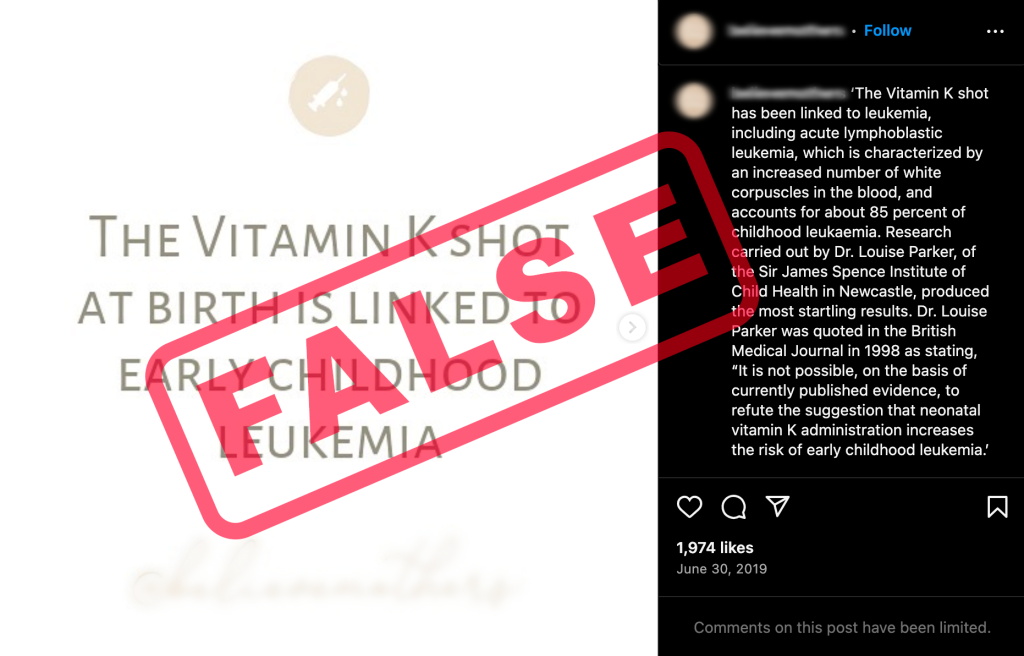

Vitamin K Hesitancy and/or Refusal
In the past decade, parent refusals of Vitamin K and the events that unfolded afterwards have made it to the news.
Six Cases of VKDB in Tennessee (2013)
In 2013, six infants were admitted to Vanderbilt Children’s Hospital in Nashville, Tennessee, with life-threatening bleeding. The infants were diagnosed with late VKDB— four of the infants had bleeding in the brain, and two had bleeding in the intestines. Although the six infants survived, two required emergency brain surgery to save their lives, one has severe brain damage (a stroke with right-sided paralysis and severe cognitive delays), and two have mild to moderate brain injuries (Schulte et al. 2014).
What did these six infants have in common? The infants ranged in age from seven weeks to five months old; three were male and three were female. Three of the infants were born in hospitals, two were born at home, and one was born in a birth center. They all had normal, vaginal births (no Cesareans, no forceps, no vacuum deliveries). Both the babies and their mothers had not been taking any antibiotics, they had not been sick, the mothers were not on restrictive diets, and the babies had no head trauma. All of the infants were exclusively breastfed, and they all had critically low levels of Vitamin K in their blood. Most importantly, what these infants had in common was that all of their parents had declined Vitamin K shots at birth.
Concerned by this outbreak, the hospital asked the Centers for Disease Control (CDC) to look into the situation. Researchers from the CDC examined Tennessee hospital records and found that between the years 2007 and 2012, there had been zero cases of Vitamin K deficiency bleeding out of more than 490,000 births. They randomly sampled records from babies born at three Nashville hospitals and found that 96.6% of infants received Vitamin K injections. In contrast, only 72% of infants born in local freestanding birth centers received Vitamin K (Warren, Miller et al. 2013).
When the parents of the five infants were asked why they had declined Vitamin K, their reasons for declining included: concern about an increased risk for leukemia, a belief that the injection was unnecessary and “unnatural,” and a fear that their infant would be exposed to toxins in the shot. Only one of the families was aware that life-threatening bleeding was a possibility if they declined the injection (Warren, Miller et al. 2013; Schulte et al. 2014; Personal communication, Dr. Robert Sidonio, 2014).
Investigation into Parents who Refused Vitamin K in Illinois (2019)
Between 2015 to 2018, the Department of Child and Family Services in Illinois adopted an internal policy that because Vitamin K was “medically necessary” procedure for newborns, that any reports of Vitamin K refusal would be taken as reports of “medical neglect” (Scott v. University of Chicago Medical Center). Over this time period, a reported 138 families were investigated for refusing Vitamin K, with seven cases leading to a finding of medical neglect (Cherney & Coen 2019). In an interview, one of the families who were investigated shared that they had declined the Vitamin K shot for religious reasons, based on their beliefs that God’s creation is not flawed and so Vitamin K is not required. They believed this policy violated their religious principles and took away their first hours with their newborn.
The policy was rescinded by the state in 2018. Several families who were impacted by these investigations filed lawsuits against the individuals and institutions they felt were responsible for what they believed to be an inappropriate and potentially unlawful investigation (Cherney & Coen 2019). While these cases were ultimately dismissed with the court finding that neither the DCFS employees, medical staff, or hospitals had done any thing wrong, they represent a tension between parental rights to decide what treatments (if any) their children receive and policies meant to protect children from preventable harm.
The evidence on the benefits of Vitamin K and its effectiveness at preventing VKDB has remained consistent for over a half century. Yet in recent years, researchers and providers have reported that parental refusal of Vitamin K is on the rise (Cheng et al. 2020; Hand & Abrams 2022; Khan et al. 2022; Loyal et al. 2017, Loyal & Shapiro 2020; Zarynski et al. 2020).
The first large-scale survey about parents refusing the Vitamin K shot was published in the U.S. (Loyal et al. 2017). This study was conducted through the Better Outcomes through Research for Newborns (BORN) network, which includes newborn care providers from 92 newborn nurseries in 34 states. About 330,000 newborns are cared for in these nurseries each year (8.25% of 4 million live births in the U.S.). The authors found that Vitamin K refusal was a widespread problem: 52% of respondents reported an increase in parent refusals of IM Vitamin K during the 5 years before the study. Refusals were highest in the Western U.S. – 76% of respondents located there reported “frequent” refusal.
In 2022, researchers published a systematic review and meta-analysis of six studies with at a total of 273,714 parents, to better understand why they might refuse Vitamin K for their newborn (Khan et al. 2022). Around 1.14% of families in the study refused Vitamin K. Researchers found that among parents who declined Vitamin K, there was a 6.5 times greater likelihood that they would go on to decline vaccinations for their children.
Learning more about why parents decline Vitamin K can help us better understand why parents may decline other common preventative treatments against deadly childhood diseases. In a 2020 review of the literature on Vitamin K refusal from 1950 to 2019, researchers found a similar connection between parental refusal of Vitamin K and other newborn procedures, including the Hepatitis B injection, erythromycin eye ointment, and routine childhood vaccinations (Loyal & Shapiro 2020).
Most Common Reasons for Vitamin K Refusal
The most common clinician-reported reasons for refusals include (Loyal et al. 2019; Loyal & Shapiro 2020; Majid et al. 2019; Ozturk et al. 2023; Rogers et al. 2023; Shaw 2023):
- Belief that risks of the Vitamin K shot are greater for their child than the risk of not accepting the Vitamin K shot.
- Belief that oral Vitamin K or prenatal Vitamin K is more natural and or less painful.
- Mistrust of the medical and pharmaceutical industry.
- Trusting friends or social media for infant health advice over medical sources of information.
- Concerns about vaccines in general, leading to concerns about any injection.
- Lack of knowledge about the role of Vitamin K in preventing VKDB.
- Concern about the ingredients in the Vitamin K shot.
In a 2019 study, researchers interviewed 19 parents who gave birth in hospitals in California and Connecticut. All of these parents had initially declined the Vitamin K shot. The researchers found that perception of risk, preference for alternatives, and level of trust and communication with providers were key factors that shaped their decision making on Vitamin K (Loyal et al. 2019). The parents incorrectly believed that an uncomplicated vaginal birth or the decision to not circumcise their infant meant their child would not experience VKDB. The influence of social media and a belief in “doing your own research” also played an important role in these parents’ decisions to decline Vitamin K. Ultimately, three of the 19 parents changed their minds and agreed to the Vitamin K shot: two did so after speaking to their pediatrician and learning more about Vitamin K and VKDB, while one did so in order to have their child circumcised.
What are some frequent concerns expressed by parents who are hesitant about Vitamin K?
Why does Vitamin K have a “black box” warning? Does that mean it’s dangerous?
Vitamin K is one of many treatments that have something called a “boxed warning,” commonly called a “black box warning” by social media influencers. But what does that really mean?
A boxed warning is the highest safety-related warning the FDA can issue. Boxed warnings were first implemented in the 1970s and have since been applied to more than 400 commonly used medications. The purpose of the boxed warning is to raise awareness of risks of a medicine, so that health care providers can be on the lookout for and take action to prevent potential adverse events. With a boxed warning, certain contraindications (reasons not to give the medicine) or serious warnings are required to be outlined by a box on the label of a medication. This helps remind providers administering the medication of the potential for complications and ways to avoid adverse effects (21CFR201.57; Delong & Preuss 2023; Rajendran et al. 2024).
Below is an image of the boxed warning for Vitamin K injections:

The boxed warning for Vitamin K tells us that rare but serious side effects (including death) have occurred (Ingold & Sergent 2023). What this boxed warning does not disclose is that nearly all these serious adverse events happened in adults receiving infusions of intravenous Vitamin K (Afanasjeva 2017; Ageno et al. 2012; Britt & Brown 2018; Shields et al. 2001).
However, adverse events, while extremely rare, have occurred across all methods of administration of Vitamin K. The boxed warning on Vitamin K helps providers weigh the risks and benefits when it comes to how and when to administer Vitamin K. Evidence has consistently shown that the benefits of Vitamin K for newborns far outweigh the potential risks of an adverse event (Hand et al 2022), and professional health guidelines around the globe continue to recommend the use of Vitamin K in newborns (see Table 3 below).
One problem we’ve heard of with the boxed warning is that some parents may refuse an intramuscular injection of Vitamin K due to the text recommending subcutaneous (under the skin) administration. Parents might be unfamiliar with the purpose of boxed warnings and ask why their provider is “disobeying” the box. An intramuscular injection into the large muscle in the thigh ensures Vitamin K becomes available to the body quickly, while also providing a reserve or “depot” of Vitamin K for months (Beirne et al. 2018; Britt & Brown 2018; Loughnan & McDougall 1996; Rishovd 2014). This is why professional guidelines around the world recommend intramuscular injections.

Unfortunately, inaccurate information about the “black box” warning on Vitamin K continues to circulate on social media. The authors of these social media posts do not communicate the meaning and definition of a boxed warning. They do not explain the context of this specific warning, and they often emphasize the term “black box” (instead of calling it by the correct term, “boxed warning”). This may intentionally or unintentionally invoke the historically racist connotation of the word “black” with “bad” or “dangerous” or “scary” (Houghton & Houghton, 2018).
What are the ingredients in the shot?
Some parents refuse the injection because they are concerned about ingredients in the shot, which they may refer to as “toxins.” One way to alleviate this concern is for parents to request the preservative-free version of Vitamin K.
The ingredients in a shot with NO preservatives include:
- 1 mg of Vitamin K1, a fat-soluble vitamin derived from plants
- 10 mg of Polysorbate 80, which helps Vitamin K1 (a fat-soluble Vitamin) dissolve in liquid for the injection. Polysorbate 80 is made from natural sorbitol and plant-based oleic acid, is used in a wide variety of foods, medicines, and vitamin supplements, and is included in the Handbook of Green Chemicals.
- 10.4 mg of Propylene glycol, which helps absorb extra water and maintain moisture in certain medicines. Propylene glycol has been recognized as safe by the FDA for use in food products.
- 0.17 mg of Sodium acetate anhydrous, a mixture of salt and bicarbonate, that is used to adjust the pH of the injection
- 0.00002 mL of Glacial acetic acid, also known as vinegar, that is used to adjust the pH of the injection
Are there any side effects from the shot ingredients?
Some parents have concerns about use of the propylene glycol. Propylene glycol is used in many medications (oral, topical, and injections) because it is a very good at helping medications absorb into liquid. Any cases about severe side effects from propylene glycol are from decades ago and were related to very high doses.
For example, in one case, infants were given a multivitamin that had 300 mg of propylene glycol daily (Macdonald et al. 1987). This daily dose, which each day delivered a 30 times higher dose than the one used in the one-time Vitamin K shot, led to seizures in the infant.
As far as allergic reactions to the Vitamin K shot, almost all of the cases in history occurred with the intravenous (IV) form, something that is never used in the newborn period unless an infant comes in with Vitamin K deficiency bleeding.
Serious side effects from a Vitamin K injection given at birth are incredibly rare, and if they are seen, they end up being case reports due to their rarity.
We could not find any case reports using the most recent version of Vitamin K used in the U.S., in which the infant became severely ill or died from it. Before the 1960s (mostly in the 1950s) there were some reports of severe jaundice and anemia, as the dose was not determined and the formulation was quite different. During this time, they were using a water-dissolved version of the Vitamin K shot and following these cases, they changed to the fat-dissolved version that is used today.
In 2014, researchers published a case report about an infant in Turkey who had a severe allergic reaction to the shot and went into shock. The infant survived, but researchers were unable to figure out why the newborn had this type of reaction. They noted that this was the first case ever reported in which an infant went into an allergic shock from Vitamin K, when the shot has been given all over the world for many decades (Koklu et al. 2014).
Any injection can lead to site irritation and redness, but this is rare and it almost never leads to any intervention. Injections can also cause pain, which can be minimized by nursing the baby during the shot.
What if you are a Care Provider who Encounters Parents who are Hesitant to Accept Vitamin K?
As a reader you may be a provider or birth professional hoping to learn more about Vitamin K and share the evidence about Vitamin K among your clients. Or you may be a parent (or provider) who is unsure about Vitamin K or who remains unconvinced by the evidence on the safety and effectiveness of Vitamin K for newborns.
Much of the research on refusal seeks to understand why parents refuse Vitamin K, mainly to help providers and educators identify concerns and resolve them. It is important for providers to recognize that while concerns over Vitamin K to infants may be shaped by misinformation or a lack of access to evidence-based resources, these hesitancies are rooted in a place of parental love and concern for their baby.
Providers who endorse Vitamin K as an evidence-based approach to reducing the risk of harm from VKDB are invested in finding ways to help educate skeptical parents about the benefits of this preventative treatment—but may not know how to overcome misinformation or know what to say when parents decline for their infant to have any supplemental Vitamin K.
Researchers have proposed a variety of strategies for providers:
- Take time to educate parents about why Vitamin K is recommended for infants shortly after birth (Burton et al. 2018; Loyal et al. 2019).
- Encourage parents to share their concerns (Holley et al. 2020). Encourage parents to ask questions about the ingredients in the Vitamin K shot and go over their questions and concerns (Holley et al. 2020).
- Advocate for health policy that encourages Vitamin K treatment (Loyal et al. 2017). However, as the Illinois example demonstrated, mandatory Vitamin K policies can be unpopular with parents who are hesitant about Vitamin K.
- Take action to reduce the pain of the Vitamin K1 injection. A 2022 study based in India compared skin-to-skin care vs. swaddling on the pain levels of newborns receiving the Vitamin K shot (Patel et al. 2022). One hundred newborns were enrolled in the study, with 50 randomly assigned to receive skin-to-skin and 50 who were swaddled after the Vitamin K1 shot. Using the Neonatal Infant Pain Scale, the researchers found that babies who had skin-to-skin after the Vitamin K shot had lower pain scale scores immediately after the injection and two minutes later. The researchers concluded babies should stay with their parents when receiving the Vitamin K1 shot, and that skin-to-skin care can provide comfort and pain management.
- Offer education on alternatives. Providers at about one-third of the nursery sites in Loyal et al.’s (2017) study offered oral Vitamin K drops as an alternative to the minority of the parents who refused the shot. Unfortunately, this strategy is more challenging in the U.S., where national guidelines do not endorse oral Vitamin K as a valid alternative to prevent VKDB. The availability of oral Vitamin K, the ability of clinics to store and administer oral Vitamin K drops, the willingness of providers to offer this service, adherence to the dose regimen, and access to follow-up monitoring and care remain largely unstudied in the U.S. (Loyal & Shapiro 2020). It also remains unclear whether or not clinicians in the U.S. have enough knowledge about oral Vitamin K drops to be able to recommend dosing and guide parents in pursuing this route (Cheng et al. 2020).
Interestingly, parents are not the only ones who may have skepticism about Vitamin K shots:
- Midwives tend to be more divided about the effectiveness of the Vitamin K injection than other professional groups (Gosai et al. 2014; Loyal et al. 2022; Majid et al. 2019). A 2014 New Zealand study found that compared to doctors, midwives were more likely to express hesitancy around Vitamin K or were less certain about its necessity for all newborns (Gosai et al. 2014).
- In the U.S., a 2022 study of Certified Nurse Midwives (CNMs) and Certified Professional Midwives (CPMs), found that CNMs routinely recommended the Vitamin K shot to clients, while CPMs reported taking a more neutral approach. Midwives in the study also perceived that the midwifery model of care might attract parents who are more likely to question interventions like Vitamin K because of the focus on physiologic birth and prioritizing birthing parents’ decision-making and autonomy (Loyal et al. 2022).
What are current professional guidelines for giving Vitamin K?
Table 3: Country Recommendations for Vitamin K, at a glance
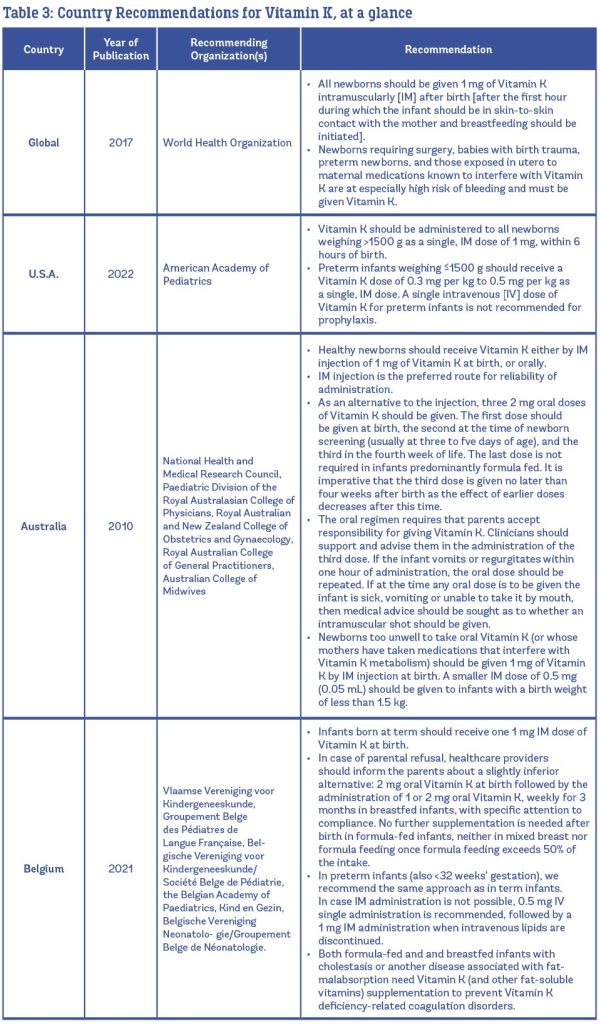
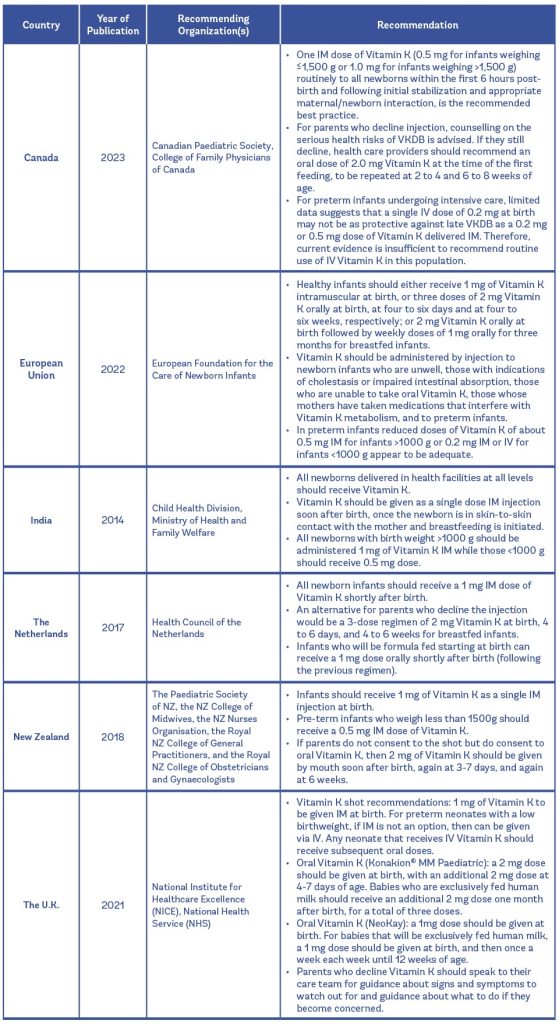
The Bottom Line
Vitamin K deficiency bleeding (VKDB) is a rare but potentially deadly complication that can occur in newborns and young infants who are exclusively fed human milk. Late VKDB (which can occur between 7 days of life and 6 months) can almost always be prevented by giving supplemental Vitamin K after birth, either in the form of a Vitamin K shot or through regular administration of oral Vitamin K drops.
Formula-fed babies are protected from late VKDB because formula is highly fortified with Vitamin K. Human milk contains very limited amounts of Vitamin K, so human milk-fed babies are at an increased risk for late VKDB if they do not receive supplemental Vitamin K after birth.
The Vitamin K shot is the most effective form of Vitamin K treatment available. The only known adverse effects of the Vitamin K shot are pain, bleeding, redness, and bruising at the site of the injection. Out of many millions of injections, there has only been one published report of a serious allergic reaction in recent history (Koklu et al. 2014). Holding your baby skin-to-skin and/or nursing them while they receive the shot can help reduce pain during the injection. Witnessing that your baby actually receives the injection is also important, as there have been rare cases of the shot being documented but not actually provided (Zurynski et al. 2020).
Some parents who are hesitant to accept the Vitamin K shot may prefer an oral drop regimen. There is no FDA-approved version of oral Vitamin K droplets for babies in the U.S. In countries where oral Vitamin K is regulated and available, researchers have found that oral Vitamin K regimens can be highly effective at preventing VKDB. Careful attention must be paid to ensure babies receive the dose close to a meal (to help with absorption), that they receive the entire dose (in other words, they do not spit it up), and that they receive all regularly prescribed oral doses. Receiving just a single oral dose or a 3-dose regimen of 1 mg oral Vitamin K1 is less effective than the Vitamin K shot at preventing late VKDB.
Research has been published on the effects of more regular (weekly or daily) regimens of oral Vitamin K drops. A weekly or daily oral regimen has been shown to offer similar protection as the shot against late VKDB for infants at higher risk—those who are exclusively fed human milk and/or have undiagnosed gallbladder disease.
Unfortunately, myths and misinformation about Vitamin K continue to circulate on the internet and on social media. Here at Evidence Based Birth®, we believe that all parents should have evidence-based information about Vitamin K options, so that their decision about supplemental Vitamin K is fully informed. All parents should also know the warning signs for VKDB and should feel empowered to contact their care provider if something does not seem right with their infant.

References:
-
- Afanasjeva, J. (2017). “Administration of Injectable Vitamin K Orally.” Hosp Pharm 52(9): 645-649.
- Ageno, W., Gallus, A. S., Wittkowsky, A., et al. (2012). “Oral anticoagulant therapy: Antithrombotic Therapy and Prevention of Thrombosis, 9th ed: American College of Chest Physicians Evidence-Based Clinical Practice Guidelines.” Chest 141(2 Suppl): e44S-e88S.
- American Academy of Pediatrics (AAP). (1961). “Report on Committee on Nutrition: Vitamin K Compounds and the Water-Soluble Analogues.” Pediatrics28: 501-507. Free full text.
- AAP (2003). “Controversies concerning vitamin K and the newborn. American Academy of Pediatrics Committee on Fetus and Newborn.” Pediatrics112(1 Pt 1): 191-192.
- Andrew, M. (1997). “The Relevance of Developmental Hemostasis to Hemorrhagic Disorders of Newborns.” Semin perinatal 21(1): 70–85. https://pubmed.ncbi.nlm.nih.gov/9190036/
- Araki, S. & Shirahata, A. (2020). “Vitamin K Deficiency Bleeding in Infancy.” Nutrients 12(3): 780. https://pubmed.ncbi.nlm.nih.gov/32187975/
- Beirne, P. V., Hennessy, S., Cadogan, S. L., et al. (2018). “Needle size for vaccination procedures in children and adolescents.” Cochrane Database Syst Rev. 8(8):CD010720.
- Berber, U., Özdemir, M. A., Unal, E., et al. (2018). “Genetic Polymorphism of VKORC1-1639in Children With Intracranial Hemorrhage Due to Vitamin K Deficiency.” Clin Appl Thromb Hemost 24(9 suppl): 89S–93S. https://pubmed.ncbi.nlm.nih.gov/30099920/
- Bolisetty, S., Gupta, J. M., Graham, G. G., et al. (1998). “Vitamin K in preterm breastmilk with maternal supplementation.” Acta Paediatr87(9): 960-962. Click here.
- British National Formulary for Children (BNFC), NICE. (nd.) “Phytomenadione.” Nice.org/uk. Accessed January 21, 2025. https://bnfc.nice.org.uk/treatment-summaries/vitamins/
- Britt, R. B. & Brown, J. N. (2018). “Characterizing the Severe Reactions of Parenteral Vitamin K1.” Clin Appl Thromb Hemost 24(1): 5-12.
- Burton, G. J. & Fowden, A. L. (2015). “The placenta: a multifaceted, transient organ.” Philos Trans R Soc Lond B Biol Sci 370(1663): 20140066. https://pubmed.ncbi.nlm.nih.gov/25602070/
- Burton, G. J. & Jauniaux, E. (2015). “What is the placenta?” Am J Obstet Gynecol 213(4 Suppl): S6.e1–S6-8. https://pubmed.ncbi.nlm.nih.gov/26428504/
- Burton, T., Saini, S., Maldonado, L., et al. (2018). “Parental Refusal for Treatments, Procedures, and Vaccines in the Newborn Nursery.” Adv Pediatr 65(1): 89–104. https://pubmed.ncbi.nlm.nih.gov/30053932/
- Busfield, A., Samuel, R., McNinch, A., et al. (2013). “Vitamin K deficiency bleeding after NICE guidance and withdrawal of Konakion Neonatal: British Paediatric Surveillance Unit study, 2006-2008.” Arch Dis Child98(1): 41-47.
- Centers for Disease Control and Prevention (CDC). (2024). “About Vitamin K Deficiency Bleeding.” Accessed December 15, 2024. https://www.cdc.gov/vitamin-k-deficiency/about/
- (2024). “How to Protect Babies from Life-threatening Bleeding.” Accessed December 15, 2024. https://www.cdc.gov/vitamin-k-deficiency/hcp/fact-sheet/index.html
- (n.d.). “Protect Your Baby from Bleeds – Talk to Your Healthcare Provider about Vitamin K.” https://www.cdc.gov/vitamin-k-deficiency/media/images/vitamin-k-p.pdf
- Cheng, J. H., Loyal, J., Wood, K. E., et al. (2020). “Oral Vitamin K Prophylaxis in Newborns: A Survey of Clinician Opinions and Practices.” Hosp Pediatr 10(2): 153–158. https://pubmed.ncbi.nlm.nih.gov/31907174/
- Cherney, E. & Coen, J. (2019). “Doctors took a newborn baby from her parents after they refused a vitamin K shot for her. Now the couple is suing the hospital and DCFS.” Chicago Tribune. September 24. Accessed December 16, 2024. https://www.chicagotribune.com/2019/09/24/doctors-took-a-newborn-baby-from-her-parents-after-they-refused-a-vitamin-k-shot-for-her-now-the-couple-is-suing-the-hospital-and-dcfs/
- Child Health Division, Ministry of Health and Family Welfare, Government of India. (2014). “Operational Guidelines: Injection Vitamin K Prophylaxis at Birth (in facilities).” https://nhm.gov.in/images/pdf/programmes/child-health/guidelines/Vitamin_K_Operational_Guidelines.pdf
- Chuansumrit, A., Plueksacheeva, T., Hanpinitsak, S., et al. (2010). “Prevalence of subclinical vitamin K deficiency in Thai newborns: relationship to maternal phylloquinone intakes and delivery risk.” Arch Dis Child Fetal Neonatal Ed95(2): F104-108.
- Clarke, P., Shearer, M. J., Card. D. J., et al. (2022). “Exclusively breastmilk-fed preterm infants are at high risk of developing subclinical vitamin K deficiency despite intramuscular prophylaxis at birth.” J Thromb Haemost 20(12): 2773–2785. https://pubmed.ncbi.nlm.nih.gov/36087073/
- Coffey, P. S. & Gerth-Guyette, E. (2018). “Current perspectives and practices of newborn vitamin K administration in low and middle income countries.” Res Rep Neonatol 8: 45–51. https://pmc.ncbi.nlm.nih.gov/articles/PMC7745116/
- Cornelissen, E. A., Kollee, L. A., De Abreu, R. A., et al. (1993). “Prevention of vitamin K deficiency in infancy by weekly administration of vitamin K.” Acta Paediatr82(8): 656-659.
- Cornelissen, M., von Kries, R., Loughnan, P., et al. (1997). “Prevention of vitamin K deficiency bleeding: efficacy of different multiple oral dose schedules of vitamin K.” Eur J Pediatr156(2): 126-130.
- Danielsson, N., Hoa, D., Thang, N., et al. (2004). “Intracranial haemorrhage due to late onset vitamin K deficiency bleeding in Hanoi province, Vietnam.” Arch Dis Child Fetal Neonatal Ed89(6): F546-550. Free full text.
- Delong, C. & Preuss, C. V. (2023). “Box Warning.” In: StatPearls. Treasure Island (FL): StatPearls Publishing. Available from: https://www.ncbi.nlm.nih.gov/books/NBK538521/
- De Winter, J. P., Joosten, K. F. M., Ijland, M. M., et al. (2011). “Nieuwe Nederlandse richtlijn voor vitamine K-toediening aan voldragen pasgeborenen [New Dutch practice guideline for administration of vitamin K to full-term newborns].” Ned Tijdschr Geneeskd 155(18): A936.
- Drugs and Lactation Database (LactMed) (2024). “Vitamin K.” Bethesda (MD): National Library of Medicine (US). https://www.ncbi.nlm.nih.gov/books/NBK500922/
- Fear, N. T., Roman, E., Ansell, P., et al. (2003). “Vitamin K and childhood cancer: a report from the United Kingdom Childhood Cancer Study.” Br J Cancer89(7): 1228-1231.
- Ferland, G. (2020). “Vitamin K.” In Present Knowledge in Nutrition: Basic Nutrition and Metabolism, 11th Marriot, B. P., Birt. D. F, Stalling, V. A., et al., eds. Elsevier: London.
- Fiesack, S., Smits, A., Rayyan, M., et al. (2021). “Belgian Consensus Recommendations to Prevent Vitamin K Deficiency Bleeding in the Term and Preterm Infant.” Nutrients 13(11): 4109. https://pubmed.ncbi.nlm.nih.gov/34836364/
- Golding, J., Greenwood, R., Birmingham, K., et al. (1992). “Childhood cancer, intramuscular vitamin K, and pethidine given during labour.” BMJ305(6849): 341-346. https://www.ncbi.nlm.nih.gov/pmc/articles/PMC1883000/
- Greer, F. R., Marshall, S., Cherry, J., et al. (1991). “Vitamin K status of lactating mothers, human milk, and breast-feeding infants.” Pediatrics88(4): 751-756.
- Greer, F. R., Marshall, S. P., Foley, A. L., et al. (1997). Improving the vitamin K status of breastfeeding infants with maternal vitamin K supplements. Pediatrics99(1): 88-92.
- Greer, F. R., Marshall, S. P., Severson, R. R., et al. (1998). A new mixed micellar preparation for oral vitamin K prophylaxis: randomized controlled comparison with an intramuscular formulation in breastfed infants. Arch Dis Child;79(4):300-5.
- Gosai, S., Broadbent, R. S., Barker, D. P., et al. (2014). “Medical and midwifery attitudes towards vitamin K prophylaxis in New Zealand neonates.” J Paediatr Child Health 50(7): 536–539. https://pubmed.ncbi.nlm.nih.gov/24528494/
- Hand, I., Noble, L., & Abrams, S. A., AAP Committee on Fetus and Newborn, Section on Breastfeeding, Committee on Nutrition. (2022). “Policy Statement: Vitamin K and the Newborn Infant.” Pediatrics 149(3): e2021056036. https://pubmed.ncbi.nlm.nih.gov/35190810/
- Hanawa, Y., Maki, M., Matsuyama, E., et al. (1988). “The second nation-wide survey in Japan of vitamin K deficiency in infancy.” Eur J Pediatr147(5): 472-477.
- Health Council of the Netherlands. (2017). Vitamin K for infants. The Hague: Health Council of the Netherlands; publication no. 2017/04e.
- Health New Zealand/Te Whatu Ora. 2023. Vitamin K for Newborn Babies. Accessed January 2, 2025. https://nationalwomenshealth.adhb.govt.nz/assets/Womens-health/Documents/Mat-patient-information/Vitamin-K-for-newborn-babies.pdf
- Holley, S. L., Green, K., Mills, M., et al. (2020). “Educating Parents on Vitamin K Prophylaxis for Newborns.” Nurs Womens Health 24(4): 283–293. https://pubmed.ncbi.nlm.nih.gov/32778394/
- Houghton, F., & Houghton, S. (2018). “‘Blacklists’ and ‘whitelists’: A salutary warning concerning the prevalence of racist language in discussions of predatory publishing.” J Am Med Library Assoc 106(4): 527-530. https://jmla.pitt.edu/ojs/jmla/article/view/490
- Hunnali, C. R., Devi, U., Kitchanan, S., et al. (2023). “Three Different Regimens for Vitamin K Birth Prophylaxis in Infants Born Preterm: A Randomized Clinical Trial.” J Pediatr 255: 98-104.
- Ijland, M. M., Pereira, R. R., & Cornelissen, E. A. M. (2008). “Incidence of late vitamin K deficiency bleeding in newborns in the Netherlands in 2005: evaluation of the current guideline.” Eur J Pediatr167(2): 165-169. Free full text.
- Ingold, C. J., Sergent, S.R. (2023). “Phytonadione (Vitamin K1).” In: StatPearls [Internet]. Treasure Island (FL): StatPearls Publishing; 2024 Jan-. Available from: https://www.ncbi.nlm.nih.gov/books/NBK557622/
- Ilyés, T., Pop, M., Surcel, M., et al. (2023). “First Comparative Evaluation of Short-Chain Fatty Acids and Vitamin-K-Dependent Proteins Levels in Mother–Newborn Pairs at Birth.” Life 13(3): 847. https://pubmed.ncbi.nlm.nih.gov/36984001/
- Julien, S. (2021). “Vitamin K prophylaxis in newborns.” BMC Pediatr 21(Suppl 1): 350. https://bmcpediatr.biomedcentral.com/articles/10.1186/s12887-021-02701-4
- Khan, T. M., et al. (2022). Parents’ refusal to vitamin-K supplementation among neonates and its association with vaccine refusal: A systematic review and meta-analysis. J Pak Med Assoc. 72(11): 2251-2258. https://pubmed.ncbi.nlm.nih.gov/37013297/
- Koklu, E., Taskale, T., Koklus, S., et al. (2014). “Anaphylactic shock due to vitamin K in a newborn and review of literature.” J Matern Fetal Neonatal Med27(11): 1180-1181.
- Koletzko, B., Buonocore, G., Zimmermann, L. J. I., et al. (2022). “European Standards of Care for Newborn Health: Prevention of vitamin K deficiency bleeding (VKDB) at birth.” European Foundation for the Care of Newborn Infants. https://newborn-health-standards.org/standards/standards-english/medical-care-clinical-practice/prevention-of-vitamin-k-deficiency-bleeding-vkdb-at-birth/
- Lehmann, J. (1944). “Vitamin K as a prophylactic in 13,000 infants.” Lancet243(6294): 493-494.
- Lippi, G. & M. Franchini. (2011). “Vitamin K in neonates: facts and myths.” Blood Transfus9(1): 4-9. Free full text.
- Loughnan, P. M. & McDougall, P. N. (1996). “Does intramuscular vitamin K1 act as an unintended depot preparation?” J Paediatr Child Health32(3): 251-254.
- Loyal, J., Taylor, J. A., Phillipi, C. A., et al. (2017). Refusal of Vitamin K by Parents of Newborns: A Survey of the Better Outcomes Through Research for Newborns Network. Acad Pediatr; 17(4): 368–373.
- Loyal, J., Weiss, T. R., Cheng, J. H., et al. (2019). Refusal of Vitamin K by Parents of Newborns: A Qualitative Study. Acad Pediatr 19(7): 793–800. https://www.ncbi.nlm.nih.gov/pmc/articles/PMC7028442/
- Loyal, J., Danziger, P., & Wood, K. E. (2022). Midwives’ perspectives about Vitamin K prophylaxis against Vitamin K deficiency bleeding of the newborn. Matern Child Health 26(8): 1641-1648. https://pubmed.ncbi.nlm.nih.gov/35551587/
- MacDonald, M. G., Getson, P. R., Glasgow, A. M., et al. (1987). “Propylene glycol: increased incidence of seizures in low birth weight infants.” Pediatrics79(4): 622-625.
- McNinch, A. W. & Tripp, J. H. (1991). “Haemorrhagic disease of the newborn in the British Isles: two year prospective study.” BMJ 303(6810): 1105–1109. https://pmc.ncbi.nlm.nih.gov/articles/PMC1671305/
- Majid, A., Blackwell, M., Broadbent, R. S., et al. (2019). “Newborn Vitamin K Prophylaxis: A Historical Perspective to Understand Modern Barriers to Uptake.” Hosp Pediatr 9(1):55-60.
- Marchili, M. R., Santoro, E., Marchesi, A., et al. (2018). Vitamin K deficiency: a case report and review of current guidelines. Ital J Pediatr 44(1):36.
- Mihatsch, W. A., Braegger, C., Bronsky, J., et al. (2016). “Prevention of Vitamin K Deficiency Bleeding in Newborn Infants: A Position Paper by the ESPGHAN Committee on Nutrition. J Pediatr Gastroenterol Nutr 63(1): 123-129.
- National Health and Medical Research Council, Government of Australia. (2010). “Joint statement and recommendations on vitamin k administration to newborn infants to prevent vitamin K deficiency bleeding in infancy.” https://www.nhmrc.gov.au/about-us/publications/vitamin-k-administration-newborns-joint-statement#block-views-block-file-attachments-content-block-1
- National Institutes of Health (NIH). (2021). “Vitamin K Fact Sheet for Health Providers.” Accessed December 15, 2024. https://ods.od.nih.gov/factsheets/VitaminK-HealthProfessional/
- National Health Service (NHS). (2022). “What happens straight after the birth?” National Health Service, UK. Accessed January 26, 2025. https://www.nhs.uk/pregnancy/labour-and-birth/after-the-birth/what-happens-straight-after/
- New Zealand College of Midwives/ Te Kāreti O Nga Kaiwhakawhanau Ki Aotearoa. (2000). Consensus Statement: Vitamin K Prophylaxis for the Newborn. Accessed January 2, 2025. https://www.midwife.org.nz/wp-content/uploads/2019/05/Vitamin-K-Prophylaxis-for-the-Newborn.pdf
- Nijsten, K., van der Minnen, L., Wiegers, H. M. G., et al. (2022). “Hyperemesis gravidarum and vitamin K deficiency: a systematic review.” Br J Nutr 128(1): 30–42. https://pubmed.ncbi.nlm.nih.gov/34325760/
- Ng, E. & Loewy, A. D, Canadian Paediatric Society, College of Family Physicians of Canada. (2018, reaffirmed 2024). “Guidelines for vitamin K prophylaxis in newborns.” Paediatr Child Health 23(6): 394–402. https://cps.ca/en/documents/position/vitamin-k-prophylaxis-in-newborns
- Olson, R. (2000). Vitamin K. Modern nutrition in health and disease. M. Shils, J. Olson and M. Shike. Philadelphia, Lippincott: 363.
- Ozturk, B., Yaradilmiş, R. M., Azapağasi, E., et al. (2023). Attention to diseases that re-emerge due to refusal of Vitamin K: An infant case. Blood Coagul Fibrinolysis 34(2): 118-121. https://pubmed.ncbi.nlm.nih.gov/36719808/
- Patel, D. V., Soni, S. N., Shukla, V. V., et al. (2022). “Efficacy of Skin-to-Skin Care versus Swaddling for Pain Control Associated with Vitamin K Administration in Full-Term Neonates: A Randomized Controlled Trial.” J Trop Pediatr 68(4): 1–8. https://pubmed.ncbi.nlm.nih.gov/35737952/
- Plank, R. M., Steinmetz, T., Sokal, D. C., et al. (2013). “Vitamin K deficiency bleeding and early infant male circumcision in Africa.” Obstet Gynecol122(2 Pt 2): 503-505.
- Perrone, S., De Bernardo, G., Lembo, C., et al. (2024). “Vitamin K insufficiency and the prophylaxis strategy in term healthy infants: A multicentre study.” Eur J Clin Invest 54(4): e14141. https://pubmed.ncbi.nlm.nih.gov/38071415/
- Puckett, R. M. & Offringa, M. (2000). “Prophylactic vitamin K for vitamin K deficiency bleeding in neonates.” Cochrane Database Syst Rev 4: CD002776.
- Rajendran, Y., Kondampati, N., Eerike, M., et al. (2024). “A Longitudinal Analysis of Black Box Warnings: Trends and Implications for Drug Safety.” Cureus 16(4): e57597.
- Rishovd, A. (2014). “Pediatric intramuscular injections: guidelines for best practice.” MCN Am J Matern Child Nurs 39(2), 107-112.
- Rogers, T. P., et al. (2023). Neonatologists and Vitamin K hesitancy. J Perinatol 43(8): 1067-1071. https://pubmed.ncbi.nlm.nih.gov/36707666/
- Roman, E., Fear, N. T., Ansell. P., et al. (2002). “Vitamin K and childhood cancer: analysis of individual patient data from six case-control studies.” Br J Cancer86(1): 63-69. Free full text.
- Schulte, R., Jordan, L. C., Morad, A., et al. (2014). “Rise in late onset vitamin K deficiency bleeding in young infants because of omission or refusal of prophylaxis at birth.” Pediatr Neurol 50(6): 564-568.
- Shahrook, S., Ota, E., Hanada, N., et al. (2018). “Vitamin K supplementation during pregnancy for improving outcomes: a systematic review and meta- analysis.” Sci Rep 8(1): 11459.
- Shaw, M. A. (2023). Take the shot: A review of Vitamin K deficiency. Pediatr Ann 52(2): e42-e45. https://pubmed.ncbi.nlm.nih.gov/36779880/
- Shearer, M. J. (2009). “Vitamin K deficiency bleeding (VKDB) in early infancy.” Blood Rev23(2): 49-59.
- Shearer, M. J., Rahim, S., Barkhan, P., et al. (1982). “Plasma vitamin K1 in mothers and their newborn babies.” Lancet2(8296): 460-463.
- Shields, R. C., McBane, R. D., Kuiper, J. D., et al. (2001). “Efficacy and safety of intravenous phytonadione (vitamin K1) in patients on long-term oral anticoagulant therapy.” Mayo Clin Proc 76(3):260-6.
- Takahashi, D., Egami, N., Ochiai, M., et al. (2024). “Vitamin K prophylaxis in neonates: comparing two different oral regimens.” J Perinatol 44(10): 1491–1495. https://pubmed.ncbi.nlm.nih.gov/38678081/
- Thijssen, H. H., Drittij, M. J., Vermeer, C., et al. (2002). Menaquinone-4 in breast milk is derived from dietary phylloquinone. Br J Nutr;87(3):219-26.
- University College London Hospital, NHS Foundation Trust. (2024). “Vitamin K for Babies at Birth.” University College London Hospital. Accessed January 26, 2025. https://www.uclh.nhs.uk/patients-and-visitors/patient-information-pages/vitamin-k-babies-birth
- van Hasselt, P. M., de Koning, T. J., Kvist, N., et al. (2008). “Prevention of vitamin K deficiency bleeding in breastfed infants: lessons from the Dutch and Danish biliary atresia registries.” Pediatrics121(4): e857-863.
- Vietti, T. J., Stephens, J.C., & Bennett K. R. (1961). “Vitamin K-1 prophylaxis in the newborn.” JAMA176: 791-793.
- von Kries, R., Hachmeister, A., & Göbel, U. (1995). “Repeated oral vitamin K prophylaxis in West Germany: acceptance and efficacy.” BMJ310(6987): 1097-1098.
- von Kries, R., Shearer, M., McCarthy, P. T., et al. (1987). “Vitamin K1 content of maternal milk: influence of the stage of lactation, lipid composition, and vitamin K1 supplements given to the mother.” Pediatr Res22(5): 513-517.
- Wallin, R. & Hutson, S. M. (2011). “Vitamin K Metabolism in the Fetus and Neonate.” In Fetal and Neonatal Physiology, 4th Polin, R. A., Fox, W. W., & Abman, S. H., eds. Elsevier: Philadelphia. Pp. 435–441.
- Warren, M., Miller, A., Traylor, J., et al. (2013). “Notes from the field: Late vitamin K deficiency bleeding in infants whose parents declined vitamin k prophylaxis– Tennessee, 2013.” Morbidity and Mortality Weekly Report62(45): 901-902.
- World Health Organization (WHO). (2017). “WHO recommendations on Newborn Health.” Geneva: World Health Organization. https://iris.who.int/bitstream/handle/10665/259269/WHO-MCA-17.07-eng.pdf?sequence=1
- Zurynski, Y., Grover, C. J., Jalaludin, B., et al. (2020). “Vitamin K deficiency bleeding in Australian infants 1993–2017: an Australian Paediatric Surveillance Unit study.” Arch Dis Child 105(5): 433–438. https://pubmed.ncbi.nlm.nih.gov/31519552/
Resources:
- CDC Real stories: People with Vitamin K. Deficiency Bleeding, click here.
- CDC VKDB information, click here.
- Watch this YouTube video from Dr. Matt and Dr. Mike about Hemostasis and the Clotting Cascade (and why Vitamin K and Calcium are important).
- International Federation of Library Associations and Institutions: How to Spot Fake News, click here.
- University of Chicago: Evaluating Resources and Misinformation, click here.
- Web Literacy for Student Fact Checkers (and other people who care about facts), click here.
Acknowledgments:
We would like to acknowledge Mandi Hardy Hillman, PhD, LPC, CD(DONA), ICCE, for her assistance with the literature search for the original 2014 article, and Anna Bertone, MPH, for her assistance with the 2019 update of this article. We would like to acknowledge the expert reviewers for the original article on Vitamin K: Mark Sloan, MD, Pediatrician and Assistant Clinical Professor at the University of California, San Francisco, and Robert F. Sidonio, Jr., MD, Pediatric Hematologist-Oncologist and Assistant Professor at Vanderbilt University.
Birth Professionals:
Join others who also want to help bring evidence-based care to their local community.
Also, gain complimentary access to a printable library of our Signature Articles, 20+ hours of CE courses, a private community, and more.



Stay empowered, read more :
EBB 413 – Evidence on Migraines and Pregnancy: Frequency, Prevention, and Comfort Measures
Don't miss an episode! Subscribe to our podcast and leave a review! iTunes | Spotify | YouTube Migraines during pregnancy can be debilitating, and figuring out how to prevent or manage them can be especially challenging. In this episode, Dr. Rebecca Dekker...
EBB 412 – Induction Tips for Families with High-Risk Doula Jennifer Anderson, RN
Don't miss an episode! Subscribe to our podcast and leave a review! iTunes | Spotify | YouTube An induction may change your birth plan, but it doesn’t mean giving up your preferences or your role in the decision-making process. In this episode, EBB's Director of...

EBB 411 – Advocating for a Family Centered Cesarean with Holly and Nathan Miller, EBB Childbirth Class Graduates
Don't miss an episode! Subscribe to our podcast and leave a review! iTunes | Spotify | YouTube When Holly and Nathan Miller learned their baby was breech late in pregnancy, the unmedicated vaginal birth they had been preparing for suddenly felt out of reach....